Event submissions
Published
This submission belongs to the session S2. Nanomaterials, Nanotechnology and Quantum Materials of the event The 4th International Online Conference on Materials
Published date
29 Oct, 2025
Academic Editor
'%3e%3cpath%20d='M12.6657%2010.9104C12.4185%2010.325%2012.0599%209.79327%2011.6097%209.34482C11.1609%208.89508%2010.6293%208.5365%2010.0442%208.28888C10.0389%208.28626%2010.0337%208.28495%2010.0285%208.28233C10.8446%207.69279%2011.3752%206.73249%2011.3752%205.64904C11.3752%203.8542%209.92103%202.39999%208.1262%202.39999C6.33136%202.39999%204.87715%203.8542%204.87715%205.64904C4.87715%206.73249%205.40774%207.69279%206.22393%208.28364C6.21869%208.28626%206.21345%208.28757%206.20821%208.29019C5.62129%208.5378%205.09463%208.89284%204.64265%209.34613C4.1929%209.79493%203.83432%2010.3266%203.58671%2010.9117C3.34345%2011.4845%203.21226%2012.0987%203.20023%2012.7209C3.19988%2012.7349%203.20233%2012.7488%203.20744%2012.7619C3.21255%2012.7749%203.22022%2012.7867%203.22998%2012.7968C3.23975%2012.8068%203.25142%2012.8147%203.26431%2012.8202C3.2772%2012.8256%203.29105%2012.8284%203.30504%2012.8284H4.09109C4.14874%2012.8284%204.19459%2012.7825%204.1959%2012.7262C4.2221%2011.7148%204.62823%2010.7676%205.34617%2010.0497C6.08899%209.30683%207.0755%208.89808%208.1262%208.89808C9.17689%208.89808%2010.1634%209.30683%2010.9062%2010.0497C11.6242%2010.7676%2012.0303%2011.7148%2012.0565%2012.7262C12.0578%2012.7838%2012.1037%2012.8284%2012.1613%2012.8284H12.9474C12.9613%2012.8284%2012.9752%2012.8256%2012.9881%2012.8202C13.001%2012.8147%2013.0126%2012.8068%2013.0224%2012.7968C13.0322%2012.7867%2013.0398%2012.7749%2013.0449%2012.7619C13.0501%2012.7488%2013.0525%2012.7349%2013.0522%2012.7209C13.0391%2012.0947%2012.9094%2011.4855%2012.6657%2010.9104ZM8.1262%207.9024C7.52486%207.9024%206.9589%207.6679%206.53312%207.24211C6.10733%206.81633%205.87283%206.25037%205.87283%205.64904C5.87283%205.0477%206.10733%204.48174%206.53312%204.05596C6.9589%203.63018%207.52486%203.39567%208.1262%203.39567C8.72753%203.39567%209.29349%203.63018%209.71927%204.05596C10.1451%204.48174%2010.3796%205.0477%2010.3796%205.64904C10.3796%206.25037%2010.1451%206.81633%209.71927%207.24211C9.29349%207.6679%208.72753%207.9024%208.1262%207.9024Z'%20fill='%235D1EE1'/%3e%3c/g%3e%3c/svg%3e) Pietro Mazzuca
Pietro MazzucaCitation
Md. Nurjaman Ridoy, Sk. Tanjim Jaman Supto, Environmental Impacts and Sustainability of Nanomaterials in Water and Soil Systems, in Proceedings of The 4th International Online Conference on Materials, 3 November–6 November 2025, MDPI: Basel, Switzerland
Share
Email
Facebook
Twitter
LinkedIn
Environmental Impacts and Sustainability of Nanomaterials in Water and Soil Systems

Md. Nurjaman Ridoy 1

Sk. Tanjim Jaman Supto 1
1. Department of Environmental Research, Nano Research Centre, Sylhet, 3114, Bangladesh
Abstract
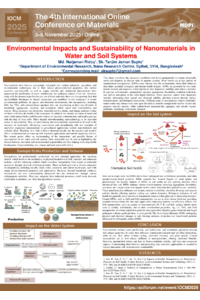
Nanoparticles have become more widely applied in industrial, consumer, and therapeutic products since the past decade, and this trend is presumed to persist due to the rapid population growth, industry, urbanization, and intensive agriculture. The manufacturing of nanomaterials is not necessarily accomplished through eco-friendly processes. Certain nanomaterials involve heavy metals like, but not exclusively, mercury (Hg), platinum (Pt), palladium (Pd), cadmium (Cd), and lead (Pb). The releasing of nanomaterials into the environment could result in soil and aquatic system contamination. These problems have stimulated intensive research aimed at the prediction of environmental concentrations of nanoparticles in water and soil and at the determination of threshold concentrations for their ecotoxicological effect on aquatic and terrestrial ecosystems. Different studies show that metal-based nanoparticles with properties like hydrophilicity and low solubility impact the environment by creating toxics for the aquatic and terrestrial biota. Like ZnO Nanoparticles produce more toxicity due to their rapid dissolving nature. Semiconductor quantum dots based on cadmium selenide release ionic cadmium, resulting in exceeding water quality guidelines. and Ag nanoparticles disrupt membrane transport in algal species and higher organisms, causing adsorption and ingestion as it releases through oxidation. On the other hand, some nanomaterials benefit from geotechnical applications, like carbon nanotubes for soil reinforcement, nano bentonite for improving drilling fluids, and colloidal silica or laponite for mitigating soil liquefaction. Furthermore, this paper deals with current research on these competing roles, examining the causes of nanotoxicity as well as their positive geotechnical and remedial applications in water and soil systems. Furthermore, this study deals with the applications of different nanomaterials in water and soil systems and their subsequent impacts. It provides a general evaluation of the beneficial and harmful roles of these nanomaterials in water and soil systems for understanding the relationship between nanotechnology and the environment.
Keywords
Environment
nanotoxicity
eco-friendly processes
soil and aquatic system
toxicity
soil reinforcement
sustainable
lifecycle-based approach
Heavy metals
Poster
sciforum-148788.pdf
Design and Characterisation of ZnAl LDH–Palmitic Acid Nanocomposites with pH-Responsive Release and Antimicrobial Activity
Synthesis and UV-Induced Modulation of Organic Selenium Nanoparticles