Event submissions
Published
This submission belongs to the session S6. Green Materials, Synthesis, Characterization and Recycling of the event The 4th International Online Conference on Materials
Published date
29 Oct, 2025
Academic Editor
'%3e%3cpath%20d='M12.6657%2010.9104C12.4185%2010.325%2012.0599%209.79327%2011.6097%209.34482C11.1609%208.89508%2010.6293%208.5365%2010.0442%208.28888C10.0389%208.28626%2010.0337%208.28495%2010.0285%208.28233C10.8446%207.69279%2011.3752%206.73249%2011.3752%205.64904C11.3752%203.8542%209.92103%202.39999%208.1262%202.39999C6.33136%202.39999%204.87715%203.8542%204.87715%205.64904C4.87715%206.73249%205.40774%207.69279%206.22393%208.28364C6.21869%208.28626%206.21345%208.28757%206.20821%208.29019C5.62129%208.5378%205.09463%208.89284%204.64265%209.34613C4.1929%209.79493%203.83432%2010.3266%203.58671%2010.9117C3.34345%2011.4845%203.21226%2012.0987%203.20023%2012.7209C3.19988%2012.7349%203.20233%2012.7488%203.20744%2012.7619C3.21255%2012.7749%203.22022%2012.7867%203.22998%2012.7968C3.23975%2012.8068%203.25142%2012.8147%203.26431%2012.8202C3.2772%2012.8256%203.29105%2012.8284%203.30504%2012.8284H4.09109C4.14874%2012.8284%204.19459%2012.7825%204.1959%2012.7262C4.2221%2011.7148%204.62823%2010.7676%205.34617%2010.0497C6.08899%209.30683%207.0755%208.89808%208.1262%208.89808C9.17689%208.89808%2010.1634%209.30683%2010.9062%2010.0497C11.6242%2010.7676%2012.0303%2011.7148%2012.0565%2012.7262C12.0578%2012.7838%2012.1037%2012.8284%2012.1613%2012.8284H12.9474C12.9613%2012.8284%2012.9752%2012.8256%2012.9881%2012.8202C13.001%2012.8147%2013.0126%2012.8068%2013.0224%2012.7968C13.0322%2012.7867%2013.0398%2012.7749%2013.0449%2012.7619C13.0501%2012.7488%2013.0525%2012.7349%2013.0522%2012.7209C13.0391%2012.0947%2012.9094%2011.4855%2012.6657%2010.9104ZM8.1262%207.9024C7.52486%207.9024%206.9589%207.6679%206.53312%207.24211C6.10733%206.81633%205.87283%206.25037%205.87283%205.64904C5.87283%205.0477%206.10733%204.48174%206.53312%204.05596C6.9589%203.63018%207.52486%203.39567%208.1262%203.39567C8.72753%203.39567%209.29349%203.63018%209.71927%204.05596C10.1451%204.48174%2010.3796%205.0477%2010.3796%205.64904C10.3796%206.25037%2010.1451%206.81633%209.71927%207.24211C9.29349%207.6679%208.72753%207.9024%208.1262%207.9024Z'%20fill='%235D1EE1'/%3e%3c/g%3e%3c/svg%3e) Ingo Dierking
Ingo DierkingCitation
Maris Puke, Daniela Godina, Prans Brazdausks, Optimizing an Integrated Biorefining Process for Birch Wood and Lignocellulosic Residues, in Proceedings of The 4th International Online Conference on Materials, 3 November–6 November 2025, MDPI: Basel, Switzerland
Share
Email
Facebook
Twitter
LinkedIn
Optimizing an Integrated Biorefining Process for Birch Wood and Lignocellulosic Residues
'%3e%3cpath%20d='M12.6647%2010.9104C12.4176%2010.325%2012.0589%209.7933%2011.6088%209.34485C11.16%208.89511%2010.6283%208.53653%2010.0432%208.28891C10.038%208.28629%2010.0327%208.28498%2010.0275%208.28236C10.8437%207.69282%2011.3743%206.73252%2011.3743%205.64907C11.3743%203.85423%209.92005%202.40002%208.12522%202.40002C6.33038%202.40002%204.87618%203.85423%204.87618%205.64907C4.87618%206.73252%205.40677%207.69282%206.22296%208.28367C6.21772%208.28629%206.21248%208.2876%206.20724%208.29022C5.62031%208.53783%205.09365%208.89287%204.64167%209.34616C4.19192%209.79496%203.83334%2010.3266%203.58573%2010.9117C3.34247%2011.4846%203.21128%2012.0987%203.19925%2012.721C3.1989%2012.735%203.20135%2012.7489%203.20646%2012.7619C3.21157%2012.7749%203.21924%2012.7868%203.22901%2012.7968C3.23877%2012.8068%203.25045%2012.8148%203.26334%2012.8202C3.27623%2012.8256%203.29007%2012.8284%203.30406%2012.8284H4.09012C4.14776%2012.8284%204.19362%2012.7825%204.19493%2012.7262C4.22113%2011.7148%204.62726%2010.7676%205.34519%2010.0497C6.08802%209.30686%207.07452%208.89811%208.12522%208.89811C9.17592%208.89811%2010.1624%209.30686%2010.9052%2010.0497C11.6232%2010.7676%2012.0293%2011.7148%2012.0555%2012.7262C12.0568%2012.7839%2012.1027%2012.8284%2012.1603%2012.8284H12.9464C12.9604%2012.8284%2012.9742%2012.8256%2012.9871%2012.8202C13%2012.8148%2013.0117%2012.8068%2013.0214%2012.7968C13.0312%2012.7868%2013.0389%2012.7749%2013.044%2012.7619C13.0491%2012.7489%2013.0515%2012.735%2013.0512%2012.721C13.0381%2012.0947%2012.9084%2011.4856%2012.6647%2010.9104ZM8.12522%207.90243C7.52388%207.90243%206.95792%207.66793%206.53214%207.24215C6.10636%206.81636%205.87185%206.2504%205.87185%205.64907C5.87185%205.04773%206.10636%204.48177%206.53214%204.05599C6.95792%203.63021%207.52388%203.3957%208.12522%203.3957C8.72655%203.3957%209.29252%203.63021%209.7183%204.05599C10.1441%204.48177%2010.3786%205.04773%2010.3786%205.64907C10.3786%206.2504%2010.1441%206.81636%209.7183%207.24215C9.29252%207.66793%208.72655%207.90243%208.12522%207.90243Z'%20fill='%235D1EE1'/%3e%3c/g%3e%3c/svg%3e)
Maris Puke 1
Daniela Godina 2
Prans Brazdausks 2
1. Latvian State Institute of Wood Chemistry, Dzerbenes 27, LV-1006 Riga, Latvia
2. Biorefinery laboratory. Latvian State Institute of Wood Chemistry, Dzerbenes 27, LV-1006 Riga, Latvia
Abstract
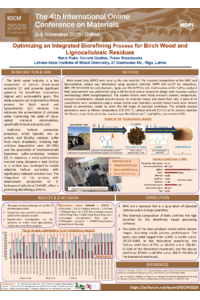
The birch wood industry is a key component of Latvia’s forest-based economy and presents significant potential for biorefinery innovations aligned with sustainability goals. This study proposes an integrated biorefining process for birch wood and lignocellulosic (LC) residues that enhances the preservation of cellulose while maximizing the yield of value-added chemical intermediates, specifically furfural and acetic acid. Traditional furfural production processes, which typically rely on sulfuric acid (H₂SO₄) catalysis, suffer from major drawbacks, including high cellulose degradation rates (40–50%) and the generation of environmentally hazardous sulfur-containing residues. In response, a novel pretreatment method using phosphoric acid (H₃PO₄) as a catalyst was developed to enable selective furfural extraction with significantly reduced cellulose loss. The integration of this process with downstream production of 5-hydroxymethylfurfural (5-HMF) offers a promising biorefining platform. The chemical composition of raw LC material and post-treatment residues was analyzed using NREL protocols (TP-510-42618, TP-510-42622) and HPLC. Process optimization was conducted using DesignExpert11 software across 26 experimental trials. Fixed parameters included raw material moisture content (45%) and H₃PO₄ concentration (55%), while catalyst amount, reaction temperature, time, and water steam flow were varied. The optimized process achieved a maximum furfural yield of 10.11% based on oven-dry mass (o.d.m.), corresponding to 65.67% of the theoretical maximum—substantially outperforming the 50–55% yields typically reported in industrial settings. Acetic acid yield reached 5.71%, while glucose loss in the LC residue was limited to 8.89%. Further optimization at Technology Readiness TRL6 reduced glucose loss to just 2.00%.
These findings demonstrate the feasibility and industrial relevance of a sustainable, integrated biorefining approach that maximizes chemical recovery while preserving carbohydrate value, supporting future developments in green chemistry and circular bioeconomy systems.
Funding: This research was funded by the Latvian Council of Science State Research Program: “Innovation in Forest Management and Value Chain for Latvia’s Growth: New Forest Services, Products and Technologies” (Forest4LV), project No VPP-ZM-VRIIILA-2024/2-0002
Keywords
Furfural
acetic acid
Lignocellulosic residue
Poster
M.Puke_poster.pdf
Synthesis and UV-Induced Modulation of Organic Selenium Nanoparticles
Soft conductive silicone composites based on carbon nanotubes modified with ferrocenyl-containing polysiloxanes