Event submissions
Published
This submission belongs to the session S6. Green Materials, Synthesis, Characterization and Recycling of the event The 4th International Online Conference on Materials
Published date
29 Oct, 2025
Academic Editor
'%3e%3cpath%20d='M12.6657%2010.9104C12.4185%2010.325%2012.0599%209.79327%2011.6097%209.34482C11.1609%208.89508%2010.6293%208.5365%2010.0442%208.28888C10.0389%208.28626%2010.0337%208.28495%2010.0285%208.28233C10.8446%207.69279%2011.3752%206.73249%2011.3752%205.64904C11.3752%203.8542%209.92103%202.39999%208.1262%202.39999C6.33136%202.39999%204.87715%203.8542%204.87715%205.64904C4.87715%206.73249%205.40774%207.69279%206.22393%208.28364C6.21869%208.28626%206.21345%208.28757%206.20821%208.29019C5.62129%208.5378%205.09463%208.89284%204.64265%209.34613C4.1929%209.79493%203.83432%2010.3266%203.58671%2010.9117C3.34345%2011.4845%203.21226%2012.0987%203.20023%2012.7209C3.19988%2012.7349%203.20233%2012.7488%203.20744%2012.7619C3.21255%2012.7749%203.22022%2012.7867%203.22998%2012.7968C3.23975%2012.8068%203.25142%2012.8147%203.26431%2012.8202C3.2772%2012.8256%203.29105%2012.8284%203.30504%2012.8284H4.09109C4.14874%2012.8284%204.19459%2012.7825%204.1959%2012.7262C4.2221%2011.7148%204.62823%2010.7676%205.34617%2010.0497C6.08899%209.30683%207.0755%208.89808%208.1262%208.89808C9.17689%208.89808%2010.1634%209.30683%2010.9062%2010.0497C11.6242%2010.7676%2012.0303%2011.7148%2012.0565%2012.7262C12.0578%2012.7838%2012.1037%2012.8284%2012.1613%2012.8284H12.9474C12.9613%2012.8284%2012.9752%2012.8256%2012.9881%2012.8202C13.001%2012.8147%2013.0126%2012.8068%2013.0224%2012.7968C13.0322%2012.7867%2013.0398%2012.7749%2013.0449%2012.7619C13.0501%2012.7488%2013.0525%2012.7349%2013.0522%2012.7209C13.0391%2012.0947%2012.9094%2011.4855%2012.6657%2010.9104ZM8.1262%207.9024C7.52486%207.9024%206.9589%207.6679%206.53312%207.24211C6.10733%206.81633%205.87283%206.25037%205.87283%205.64904C5.87283%205.0477%206.10733%204.48174%206.53312%204.05596C6.9589%203.63018%207.52486%203.39567%208.1262%203.39567C8.72753%203.39567%209.29349%203.63018%209.71927%204.05596C10.1451%204.48174%2010.3796%205.0477%2010.3796%205.64904C10.3796%206.25037%2010.1451%206.81633%209.71927%207.24211C9.29349%207.6679%208.72753%207.9024%208.1262%207.9024Z'%20fill='%235D1EE1'/%3e%3c/g%3e%3c/svg%3e) SARA GARCIA BALLESTEROS
SARA GARCIA BALLESTEROSCitation
Naienne da Silva Santana, João Vitor Gaiotto Gomes, Michelle Gonçalves Mothé, Sustainable Valorization and Characterization of Rice Husk as a Potential Bioadsorbent, in Proceedings of The 4th International Online Conference on Materials, 3 November–6 November 2025, MDPI: Basel, Switzerland
Share
Email
Facebook
Twitter
LinkedIn
Sustainable Valorization and Characterization of Rice Husk as a Potential Bioadsorbent
'%3e%3cpath%20d='M12.6647%2010.9104C12.4176%2010.325%2012.0589%209.7933%2011.6088%209.34485C11.16%208.89511%2010.6283%208.53653%2010.0432%208.28891C10.038%208.28629%2010.0327%208.28498%2010.0275%208.28236C10.8437%207.69282%2011.3743%206.73252%2011.3743%205.64907C11.3743%203.85423%209.92005%202.40002%208.12522%202.40002C6.33038%202.40002%204.87618%203.85423%204.87618%205.64907C4.87618%206.73252%205.40677%207.69282%206.22296%208.28367C6.21772%208.28629%206.21248%208.2876%206.20724%208.29022C5.62031%208.53783%205.09365%208.89287%204.64167%209.34616C4.19192%209.79496%203.83334%2010.3266%203.58573%2010.9117C3.34247%2011.4846%203.21128%2012.0987%203.19925%2012.721C3.1989%2012.735%203.20135%2012.7489%203.20646%2012.7619C3.21157%2012.7749%203.21924%2012.7868%203.22901%2012.7968C3.23877%2012.8068%203.25045%2012.8148%203.26334%2012.8202C3.27623%2012.8256%203.29007%2012.8284%203.30406%2012.8284H4.09012C4.14776%2012.8284%204.19362%2012.7825%204.19493%2012.7262C4.22113%2011.7148%204.62726%2010.7676%205.34519%2010.0497C6.08802%209.30686%207.07452%208.89811%208.12522%208.89811C9.17592%208.89811%2010.1624%209.30686%2010.9052%2010.0497C11.6232%2010.7676%2012.0293%2011.7148%2012.0555%2012.7262C12.0568%2012.7839%2012.1027%2012.8284%2012.1603%2012.8284H12.9464C12.9604%2012.8284%2012.9742%2012.8256%2012.9871%2012.8202C13%2012.8148%2013.0117%2012.8068%2013.0214%2012.7968C13.0312%2012.7868%2013.0389%2012.7749%2013.044%2012.7619C13.0491%2012.7489%2013.0515%2012.735%2013.0512%2012.721C13.0381%2012.0947%2012.9084%2011.4856%2012.6647%2010.9104ZM8.12522%207.90243C7.52388%207.90243%206.95792%207.66793%206.53214%207.24215C6.10636%206.81636%205.87185%206.2504%205.87185%205.64907C5.87185%205.04773%206.10636%204.48177%206.53214%204.05599C6.95792%203.63021%207.52388%203.3957%208.12522%203.3957C8.72655%203.3957%209.29252%203.63021%209.7183%204.05599C10.1441%204.48177%2010.3786%205.04773%2010.3786%205.64907C10.3786%206.2504%2010.1441%206.81636%209.7183%207.24215C9.29252%207.66793%208.72655%207.90243%208.12522%207.90243Z'%20fill='%235D1EE1'/%3e%3c/g%3e%3c/svg%3e)
Naienne da Silva Santana 1
João Vitor Gaiotto Gomes 2

Michelle Gonçalves Mothé 1
1. School of Chemistry, Federal University of Rio de Janeiro, Rio de Janeiro, Brazil
2. Polytechnic School, Federal University of Rio de Janeiro, Rio de Janeiro, Brazil
Abstract
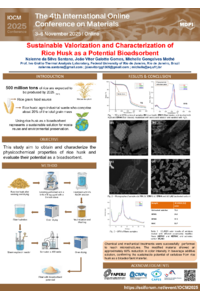
According to the Food and Agriculture Organization of the United Nations (FAO), global rice production is projected to exceed 550 million tons by 2025. As one of the world's primary food crops, rice generates a remarkable amount of agro-industrial waste, particularly rice husks, which comprise about 20% of the total grain mass. This waste is often used for energy generation but releases polluting gases into the atmosphere, highlighting the need for more sustainable recovery alternatives. In this context, this study aimed to characterize the physicochemical properties of rice husks and evaluate their potential as a bioadsorbent. Ground rice husks were treated with NaOH solutions (less than 5% w/v) for delignification, followed by acidification with acetic acid under mild conditions. The samples underwent additional steam explosion pretreatment, followed by agitation in the Turrax. The physicochemical characterization of the samples was conducted using TG/DTG (model Q600 from TA Instruments, N2 atmosphere, 25 to 600°C), SEM (model Quanta 400 FEG from FEI Company), and UV-Vis (model UV-2600i from Shimadzu). The TG curves revealed two significant decomposition stages between 25-100°C and 225-600°C. DTG curves indicated peaks at 40 and 325°C, linked to water loss and cellulose degradation, respectively. The micrographs indicated significant changes in fiber morphology after treatment, with exposure of cellulose nanofibers. Also, all samples were evaluated for color removal in beverage additives. Remarkably, as a bioadsorbent, the rice husks achieved an approximate 60% reduction in color intensity, especially in samples that underwent more extensive depressurization during steam explosion. These results reveal the potential of rice husks as a sustainable and effective material for color adsorption in aqueous solutions.
Keywords
rice husk
deslignification
thermal analysis
bioadsorbent
Poster
posterdocongressoIOCM.pdf
DFT Study of Electronic and Optical Properties of Poly(p-phenylene vinylene) (PPV) for Optoelectronic Devices
Molecular Dynamics Study of the Mechanical Behavior of BaTiO₃/PVDF Nanocomposites