Event submissions
Published
This submission belongs to the session S6. Green Materials, Synthesis, Characterization and Recycling of the event The 4th International Online Conference on Materials
Published date
29 Oct, 2025
Academic Editor
'%3e%3cpath%20d='M12.6657%2010.9104C12.4185%2010.325%2012.0599%209.79327%2011.6097%209.34482C11.1609%208.89508%2010.6293%208.5365%2010.0442%208.28888C10.0389%208.28626%2010.0337%208.28495%2010.0285%208.28233C10.8446%207.69279%2011.3752%206.73249%2011.3752%205.64904C11.3752%203.8542%209.92103%202.39999%208.1262%202.39999C6.33136%202.39999%204.87715%203.8542%204.87715%205.64904C4.87715%206.73249%205.40774%207.69279%206.22393%208.28364C6.21869%208.28626%206.21345%208.28757%206.20821%208.29019C5.62129%208.5378%205.09463%208.89284%204.64265%209.34613C4.1929%209.79493%203.83432%2010.3266%203.58671%2010.9117C3.34345%2011.4845%203.21226%2012.0987%203.20023%2012.7209C3.19988%2012.7349%203.20233%2012.7488%203.20744%2012.7619C3.21255%2012.7749%203.22022%2012.7867%203.22998%2012.7968C3.23975%2012.8068%203.25142%2012.8147%203.26431%2012.8202C3.2772%2012.8256%203.29105%2012.8284%203.30504%2012.8284H4.09109C4.14874%2012.8284%204.19459%2012.7825%204.1959%2012.7262C4.2221%2011.7148%204.62823%2010.7676%205.34617%2010.0497C6.08899%209.30683%207.0755%208.89808%208.1262%208.89808C9.17689%208.89808%2010.1634%209.30683%2010.9062%2010.0497C11.6242%2010.7676%2012.0303%2011.7148%2012.0565%2012.7262C12.0578%2012.7838%2012.1037%2012.8284%2012.1613%2012.8284H12.9474C12.9613%2012.8284%2012.9752%2012.8256%2012.9881%2012.8202C13.001%2012.8147%2013.0126%2012.8068%2013.0224%2012.7968C13.0322%2012.7867%2013.0398%2012.7749%2013.0449%2012.7619C13.0501%2012.7488%2013.0525%2012.7349%2013.0522%2012.7209C13.0391%2012.0947%2012.9094%2011.4855%2012.6657%2010.9104ZM8.1262%207.9024C7.52486%207.9024%206.9589%207.6679%206.53312%207.24211C6.10733%206.81633%205.87283%206.25037%205.87283%205.64904C5.87283%205.0477%206.10733%204.48174%206.53312%204.05596C6.9589%203.63018%207.52486%203.39567%208.1262%203.39567C8.72753%203.39567%209.29349%203.63018%209.71927%204.05596C10.1451%204.48174%2010.3796%205.0477%2010.3796%205.64904C10.3796%206.25037%2010.1451%206.81633%209.71927%207.24211C9.29349%207.6679%208.72753%207.9024%208.1262%207.9024Z'%20fill='%235D1EE1'/%3e%3c/g%3e%3c/svg%3e) SARA GARCIA BALLESTEROS
SARA GARCIA BALLESTEROSCitation
Brahim Jouamai, A Blueprint for Carbon-Negative Construction: A Comparative Analysis of CCUS Integration in Concrete, in Proceedings of The 4th International Online Conference on Materials, 3 November–6 November 2025, MDPI: Basel, Switzerland
Share
Email
Facebook
Twitter
LinkedIn
A Blueprint for Carbon-Negative Construction: A Comparative Analysis of CCUS Integration in Concrete
'%3e%3cpath%20d='M12.6647%2010.9104C12.4176%2010.325%2012.0589%209.7933%2011.6088%209.34485C11.16%208.89511%2010.6283%208.53653%2010.0432%208.28891C10.038%208.28629%2010.0327%208.28498%2010.0275%208.28236C10.8437%207.69282%2011.3743%206.73252%2011.3743%205.64907C11.3743%203.85423%209.92005%202.40002%208.12522%202.40002C6.33038%202.40002%204.87618%203.85423%204.87618%205.64907C4.87618%206.73252%205.40677%207.69282%206.22296%208.28367C6.21772%208.28629%206.21248%208.2876%206.20724%208.29022C5.62031%208.53783%205.09365%208.89287%204.64167%209.34616C4.19192%209.79496%203.83334%2010.3266%203.58573%2010.9117C3.34247%2011.4846%203.21128%2012.0987%203.19925%2012.721C3.1989%2012.735%203.20135%2012.7489%203.20646%2012.7619C3.21157%2012.7749%203.21924%2012.7868%203.22901%2012.7968C3.23877%2012.8068%203.25045%2012.8148%203.26334%2012.8202C3.27623%2012.8256%203.29007%2012.8284%203.30406%2012.8284H4.09012C4.14776%2012.8284%204.19362%2012.7825%204.19493%2012.7262C4.22113%2011.7148%204.62726%2010.7676%205.34519%2010.0497C6.08802%209.30686%207.07452%208.89811%208.12522%208.89811C9.17592%208.89811%2010.1624%209.30686%2010.9052%2010.0497C11.6232%2010.7676%2012.0293%2011.7148%2012.0555%2012.7262C12.0568%2012.7839%2012.1027%2012.8284%2012.1603%2012.8284H12.9464C12.9604%2012.8284%2012.9742%2012.8256%2012.9871%2012.8202C13%2012.8148%2013.0117%2012.8068%2013.0214%2012.7968C13.0312%2012.7868%2013.0389%2012.7749%2013.044%2012.7619C13.0491%2012.7489%2013.0515%2012.735%2013.0512%2012.721C13.0381%2012.0947%2012.9084%2011.4856%2012.6647%2010.9104ZM8.12522%207.90243C7.52388%207.90243%206.95792%207.66793%206.53214%207.24215C6.10636%206.81636%205.87185%206.2504%205.87185%205.64907C5.87185%205.04773%206.10636%204.48177%206.53214%204.05599C6.95792%203.63021%207.52388%203.3957%208.12522%203.3957C8.72655%203.3957%209.29252%203.63021%209.7183%204.05599C10.1441%204.48177%2010.3786%205.04773%2010.3786%205.64907C10.3786%206.2504%2010.1441%206.81636%209.7183%207.24215C9.29252%207.66793%208.72655%207.90243%208.12522%207.90243Z'%20fill='%235D1EE1'/%3e%3c/g%3e%3c/svg%3e)
Brahim Jouamai 1
1. Department of Mechanics, Materials and Civil Engineering, National School of Applied Sciences, Ibn Zohr University, Agadir 80000, Morocco
Abstract
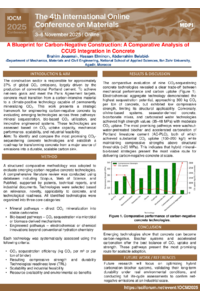
To align with global climate targets, the construction industry, responsible for approximately 37% of emissions, must transition from a carbon source to a net carbon sink. This study pioneers a strategic blueprint for this transformation by identifying the most viable pathways for engineering genuinely carbon-negative concrete. We address the urgent need for a comprehensive framework that evaluates and compares emerging Carbon Capture, Utilization, and Storage (CCUS) technologies beyond isolated studies.
Our methodology involved a systematic analysis of nine distinct technologies sourced from scientific literature, patents, and industry reports. These approaches were organized into three foundational categories for comparison: direct mineral sequestration, bio-based additives, and engineered systems. Each technology was assessed against critical metrics for industrial adoption, including its CO2 sequestration efficiency, resulting mechanical strength, and potential for scalable, energy-efficient implementation.
Our findings underscore an inherent tension between carbon uptake potential and material performance. Among the evaluated options, washout-pretreated biochar stands out as a promising solution, achieving a significant carbon sequestration of 150-200 kg of CO2/m3 while preserving a structural-grade compressive strength of 27.6 MPa. This balanced performance contrasts with other methods, like enzymatic biomineralization, which yield stronger concrete but with substantially lower carbon removal capacity.
The research concludes that the most effective strategy for sectoral decarbonization lies not in a single "silver bullet" but in a versatile portfolio of CCUS solutions. This approach would combine partial cement substitution with specific CCUS admixtures tailored to different performance requirements. Realizing this vision requires a coordinated effort that integrates advances in materials science with supportive policy frameworks to de-risk investment and scale up supply chains. This work provides a clear roadmap to guide industry and policymakers, demonstrating how the built environment can become a key asset in mitigating climate change.
Keywords
Carbon-Negative Concrete
Carbon Capture utilization and storage (CCUS)
Sectoral Decarbonization
Sustainable Construction
CO2 Sequestration
Climate Mitigation
Green Materials.
Poster
IOCM 2025 - poster.pdf
Molecular Dynamics Study of the Mechanical Behavior of BaTiO₃/PVDF Nanocomposites
Capacitive Behavior of Poly-Si Thin Films in TFTs: Optimizing Device Performance through 2D Numerical Modeling