Event submissions
Published
This submission belongs to the session S4. Materials Theory, Simulations and AI of the event The 4th International Online Conference on Materials
Published date
29 Oct, 2025
Academic Editor
'%3e%3cpath%20d='M12.6657%2010.9104C12.4185%2010.325%2012.0599%209.79327%2011.6097%209.34482C11.1609%208.89508%2010.6293%208.5365%2010.0442%208.28888C10.0389%208.28626%2010.0337%208.28495%2010.0285%208.28233C10.8446%207.69279%2011.3752%206.73249%2011.3752%205.64904C11.3752%203.8542%209.92103%202.39999%208.1262%202.39999C6.33136%202.39999%204.87715%203.8542%204.87715%205.64904C4.87715%206.73249%205.40774%207.69279%206.22393%208.28364C6.21869%208.28626%206.21345%208.28757%206.20821%208.29019C5.62129%208.5378%205.09463%208.89284%204.64265%209.34613C4.1929%209.79493%203.83432%2010.3266%203.58671%2010.9117C3.34345%2011.4845%203.21226%2012.0987%203.20023%2012.7209C3.19988%2012.7349%203.20233%2012.7488%203.20744%2012.7619C3.21255%2012.7749%203.22022%2012.7867%203.22998%2012.7968C3.23975%2012.8068%203.25142%2012.8147%203.26431%2012.8202C3.2772%2012.8256%203.29105%2012.8284%203.30504%2012.8284H4.09109C4.14874%2012.8284%204.19459%2012.7825%204.1959%2012.7262C4.2221%2011.7148%204.62823%2010.7676%205.34617%2010.0497C6.08899%209.30683%207.0755%208.89808%208.1262%208.89808C9.17689%208.89808%2010.1634%209.30683%2010.9062%2010.0497C11.6242%2010.7676%2012.0303%2011.7148%2012.0565%2012.7262C12.0578%2012.7838%2012.1037%2012.8284%2012.1613%2012.8284H12.9474C12.9613%2012.8284%2012.9752%2012.8256%2012.9881%2012.8202C13.001%2012.8147%2013.0126%2012.8068%2013.0224%2012.7968C13.0322%2012.7867%2013.0398%2012.7749%2013.0449%2012.7619C13.0501%2012.7488%2013.0525%2012.7349%2013.0522%2012.7209C13.0391%2012.0947%2012.9094%2011.4855%2012.6657%2010.9104ZM8.1262%207.9024C7.52486%207.9024%206.9589%207.6679%206.53312%207.24211C6.10733%206.81633%205.87283%206.25037%205.87283%205.64904C5.87283%205.0477%206.10733%204.48174%206.53312%204.05596C6.9589%203.63018%207.52486%203.39567%208.1262%203.39567C8.72753%203.39567%209.29349%203.63018%209.71927%204.05596C10.1451%204.48174%2010.3796%205.0477%2010.3796%205.64904C10.3796%206.25037%2010.1451%206.81633%209.71927%207.24211C9.29349%207.6679%208.72753%207.9024%208.1262%207.9024Z'%20fill='%235D1EE1'/%3e%3c/g%3e%3c/svg%3e) Geo Paul
Geo PaulCitation
Hadjira TAYOUB, Ahlam Harhouz, Capacitive Behavior of Poly-Si Thin Films in TFTs: Optimizing Device Performance through 2D Numerical Modeling, in Proceedings of The 4th International Online Conference on Materials, 3 November–6 November 2025, MDPI: Basel, Switzerland
Share
Email
Facebook
Twitter
LinkedIn
Capacitive Behavior of Poly-Si Thin Films in TFTs: Optimizing Device Performance through 2D Numerical Modeling
'%3e%3cpath%20d='M12.6647%2010.9104C12.4176%2010.325%2012.0589%209.7933%2011.6088%209.34485C11.16%208.89511%2010.6283%208.53653%2010.0432%208.28891C10.038%208.28629%2010.0327%208.28498%2010.0275%208.28236C10.8437%207.69282%2011.3743%206.73252%2011.3743%205.64907C11.3743%203.85423%209.92005%202.40002%208.12522%202.40002C6.33038%202.40002%204.87618%203.85423%204.87618%205.64907C4.87618%206.73252%205.40677%207.69282%206.22296%208.28367C6.21772%208.28629%206.21248%208.2876%206.20724%208.29022C5.62031%208.53783%205.09365%208.89287%204.64167%209.34616C4.19192%209.79496%203.83334%2010.3266%203.58573%2010.9117C3.34247%2011.4846%203.21128%2012.0987%203.19925%2012.721C3.1989%2012.735%203.20135%2012.7489%203.20646%2012.7619C3.21157%2012.7749%203.21924%2012.7868%203.22901%2012.7968C3.23877%2012.8068%203.25045%2012.8148%203.26334%2012.8202C3.27623%2012.8256%203.29007%2012.8284%203.30406%2012.8284H4.09012C4.14776%2012.8284%204.19362%2012.7825%204.19493%2012.7262C4.22113%2011.7148%204.62726%2010.7676%205.34519%2010.0497C6.08802%209.30686%207.07452%208.89811%208.12522%208.89811C9.17592%208.89811%2010.1624%209.30686%2010.9052%2010.0497C11.6232%2010.7676%2012.0293%2011.7148%2012.0555%2012.7262C12.0568%2012.7839%2012.1027%2012.8284%2012.1603%2012.8284H12.9464C12.9604%2012.8284%2012.9742%2012.8256%2012.9871%2012.8202C13%2012.8148%2013.0117%2012.8068%2013.0214%2012.7968C13.0312%2012.7868%2013.0389%2012.7749%2013.044%2012.7619C13.0491%2012.7489%2013.0515%2012.735%2013.0512%2012.721C13.0381%2012.0947%2012.9084%2011.4856%2012.6647%2010.9104ZM8.12522%207.90243C7.52388%207.90243%206.95792%207.66793%206.53214%207.24215C6.10636%206.81636%205.87185%206.2504%205.87185%205.64907C5.87185%205.04773%206.10636%204.48177%206.53214%204.05599C6.95792%203.63021%207.52388%203.3957%208.12522%203.3957C8.72655%203.3957%209.29252%203.63021%209.7183%204.05599C10.1441%204.48177%2010.3786%205.04773%2010.3786%205.64907C10.3786%206.2504%2010.1441%206.81636%209.7183%207.24215C9.29252%207.66793%208.72655%207.90243%208.12522%207.90243Z'%20fill='%235D1EE1'/%3e%3c/g%3e%3c/svg%3e)
Hadjira TAYOUB 1
Ahlam Harhouz 2
1. Research Center in Industrial Technologies, CRTI, P.O. Box 64, Cheraga, 16014 Algiers, Algeria
2. Laboratoire d’Analyse des Signaux et Systèmes, Department of Electronics, University of M’Sila BP.166, Route Ichebilia, M’Sila, 28000, Algeria
Abstract
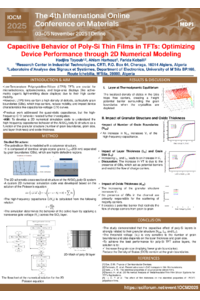
This study investigates the high-frequency capacitance behavior of metal/insulator/polysilicon (MIS) structures used in polycrystalline silicon (poly-Si) thin-film transistors (TFTs) through two-dimensional numerical modeling. A custom simulation code based on Poisson’s equation was developed to model the electrostatic potential and capacitance characteristics of an Al/SiO₂/poly-Si structure, accounting for the granular nature of poly-Si.
The poly-Si active layer is represented as a series of columnar grains separated by narrow, highly defective grain boundaries (GBs). These GBs, oriented perpendicular to the oxide interface, act as energy barriers that trap free carriers and reduce mobility. Simulations highlight how the number of GBs, grain size, layer thickness, and oxide thickness impact high-frequency capacitance and threshold voltage.
Results show that increasing the number of GBs shifts the capacitance–voltage C (V) curve, raising the threshold voltage due to enhanced charge trapping. Similarly, larger grain sizes and thicker active layers also lead to increased threshold voltages, with a quasi-linear relationship between grain size and layer thickness amplifying this effect. Thicker oxide layers reduce gate control, further increasing the threshold voltage.
A detailed electrostatic potential distribution confirms that GBs trap carriers and form potential barriers, especially under depletion conditions. These findings demonstrate the strong dependence of poly-Si TFT capacitance behavior on structural properties.
To optimize TFT performance, the study suggests increasing grain size and reducing GB density, which can be achieved through techniques like laser crystallization or rapid thermal annealing. These modifications lower defect density, improve carrier mobility, and enhance device performance.
In conclusion, the paper provides a valuable numerical tool and physical insights into the capacitive behavior of poly-Si TFTs, with direct implications for designing efficient electronic and display components.
Keywords
MIS structures
Polysilicon
Granular structure
Poisson's equation
C (V) characteristics
TFTs,
Poster
IOCM2025.pdf
A Blueprint for Carbon-Negative Construction: A Comparative Analysis of CCUS Integration in Concrete
Green Treatment and Thermal Characterization of Eucalyptus urograndis Leaves by TG/DTG