Event submissions
Published
This submission belongs to the session S4. Materials Theory, Simulations and AI of the event The 4th International Online Conference on Materials
Published date
29 Oct, 2025
Academic Editor
'%3e%3cpath%20d='M12.6657%2010.9104C12.4185%2010.325%2012.0599%209.79327%2011.6097%209.34482C11.1609%208.89508%2010.6293%208.5365%2010.0442%208.28888C10.0389%208.28626%2010.0337%208.28495%2010.0285%208.28233C10.8446%207.69279%2011.3752%206.73249%2011.3752%205.64904C11.3752%203.8542%209.92103%202.39999%208.1262%202.39999C6.33136%202.39999%204.87715%203.8542%204.87715%205.64904C4.87715%206.73249%205.40774%207.69279%206.22393%208.28364C6.21869%208.28626%206.21345%208.28757%206.20821%208.29019C5.62129%208.5378%205.09463%208.89284%204.64265%209.34613C4.1929%209.79493%203.83432%2010.3266%203.58671%2010.9117C3.34345%2011.4845%203.21226%2012.0987%203.20023%2012.7209C3.19988%2012.7349%203.20233%2012.7488%203.20744%2012.7619C3.21255%2012.7749%203.22022%2012.7867%203.22998%2012.7968C3.23975%2012.8068%203.25142%2012.8147%203.26431%2012.8202C3.2772%2012.8256%203.29105%2012.8284%203.30504%2012.8284H4.09109C4.14874%2012.8284%204.19459%2012.7825%204.1959%2012.7262C4.2221%2011.7148%204.62823%2010.7676%205.34617%2010.0497C6.08899%209.30683%207.0755%208.89808%208.1262%208.89808C9.17689%208.89808%2010.1634%209.30683%2010.9062%2010.0497C11.6242%2010.7676%2012.0303%2011.7148%2012.0565%2012.7262C12.0578%2012.7838%2012.1037%2012.8284%2012.1613%2012.8284H12.9474C12.9613%2012.8284%2012.9752%2012.8256%2012.9881%2012.8202C13.001%2012.8147%2013.0126%2012.8068%2013.0224%2012.7968C13.0322%2012.7867%2013.0398%2012.7749%2013.0449%2012.7619C13.0501%2012.7488%2013.0525%2012.7349%2013.0522%2012.7209C13.0391%2012.0947%2012.9094%2011.4855%2012.6657%2010.9104ZM8.1262%207.9024C7.52486%207.9024%206.9589%207.6679%206.53312%207.24211C6.10733%206.81633%205.87283%206.25037%205.87283%205.64904C5.87283%205.0477%206.10733%204.48174%206.53312%204.05596C6.9589%203.63018%207.52486%203.39567%208.1262%203.39567C8.72753%203.39567%209.29349%203.63018%209.71927%204.05596C10.1451%204.48174%2010.3796%205.0477%2010.3796%205.64904C10.3796%206.25037%2010.1451%206.81633%209.71927%207.24211C9.29349%207.6679%208.72753%207.9024%208.1262%207.9024Z'%20fill='%235D1EE1'/%3e%3c/g%3e%3c/svg%3e) Dimosthenis Stamopoulos
Dimosthenis StamopoulosCitation
Maryam AYAD, Lalla Btissam DRISSI, Chaymaa KASBAOUI, Double Hydride Perovskites as Promising Materials for Clean Energy Storage: A First-Principles (DFT) Study, in Proceedings of The 4th International Online Conference on Materials, 3 November–6 November 2025, MDPI: Basel, Switzerland
Share
Email
Facebook
Twitter
LinkedIn
Double Hydride Perovskites as Promising Materials for Clean Energy Storage: A First-Principles (DFT) Study
'%3e%3cpath%20d='M12.6647%2010.9104C12.4176%2010.325%2012.0589%209.7933%2011.6088%209.34485C11.16%208.89511%2010.6283%208.53653%2010.0432%208.28891C10.038%208.28629%2010.0327%208.28498%2010.0275%208.28236C10.8437%207.69282%2011.3743%206.73252%2011.3743%205.64907C11.3743%203.85423%209.92005%202.40002%208.12522%202.40002C6.33038%202.40002%204.87618%203.85423%204.87618%205.64907C4.87618%206.73252%205.40677%207.69282%206.22296%208.28367C6.21772%208.28629%206.21248%208.2876%206.20724%208.29022C5.62031%208.53783%205.09365%208.89287%204.64167%209.34616C4.19192%209.79496%203.83334%2010.3266%203.58573%2010.9117C3.34247%2011.4846%203.21128%2012.0987%203.19925%2012.721C3.1989%2012.735%203.20135%2012.7489%203.20646%2012.7619C3.21157%2012.7749%203.21924%2012.7868%203.22901%2012.7968C3.23877%2012.8068%203.25045%2012.8148%203.26334%2012.8202C3.27623%2012.8256%203.29007%2012.8284%203.30406%2012.8284H4.09012C4.14776%2012.8284%204.19362%2012.7825%204.19493%2012.7262C4.22113%2011.7148%204.62726%2010.7676%205.34519%2010.0497C6.08802%209.30686%207.07452%208.89811%208.12522%208.89811C9.17592%208.89811%2010.1624%209.30686%2010.9052%2010.0497C11.6232%2010.7676%2012.0293%2011.7148%2012.0555%2012.7262C12.0568%2012.7839%2012.1027%2012.8284%2012.1603%2012.8284H12.9464C12.9604%2012.8284%2012.9742%2012.8256%2012.9871%2012.8202C13%2012.8148%2013.0117%2012.8068%2013.0214%2012.7968C13.0312%2012.7868%2013.0389%2012.7749%2013.044%2012.7619C13.0491%2012.7489%2013.0515%2012.735%2013.0512%2012.721C13.0381%2012.0947%2012.9084%2011.4856%2012.6647%2010.9104ZM8.12522%207.90243C7.52388%207.90243%206.95792%207.66793%206.53214%207.24215C6.10636%206.81636%205.87185%206.2504%205.87185%205.64907C5.87185%205.04773%206.10636%204.48177%206.53214%204.05599C6.95792%203.63021%207.52388%203.3957%208.12522%203.3957C8.72655%203.3957%209.29252%203.63021%209.7183%204.05599C10.1441%204.48177%2010.3786%205.04773%2010.3786%205.64907C10.3786%206.2504%2010.1441%206.81636%209.7183%207.24215C9.29252%207.66793%208.72655%207.90243%208.12522%207.90243Z'%20fill='%235D1EE1'/%3e%3c/g%3e%3c/svg%3e)
Maryam AYAD 1
Lalla Btissam DRISSI 1,2,3
Chaymaa KASBAOUI 4,5
1. LPHE, Modeling & Simulations, Faculty of Science, Mohammed V University in Rabat, Morocco
2. CPM, Centre of Physics and Mathematics, Faculty of Science, Mohammed V University in Rabat, Morocco
3. College of Physical and Chemical Sciences, Hassan II Academy of Science and Technology, Rabat, Morocco
4. 1LPHE, Modeling & Simulations, Faculty of Science, Mohammed V University in Rabat, Morocco
5. 2CPM, Centre of Physics and Mathematics, Faculty of Science, Mohammed V University in Rabat, Morocco
Abstract
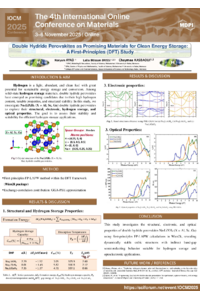
Hydride materials are widely recognized for their significant potential in hydrogen storage, a crucial component of renewable energy systems. This study employs density functional theory (DFT) to investigate the structural, electronic, optical, and hydrogen storage properties of novel double hydride perovskites, such as Na₂LiXH₆ (X = Al, Ga). The materials crystallize in a cubic structure (Fm-3m), the optimized structural parameters are obtained through energy–volume (E-V) curve analysis, and the negative formation enthalpies confirm the thermodynamic stability of these compounds.
Electronic structure calculations reveal that Na₂LiAlH₆ and Na₂LiGaH₆ are semiconductors with indirect band gaps of approximately 2.60 eV and 0.66 eV, respectively. These values suggest potential applications in semiconductor-based devices. Optical analyses including the dielectric function, absorption coefficient, refractive index, extinction coefficient, and optical conductivity indicate strong absorption in the ultraviolet region, highlighting the materials’ potential for optoelectronic applications such as UV detectors and solar energy harvesting.
Moreover, the predicted gravimetric hydrogen storage capacities Cwt(%) are favorable, and the hydrogen desorption temperatures Td are calculated to be 373.9 K for Na₂LiAlH₆ and 337.1 K for Na₂LiGaH₆. These properties indicate practical viability for energy storage applications. Together, these characteristics position Na₂LiXH₆ hydrides as promising multifunctional materials for next-generation clean energy technologies, combining efficient hydrogen storage with valuable electronic and optical features. This work contributes to the ongoing search for sustainable materials supporting the transition to renewable energy.
Keywords
Hydrogen Storage
DFT
Double perovskite
Optoelectronic
Semiconductors
Desorption temperature
Poster
Maryam_AYAD_IOCM_2025 _poster.pdf
Green Treatment and Thermal Characterization of Eucalyptus urograndis Leaves by TG/DTG
AI-Driven Smart Material Design for Driver Stress Detection Based on Physiological Databases