Event submissions
Published
This submission belongs to the session S6. Green Materials, Synthesis, Characterization and Recycling of the event The 4th International Online Conference on Materials
Published date
29 Oct, 2025
Academic Editor
'%3e%3cpath%20d='M12.6657%2010.9104C12.4185%2010.325%2012.0599%209.79327%2011.6097%209.34482C11.1609%208.89508%2010.6293%208.5365%2010.0442%208.28888C10.0389%208.28626%2010.0337%208.28495%2010.0285%208.28233C10.8446%207.69279%2011.3752%206.73249%2011.3752%205.64904C11.3752%203.8542%209.92103%202.39999%208.1262%202.39999C6.33136%202.39999%204.87715%203.8542%204.87715%205.64904C4.87715%206.73249%205.40774%207.69279%206.22393%208.28364C6.21869%208.28626%206.21345%208.28757%206.20821%208.29019C5.62129%208.5378%205.09463%208.89284%204.64265%209.34613C4.1929%209.79493%203.83432%2010.3266%203.58671%2010.9117C3.34345%2011.4845%203.21226%2012.0987%203.20023%2012.7209C3.19988%2012.7349%203.20233%2012.7488%203.20744%2012.7619C3.21255%2012.7749%203.22022%2012.7867%203.22998%2012.7968C3.23975%2012.8068%203.25142%2012.8147%203.26431%2012.8202C3.2772%2012.8256%203.29105%2012.8284%203.30504%2012.8284H4.09109C4.14874%2012.8284%204.19459%2012.7825%204.1959%2012.7262C4.2221%2011.7148%204.62823%2010.7676%205.34617%2010.0497C6.08899%209.30683%207.0755%208.89808%208.1262%208.89808C9.17689%208.89808%2010.1634%209.30683%2010.9062%2010.0497C11.6242%2010.7676%2012.0303%2011.7148%2012.0565%2012.7262C12.0578%2012.7838%2012.1037%2012.8284%2012.1613%2012.8284H12.9474C12.9613%2012.8284%2012.9752%2012.8256%2012.9881%2012.8202C13.001%2012.8147%2013.0126%2012.8068%2013.0224%2012.7968C13.0322%2012.7867%2013.0398%2012.7749%2013.0449%2012.7619C13.0501%2012.7488%2013.0525%2012.7349%2013.0522%2012.7209C13.0391%2012.0947%2012.9094%2011.4855%2012.6657%2010.9104ZM8.1262%207.9024C7.52486%207.9024%206.9589%207.6679%206.53312%207.24211C6.10733%206.81633%205.87283%206.25037%205.87283%205.64904C5.87283%205.0477%206.10733%204.48174%206.53312%204.05596C6.9589%203.63018%207.52486%203.39567%208.1262%203.39567C8.72753%203.39567%209.29349%203.63018%209.71927%204.05596C10.1451%204.48174%2010.3796%205.0477%2010.3796%205.64904C10.3796%206.25037%2010.1451%206.81633%209.71927%207.24211C9.29349%207.6679%208.72753%207.9024%208.1262%207.9024Z'%20fill='%235D1EE1'/%3e%3c/g%3e%3c/svg%3e) SARA GARCIA BALLESTEROS
SARA GARCIA BALLESTEROSCitation
Touafek Ouassila, Touafek Naima, El Hattab Mohamed, Eco-friendly Synthesis of CuO Nanoparticles Using Ascorbic Acid and Evaluation of Their Antioxidant and Photocatalytic Activities, in Proceedings of The 4th International Online Conference on Materials, 3 November–6 November 2025, MDPI: Basel, Switzerland
Share
Email
Facebook
Twitter
LinkedIn
Eco-friendly Synthesis of CuO Nanoparticles Using Ascorbic Acid and Evaluation of Their Antioxidant and Photocatalytic Activities
'%3e%3cpath%20d='M12.6647%2010.9104C12.4176%2010.325%2012.0589%209.7933%2011.6088%209.34485C11.16%208.89511%2010.6283%208.53653%2010.0432%208.28891C10.038%208.28629%2010.0327%208.28498%2010.0275%208.28236C10.8437%207.69282%2011.3743%206.73252%2011.3743%205.64907C11.3743%203.85423%209.92005%202.40002%208.12522%202.40002C6.33038%202.40002%204.87618%203.85423%204.87618%205.64907C4.87618%206.73252%205.40677%207.69282%206.22296%208.28367C6.21772%208.28629%206.21248%208.2876%206.20724%208.29022C5.62031%208.53783%205.09365%208.89287%204.64167%209.34616C4.19192%209.79496%203.83334%2010.3266%203.58573%2010.9117C3.34247%2011.4846%203.21128%2012.0987%203.19925%2012.721C3.1989%2012.735%203.20135%2012.7489%203.20646%2012.7619C3.21157%2012.7749%203.21924%2012.7868%203.22901%2012.7968C3.23877%2012.8068%203.25045%2012.8148%203.26334%2012.8202C3.27623%2012.8256%203.29007%2012.8284%203.30406%2012.8284H4.09012C4.14776%2012.8284%204.19362%2012.7825%204.19493%2012.7262C4.22113%2011.7148%204.62726%2010.7676%205.34519%2010.0497C6.08802%209.30686%207.07452%208.89811%208.12522%208.89811C9.17592%208.89811%2010.1624%209.30686%2010.9052%2010.0497C11.6232%2010.7676%2012.0293%2011.7148%2012.0555%2012.7262C12.0568%2012.7839%2012.1027%2012.8284%2012.1603%2012.8284H12.9464C12.9604%2012.8284%2012.9742%2012.8256%2012.9871%2012.8202C13%2012.8148%2013.0117%2012.8068%2013.0214%2012.7968C13.0312%2012.7868%2013.0389%2012.7749%2013.044%2012.7619C13.0491%2012.7489%2013.0515%2012.735%2013.0512%2012.721C13.0381%2012.0947%2012.9084%2011.4856%2012.6647%2010.9104ZM8.12522%207.90243C7.52388%207.90243%206.95792%207.66793%206.53214%207.24215C6.10636%206.81636%205.87185%206.2504%205.87185%205.64907C5.87185%205.04773%206.10636%204.48177%206.53214%204.05599C6.95792%203.63021%207.52388%203.3957%208.12522%203.3957C8.72655%203.3957%209.29252%203.63021%209.7183%204.05599C10.1441%204.48177%2010.3786%205.04773%2010.3786%205.64907C10.3786%206.2504%2010.1441%206.81636%209.7183%207.24215C9.29252%207.66793%208.72655%207.90243%208.12522%207.90243Z'%20fill='%235D1EE1'/%3e%3c/g%3e%3c/svg%3e)
Touafek Ouassila 1
Touafek Naima 2
El Hattab Mohamed 1
1. Laboratory of Natural Products Chemistry and Biomolecules, Faculty of Sciences, University Blida 1, POB 270, Soumaa Road, Blida 09000, Algeria.
2. Higher National School of Biotechnology “Toufik Khaznadar”, Ville University Ali Mendjeli, Boite
Postale E66 Constantine (Population range : 250,000-499,999), Constantine 25000, Algeria.
Abstract
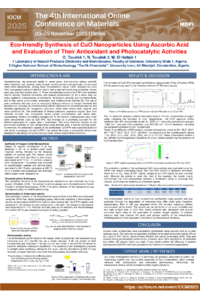
Nanotechnology has advanced rapidly in recent years, revolutionizing various scientific fields, industries, and research areas through the development and application of metal and metal oxide nanoparticles. Among these nanomaterials, copper oxide nanoparticles (CuO NPs) have gained significant attention due to their p-type semiconducting properties, narrow band gap, and large surface area [1]. These characteristics provide CuO NPs with excellent thermal stability, chemical resistance, and catalytic performance [2]. As a result, they are widely applied in photocatalysis, environmental remediation, sensing, and biomedical fields, due to their strong antimicrobial, antioxidant, and multifunctional activities [3,4]. The present study aimed to synthesize copper oxide nanoparticles (CuO NPs) using pure ascorbic acid as a potential reducing and stabilizing agent through an environmentally friendly green synthesis approach, and to evaluate their antioxidant and photocatalytic activities. The formation of CuO NPs has been confirmed by using powder X-Ray diffraction (XRD), UV-Vis spectroscopy and Fourier Transform Infrared (FTIR) spectroscopy. The antioxidant potential of the synthesized CuO NPs was evaluated by assessing their scavenging activity against the stable DPPH free radical. The obtained results show that the CuO NPs possessed significant antioxidant capacity, with (IC50 = 0.21 mg/ml). In comparison, pure ascorbic acid, used as a positive control, exhibited an IC₅₀ of 0.014 mg/mL. The photocatalytic activity was evaluated through the degradation of methylene blue under solar irradiation. The obtained results revealed that the biosynthesized CuO NPs were able to degrade approximately 80% of the dye within 120 minutes.
Keywords
CuO nanoparticles
Antioxidant activity
DPPH assay
Photocatalytic activity
Poster
Poster Touafek IOCM 2025.pdf
AI-Driven Smart Material Design for Driver Stress Detection Based on Physiological Databases
Mathematical Modelling of the Influence of Powder Boriding Parameters on Surface Roughness and Electrochemical Behaviour of Austenitic Stainless Steel AISI 316