Event submissions
Published
This submission belongs to the session S4. Materials Theory, Simulations and AI of the event The 4th International Online Conference on Materials
Published date
29 Oct, 2025
Academic Editor
'%3e%3cpath%20d='M12.6657%2010.9104C12.4185%2010.325%2012.0599%209.79327%2011.6097%209.34482C11.1609%208.89508%2010.6293%208.5365%2010.0442%208.28888C10.0389%208.28626%2010.0337%208.28495%2010.0285%208.28233C10.8446%207.69279%2011.3752%206.73249%2011.3752%205.64904C11.3752%203.8542%209.92103%202.39999%208.1262%202.39999C6.33136%202.39999%204.87715%203.8542%204.87715%205.64904C4.87715%206.73249%205.40774%207.69279%206.22393%208.28364C6.21869%208.28626%206.21345%208.28757%206.20821%208.29019C5.62129%208.5378%205.09463%208.89284%204.64265%209.34613C4.1929%209.79493%203.83432%2010.3266%203.58671%2010.9117C3.34345%2011.4845%203.21226%2012.0987%203.20023%2012.7209C3.19988%2012.7349%203.20233%2012.7488%203.20744%2012.7619C3.21255%2012.7749%203.22022%2012.7867%203.22998%2012.7968C3.23975%2012.8068%203.25142%2012.8147%203.26431%2012.8202C3.2772%2012.8256%203.29105%2012.8284%203.30504%2012.8284H4.09109C4.14874%2012.8284%204.19459%2012.7825%204.1959%2012.7262C4.2221%2011.7148%204.62823%2010.7676%205.34617%2010.0497C6.08899%209.30683%207.0755%208.89808%208.1262%208.89808C9.17689%208.89808%2010.1634%209.30683%2010.9062%2010.0497C11.6242%2010.7676%2012.0303%2011.7148%2012.0565%2012.7262C12.0578%2012.7838%2012.1037%2012.8284%2012.1613%2012.8284H12.9474C12.9613%2012.8284%2012.9752%2012.8256%2012.9881%2012.8202C13.001%2012.8147%2013.0126%2012.8068%2013.0224%2012.7968C13.0322%2012.7867%2013.0398%2012.7749%2013.0449%2012.7619C13.0501%2012.7488%2013.0525%2012.7349%2013.0522%2012.7209C13.0391%2012.0947%2012.9094%2011.4855%2012.6657%2010.9104ZM8.1262%207.9024C7.52486%207.9024%206.9589%207.6679%206.53312%207.24211C6.10733%206.81633%205.87283%206.25037%205.87283%205.64904C5.87283%205.0477%206.10733%204.48174%206.53312%204.05596C6.9589%203.63018%207.52486%203.39567%208.1262%203.39567C8.72753%203.39567%209.29349%203.63018%209.71927%204.05596C10.1451%204.48174%2010.3796%205.0477%2010.3796%205.64904C10.3796%206.25037%2010.1451%206.81633%209.71927%207.24211C9.29349%207.6679%208.72753%207.9024%208.1262%207.9024Z'%20fill='%235D1EE1'/%3e%3c/g%3e%3c/svg%3e) Dimosthenis Stamopoulos
Dimosthenis StamopoulosCitation
Tochukwu Oluwatosin Maduka, Christian Ebere Enyoh, Qingyue Wang, Miho Suzuki, Molecular Dynamics Simulation of Cry j 1 Allergen Adsorption on a PET Microplastic Surface, in Proceedings of The 4th International Online Conference on Materials, 3 November–6 November 2025, MDPI: Basel, Switzerland
Share
Email
Facebook
Twitter
LinkedIn
Molecular Dynamics Simulation of Cry j 1 Allergen Adsorption on a PET Microplastic Surface

Tochukwu Oluwatosin Maduka 1
'%3e%3cpath%20d='M12.6647%2010.9104C12.4176%2010.325%2012.0589%209.7933%2011.6088%209.34485C11.16%208.89511%2010.6283%208.53653%2010.0432%208.28891C10.038%208.28629%2010.0327%208.28498%2010.0275%208.28236C10.8437%207.69282%2011.3743%206.73252%2011.3743%205.64907C11.3743%203.85423%209.92005%202.40002%208.12522%202.40002C6.33038%202.40002%204.87618%203.85423%204.87618%205.64907C4.87618%206.73252%205.40677%207.69282%206.22296%208.28367C6.21772%208.28629%206.21248%208.2876%206.20724%208.29022C5.62031%208.53783%205.09365%208.89287%204.64167%209.34616C4.19192%209.79496%203.83334%2010.3266%203.58573%2010.9117C3.34247%2011.4846%203.21128%2012.0987%203.19925%2012.721C3.1989%2012.735%203.20135%2012.7489%203.20646%2012.7619C3.21157%2012.7749%203.21924%2012.7868%203.22901%2012.7968C3.23877%2012.8068%203.25045%2012.8148%203.26334%2012.8202C3.27623%2012.8256%203.29007%2012.8284%203.30406%2012.8284H4.09012C4.14776%2012.8284%204.19362%2012.7825%204.19493%2012.7262C4.22113%2011.7148%204.62726%2010.7676%205.34519%2010.0497C6.08802%209.30686%207.07452%208.89811%208.12522%208.89811C9.17592%208.89811%2010.1624%209.30686%2010.9052%2010.0497C11.6232%2010.7676%2012.0293%2011.7148%2012.0555%2012.7262C12.0568%2012.7839%2012.1027%2012.8284%2012.1603%2012.8284H12.9464C12.9604%2012.8284%2012.9742%2012.8256%2012.9871%2012.8202C13%2012.8148%2013.0117%2012.8068%2013.0214%2012.7968C13.0312%2012.7868%2013.0389%2012.7749%2013.044%2012.7619C13.0491%2012.7489%2013.0515%2012.735%2013.0512%2012.721C13.0381%2012.0947%2012.9084%2011.4856%2012.6647%2010.9104ZM8.12522%207.90243C7.52388%207.90243%206.95792%207.66793%206.53214%207.24215C6.10636%206.81636%205.87185%206.2504%205.87185%205.64907C5.87185%205.04773%206.10636%204.48177%206.53214%204.05599C6.95792%203.63021%207.52388%203.3957%208.12522%203.3957C8.72655%203.3957%209.29252%203.63021%209.7183%204.05599C10.1441%204.48177%2010.3786%205.04773%2010.3786%205.64907C10.3786%206.2504%2010.1441%206.81636%209.7183%207.24215C9.29252%207.66793%208.72655%207.90243%208.12522%207.90243Z'%20fill='%235D1EE1'/%3e%3c/g%3e%3c/svg%3e)
Christian Ebere Enyoh 2

Qingyue Wang 3
Miho Suzuki 4
1. Department of Material Science, Graduate School of Science and Engineering, Saitama University, Saitama, 338-0825, Japan
2. Department of Environmental Science, Graduate School of Science and Engineering, Saitama University, Saitama, 338-0825, Japan
3. Graduate School of Science and Engineering, Saitama University, Saitama, 338-0825, Japan
4. Department of Functional Materials and Science, Graduate School of Science and Engineering, Saitama University, Saitama, 338-0825, Japan
Abstract
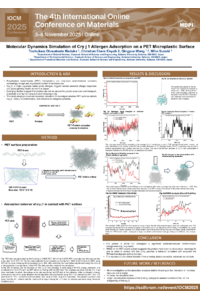
Microplastic pollution is an emerging environmental concern, and polyethylene terephthalate (PET) particles are among the most widespread synthetic polymers. Recent studies suggest that microplastics can act as carriers for biomolecules, including allergens, potentially influencing their transport, persistence, and biological activity. In this work, we investigate the adsorption mechanism of Cry j 1, a major Japanese cedar pollen allergen, onto a PET microplastic surface using atomistic molecular dynamics (MDs) simulations. A PET slab was constructed from a 6-mer repeat unit with CHARMM36 force field parameters and solvated in a TIP3P water box containing physiological ion concentrations. The Cry j 1 structure, obtained from AlphaFold2, was preprocessed and positioned 2 nm above the PET surface using Packmol. Simulations were conducted in GROMACS at 310 K under NPT conditions to monitor protein conformational changes, adsorption energy, hydrogen bonding, and hydrophobic interactions. Preliminary 20 ns trajectories reveal a progressive reduction in protein–surface separation distance, accompanied by stable hydrophobic contacts between PET aromatic rings and Cry j 1 surface residues. Ongoing analyses aim to quantify residue-specific interactions, solvent-accessible surface area changes, and adsorption free energy to better understand the driving forces behind allergen binding. This study provides atomistic insight into allergen–microplastic interactions, offering a predictive framework for assessing environmental exposure risks and informing strategies to mitigate the impact of microplastic-associated allergens in polluted ecosystems.
Keywords
Molecular dynamics
PET microplastics
allergen adsorption
protein–surface interaction
environmental exposure
Poster
IOCM 2025 - poster_Maduka_et_al.pdf
Assessment of Earthquake Vulnerability in RC Frames Featuring Varied Masonry Infill Patterns
First-Principles Study of the Structural, Electronic, Magnetic, Elastic, and Optical Properties of CoFeZrGe Quaternary Heusler Alloy