Event submissions
Published
This submission belongs to the session S4. Materials Theory, Simulations and AI of the event The 4th International Online Conference on Materials
Published date
29 Oct, 2025
Academic Editor
'%3e%3cpath%20d='M12.6657%2010.9104C12.4185%2010.325%2012.0599%209.79327%2011.6097%209.34482C11.1609%208.89508%2010.6293%208.5365%2010.0442%208.28888C10.0389%208.28626%2010.0337%208.28495%2010.0285%208.28233C10.8446%207.69279%2011.3752%206.73249%2011.3752%205.64904C11.3752%203.8542%209.92103%202.39999%208.1262%202.39999C6.33136%202.39999%204.87715%203.8542%204.87715%205.64904C4.87715%206.73249%205.40774%207.69279%206.22393%208.28364C6.21869%208.28626%206.21345%208.28757%206.20821%208.29019C5.62129%208.5378%205.09463%208.89284%204.64265%209.34613C4.1929%209.79493%203.83432%2010.3266%203.58671%2010.9117C3.34345%2011.4845%203.21226%2012.0987%203.20023%2012.7209C3.19988%2012.7349%203.20233%2012.7488%203.20744%2012.7619C3.21255%2012.7749%203.22022%2012.7867%203.22998%2012.7968C3.23975%2012.8068%203.25142%2012.8147%203.26431%2012.8202C3.2772%2012.8256%203.29105%2012.8284%203.30504%2012.8284H4.09109C4.14874%2012.8284%204.19459%2012.7825%204.1959%2012.7262C4.2221%2011.7148%204.62823%2010.7676%205.34617%2010.0497C6.08899%209.30683%207.0755%208.89808%208.1262%208.89808C9.17689%208.89808%2010.1634%209.30683%2010.9062%2010.0497C11.6242%2010.7676%2012.0303%2011.7148%2012.0565%2012.7262C12.0578%2012.7838%2012.1037%2012.8284%2012.1613%2012.8284H12.9474C12.9613%2012.8284%2012.9752%2012.8256%2012.9881%2012.8202C13.001%2012.8147%2013.0126%2012.8068%2013.0224%2012.7968C13.0322%2012.7867%2013.0398%2012.7749%2013.0449%2012.7619C13.0501%2012.7488%2013.0525%2012.7349%2013.0522%2012.7209C13.0391%2012.0947%2012.9094%2011.4855%2012.6657%2010.9104ZM8.1262%207.9024C7.52486%207.9024%206.9589%207.6679%206.53312%207.24211C6.10733%206.81633%205.87283%206.25037%205.87283%205.64904C5.87283%205.0477%206.10733%204.48174%206.53312%204.05596C6.9589%203.63018%207.52486%203.39567%208.1262%203.39567C8.72753%203.39567%209.29349%203.63018%209.71927%204.05596C10.1451%204.48174%2010.3796%205.0477%2010.3796%205.64904C10.3796%206.25037%2010.1451%206.81633%209.71927%207.24211C9.29349%207.6679%208.72753%207.9024%208.1262%207.9024Z'%20fill='%235D1EE1'/%3e%3c/g%3e%3c/svg%3e) Dimosthenis Stamopoulos
Dimosthenis StamopoulosCitation
Shangcong Cheng, Starting temperature of the silica-glass transition, in Proceedings of The 4th International Online Conference on Materials, 3 November–6 November 2025, MDPI: Basel, Switzerland
Share
Email
Facebook
Twitter
LinkedIn
Starting temperature of the silica-glass transition

Shangcong Cheng 1
1. Molecular Foundry, Lawrence Berkeley National Laboratory, Berkeley, California, 94720, USA
Abstract
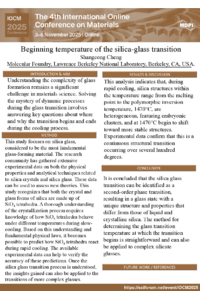
Understanding the complexity of glass formation remains a significant challenge in materials science. Solving the mystery of the dynamic processes involved during glass transition involves answering the key questions of where and why the transition begins and ends during the cooling process.
This study focuses on silica glass, considered to be the most fundamental glass-forming material. The research community has gathered extensive experimental data on both the physical properties and analytical techniques related to silica crystals and silica glass. These data can be used to assess new theories. This study recognizes that both the crystal and glass forms of silica are made up of SiO4 tetrahedra. A thorough understanding of the crystallization process requires knowledge of how SiO4 tetrahedra behave under different temperatures during slow-cooling. Based on this understanding and fundamental physical laws, it becomes possible to predict how SiO4 tetrahedra react during rapid cooling. The available experimental data can help to verify the accuracy of these predictions. Once the silica glass transition process is understood, the insights gained can also be applied to the transitions of more complex glasses.
This analysis indicates that, during rapid cooling, silica structures within the temperature range from the melting point to the polymorphic inversion temperature, 1470°C, are heterogeneous, featuring embryonic clusters, and begin to shift toward more stable structures at 1470°C. Experimental data confirm that this is a continuous structural transition occurring over several hundred degrees.
It is concluded that the silica glass transition can be identified as a second-order phase transition, resulting in a glass state with a unique structure and properties that differ from those of liquid and crystalline silica. The method for determining the glass transition temperatures where the transition begins is straightforward and can also be applied to complex silicate glasses.
Keywords
silica glass
glass transition
SiO4 tetrahedra
embryonic clusters
polymorphic inversion temperature
second-order phase transition
Poster
IOCM 2025 - poster template.pdf
First-Principles Study of the Structural, Electronic, Magnetic, Elastic, and Optical Properties of CoFeZrGe Quaternary Heusler Alloy
Key predictors of lightweight aggregate concrete compressive strength by machine learning from density parameters and ultrasonic pulse velocity testing