Event submissions
Published
This submission belongs to the session S4. Materials Theory, Simulations and AI of the event The 4th International Online Conference on Materials
Published date
29 Oct, 2025
Academic Editor
'%3e%3cpath%20d='M12.6657%2010.9104C12.4185%2010.325%2012.0599%209.79327%2011.6097%209.34482C11.1609%208.89508%2010.6293%208.5365%2010.0442%208.28888C10.0389%208.28626%2010.0337%208.28495%2010.0285%208.28233C10.8446%207.69279%2011.3752%206.73249%2011.3752%205.64904C11.3752%203.8542%209.92103%202.39999%208.1262%202.39999C6.33136%202.39999%204.87715%203.8542%204.87715%205.64904C4.87715%206.73249%205.40774%207.69279%206.22393%208.28364C6.21869%208.28626%206.21345%208.28757%206.20821%208.29019C5.62129%208.5378%205.09463%208.89284%204.64265%209.34613C4.1929%209.79493%203.83432%2010.3266%203.58671%2010.9117C3.34345%2011.4845%203.21226%2012.0987%203.20023%2012.7209C3.19988%2012.7349%203.20233%2012.7488%203.20744%2012.7619C3.21255%2012.7749%203.22022%2012.7867%203.22998%2012.7968C3.23975%2012.8068%203.25142%2012.8147%203.26431%2012.8202C3.2772%2012.8256%203.29105%2012.8284%203.30504%2012.8284H4.09109C4.14874%2012.8284%204.19459%2012.7825%204.1959%2012.7262C4.2221%2011.7148%204.62823%2010.7676%205.34617%2010.0497C6.08899%209.30683%207.0755%208.89808%208.1262%208.89808C9.17689%208.89808%2010.1634%209.30683%2010.9062%2010.0497C11.6242%2010.7676%2012.0303%2011.7148%2012.0565%2012.7262C12.0578%2012.7838%2012.1037%2012.8284%2012.1613%2012.8284H12.9474C12.9613%2012.8284%2012.9752%2012.8256%2012.9881%2012.8202C13.001%2012.8147%2013.0126%2012.8068%2013.0224%2012.7968C13.0322%2012.7867%2013.0398%2012.7749%2013.0449%2012.7619C13.0501%2012.7488%2013.0525%2012.7349%2013.0522%2012.7209C13.0391%2012.0947%2012.9094%2011.4855%2012.6657%2010.9104ZM8.1262%207.9024C7.52486%207.9024%206.9589%207.6679%206.53312%207.24211C6.10733%206.81633%205.87283%206.25037%205.87283%205.64904C5.87283%205.0477%206.10733%204.48174%206.53312%204.05596C6.9589%203.63018%207.52486%203.39567%208.1262%203.39567C8.72753%203.39567%209.29349%203.63018%209.71927%204.05596C10.1451%204.48174%2010.3796%205.0477%2010.3796%205.64904C10.3796%206.25037%2010.1451%206.81633%209.71927%207.24211C9.29349%207.6679%208.72753%207.9024%208.1262%207.9024Z'%20fill='%235D1EE1'/%3e%3c/g%3e%3c/svg%3e) Geo Paul
Geo PaulCitation
F. Rivera-López, Rubén Sahuquillo Redondo, Optimization of Commercial Extruder for Production of Polymeric Filament for 3D Printing Applications, in Proceedings of The 4th International Online Conference on Materials, 3 November–6 November 2025, MDPI: Basel, Switzerland
Share
Email
Facebook
Twitter
LinkedIn
Optimization of Commercial Extruder for Production of Polymeric Filament for 3D Printing Applications

F. Rivera-López 1

Rubén Sahuquillo Redondo 1
1. Departamento de Ingeniería Industrial, Escuela Superior de Ingeniería y Tecnología, Universidad de La Laguna. Apdo. 456. E-38200 San Cristóbal de La Laguna, Santa Cruz de Tenerife, Spain
Abstract
Introduction
The growing use of 3D printing in both industrial and academic settings has increased the demand for high-quality polymeric filament [1]. Producing filament using a commercial extruder from pellets can reduce costs and improve material customization. However, ensuring dimensional stability and consistent quality remains a key challenge. This work focuses on the setup and optimization of a commercial single-screw extruder for the production of filament suitable for fused deposition modeling (FDM) 3D printers.
Methods
A commercial tabletop extruder was adapted and calibrated to process thermoplastic pellets into filament. Key operational parameters, including extrusion temperature, screw speed, and cooling rate, were systematically varied. A real-time diameter monitoring system was implemented to assess filament uniformity during extrusion. The influence of each parameter on filament diameter and surface finish was analyzed. Post-extrusion, the filament was evaluated using calipers and visual inspection to ensure dimensional consistency.
Results
This research found that maintaining a stable extrusion temperature and carefully controlling the extrusion rate and cooling environment are critical for achieving consistent filament diameter. The optimal combination of parameters led to the production of filament with a diameter close to 1.75 mm. The real-time implemented monitoring system proved effective in identifying anomalies during the manufacturing process, allowing for rapid control adjustments.
Conclusions
The successful optimization of the extrusion process enables the reliable production of polymeric filament from raw pellets using a commercial extruder. The methodology ensures dimensional stability and quality suitable for 3D printing applications. Future work will focus on extending the approach to recycled plastic to promote sustainability in additive manufacturing.
Keywords
3D Printing
Extruder
FDM
Poster
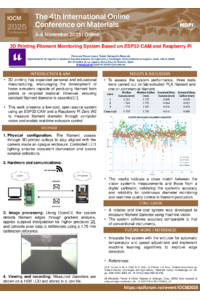
IOCM 2025 - Optimization of a Commercial Extruder for the Production of Polymeric Filament for 3D Printing Applications.pdf
Corrosion Effects on Buckling Resistance of Steel Columns: A 3D Numerical approach
Utilization of ceramic and brick waste in geopolymers: A preliminary study of physical and mechanical properties