Event submissions
Published
This submission belongs to the session S3. Soft Matter, Biomaterials, Composites and Interfaces of the event The 4th International Online Conference on Materials
Published date
29 Oct, 2025
Academic Editor
'%3e%3cpath%20d='M12.6657%2010.9104C12.4185%2010.325%2012.0599%209.79327%2011.6097%209.34482C11.1609%208.89508%2010.6293%208.5365%2010.0442%208.28888C10.0389%208.28626%2010.0337%208.28495%2010.0285%208.28233C10.8446%207.69279%2011.3752%206.73249%2011.3752%205.64904C11.3752%203.8542%209.92103%202.39999%208.1262%202.39999C6.33136%202.39999%204.87715%203.8542%204.87715%205.64904C4.87715%206.73249%205.40774%207.69279%206.22393%208.28364C6.21869%208.28626%206.21345%208.28757%206.20821%208.29019C5.62129%208.5378%205.09463%208.89284%204.64265%209.34613C4.1929%209.79493%203.83432%2010.3266%203.58671%2010.9117C3.34345%2011.4845%203.21226%2012.0987%203.20023%2012.7209C3.19988%2012.7349%203.20233%2012.7488%203.20744%2012.7619C3.21255%2012.7749%203.22022%2012.7867%203.22998%2012.7968C3.23975%2012.8068%203.25142%2012.8147%203.26431%2012.8202C3.2772%2012.8256%203.29105%2012.8284%203.30504%2012.8284H4.09109C4.14874%2012.8284%204.19459%2012.7825%204.1959%2012.7262C4.2221%2011.7148%204.62823%2010.7676%205.34617%2010.0497C6.08899%209.30683%207.0755%208.89808%208.1262%208.89808C9.17689%208.89808%2010.1634%209.30683%2010.9062%2010.0497C11.6242%2010.7676%2012.0303%2011.7148%2012.0565%2012.7262C12.0578%2012.7838%2012.1037%2012.8284%2012.1613%2012.8284H12.9474C12.9613%2012.8284%2012.9752%2012.8256%2012.9881%2012.8202C13.001%2012.8147%2013.0126%2012.8068%2013.0224%2012.7968C13.0322%2012.7867%2013.0398%2012.7749%2013.0449%2012.7619C13.0501%2012.7488%2013.0525%2012.7349%2013.0522%2012.7209C13.0391%2012.0947%2012.9094%2011.4855%2012.6657%2010.9104ZM8.1262%207.9024C7.52486%207.9024%206.9589%207.6679%206.53312%207.24211C6.10733%206.81633%205.87283%206.25037%205.87283%205.64904C5.87283%205.0477%206.10733%204.48174%206.53312%204.05596C6.9589%203.63018%207.52486%203.39567%208.1262%203.39567C8.72753%203.39567%209.29349%203.63018%209.71927%204.05596C10.1451%204.48174%2010.3796%205.0477%2010.3796%205.64904C10.3796%206.25037%2010.1451%206.81633%209.71927%207.24211C9.29349%207.6679%208.72753%207.9024%208.1262%207.9024Z'%20fill='%235D1EE1'/%3e%3c/g%3e%3c/svg%3e) Ingo Dierking
Ingo DierkingCitation
Anna Drzewicz, Michał Krupiński, Oleksandr Tomchuk, Ewa Pięta, Gabriela Lewińska, Ewa Juszyńska-Gałązka, Thin films of non-glassforming liquid crystal: relaxation and vibrational dynamics, in Proceedings of The 4th International Online Conference on Materials, 3 November–6 November 2025, MDPI: Basel, Switzerland
Share
Email
Facebook
Twitter
LinkedIn
Thin films of non-glassforming liquid crystal: relaxation and vibrational dynamics

Anna Drzewicz 1
'%3e%3cpath%20d='M12.6647%2010.9104C12.4176%2010.325%2012.0589%209.7933%2011.6088%209.34485C11.16%208.89511%2010.6283%208.53653%2010.0432%208.28891C10.038%208.28629%2010.0327%208.28498%2010.0275%208.28236C10.8437%207.69282%2011.3743%206.73252%2011.3743%205.64907C11.3743%203.85423%209.92005%202.40002%208.12522%202.40002C6.33038%202.40002%204.87618%203.85423%204.87618%205.64907C4.87618%206.73252%205.40677%207.69282%206.22296%208.28367C6.21772%208.28629%206.21248%208.2876%206.20724%208.29022C5.62031%208.53783%205.09365%208.89287%204.64167%209.34616C4.19192%209.79496%203.83334%2010.3266%203.58573%2010.9117C3.34247%2011.4846%203.21128%2012.0987%203.19925%2012.721C3.1989%2012.735%203.20135%2012.7489%203.20646%2012.7619C3.21157%2012.7749%203.21924%2012.7868%203.22901%2012.7968C3.23877%2012.8068%203.25045%2012.8148%203.26334%2012.8202C3.27623%2012.8256%203.29007%2012.8284%203.30406%2012.8284H4.09012C4.14776%2012.8284%204.19362%2012.7825%204.19493%2012.7262C4.22113%2011.7148%204.62726%2010.7676%205.34519%2010.0497C6.08802%209.30686%207.07452%208.89811%208.12522%208.89811C9.17592%208.89811%2010.1624%209.30686%2010.9052%2010.0497C11.6232%2010.7676%2012.0293%2011.7148%2012.0555%2012.7262C12.0568%2012.7839%2012.1027%2012.8284%2012.1603%2012.8284H12.9464C12.9604%2012.8284%2012.9742%2012.8256%2012.9871%2012.8202C13%2012.8148%2013.0117%2012.8068%2013.0214%2012.7968C13.0312%2012.7868%2013.0389%2012.7749%2013.044%2012.7619C13.0491%2012.7489%2013.0515%2012.735%2013.0512%2012.721C13.0381%2012.0947%2012.9084%2011.4856%2012.6647%2010.9104ZM8.12522%207.90243C7.52388%207.90243%206.95792%207.66793%206.53214%207.24215C6.10636%206.81636%205.87185%206.2504%205.87185%205.64907C5.87185%205.04773%206.10636%204.48177%206.53214%204.05599C6.95792%203.63021%207.52388%203.3957%208.12522%203.3957C8.72655%203.3957%209.29252%203.63021%209.7183%204.05599C10.1441%204.48177%2010.3786%205.04773%2010.3786%205.64907C10.3786%206.2504%2010.1441%206.81636%209.7183%207.24215C9.29252%207.66793%208.72655%207.90243%208.12522%207.90243Z'%20fill='%235D1EE1'/%3e%3c/g%3e%3c/svg%3e)
Michał Krupiński 1

Oleksandr Tomchuk 2
Ewa Pięta 1
Gabriela Lewińska 3
Ewa Juszyńska-Gałązka 1
1. Institute of Nuclear Physics Polish Academy of Sciences, PL-31342 Krakow, Poland
2. ISIS Neutron and Muon Source, Rutherford Appleton Laboratory, Didcot OX11 0QX, United Kingdom
3. Institute of Electronics, AGH University of Krakow, 30 Mickiewicza Ave, 30-059 Krakow, Poland
Abstract
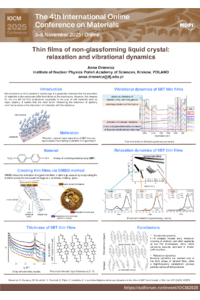
The progressive miniaturization of electronic and photonic devices has catalyzed growing scientific interest in the structural and functional behavior of ultrathin liquid crystal (LC) films. In this study, we present the first successful fabrication of ultrathin films of 4-hexyl-4’-isothiocyanatobiphenyl (6BT), a non-glassforming liquid crystal, using organic molecular beam deposition (OMBD) under room temperature conditions. This solvent-free, vacuum-based deposition technique enables precise control over film growth and molecular organization at the nanoscale.
Quantitative thickness measurements were performed using spectroscopic ellipsometry and X-ray reflectometry, allowing nanometer-resolution characterization of film morphology. Fourier-transform infrared (FTIR) spectroscopy revealed a distinct evolution of molecular ordering with increasing film thickness. At minimal thicknesses, we observe initial self-organization dominated by π–π stacking of aromatic biphenyl cores and van der Waals interactions among alkyl chains. As the film grows thicker, a significant degree of orientational ordering emerges among the isothiocyanate (-NCS) terminal groups, suggesting enhanced intermolecular cooperativity.
Complementary broadband dielectric spectroscopy (BDS) was employed to probe the dynamic response of the films, uncovering relaxation processes and vibrational dynamics that progressively shift toward bulk-like behavior with increasing thickness. These findings provide fundamental insight into structure–property relationships in confined liquid crystalline systems.
Our results offer a new platform for tailoring liquid crystal alignment, dynamics, and interfacial interactions in ultrathin geometries, opening promising avenues for the integration of anisotropic organic materials into next-generation nanoelectronic, photonic, and sensing technologies.
Keywords
liquid crystals
thin films
organic molecular beam deposition
infrared spectroscopy
dielectric spectroscopy
Poster
Drzewicz_IOCM_poster.pdf
Mechanical Performance of AISI 304 Austenitic Stainless Steel for Cryo-Compressed Hydrogen Storage in Support of the 2050 Energy Transition
Alkalizing properties of biomass ash