Event submissions
Published
This submission belongs to the session S6. Green Materials, Synthesis, Characterization and Recycling of the event The 4th International Online Conference on Materials
Published date
29 Oct, 2025
Academic Editor
'%3e%3cpath%20d='M12.6657%2010.9104C12.4185%2010.325%2012.0599%209.79327%2011.6097%209.34482C11.1609%208.89508%2010.6293%208.5365%2010.0442%208.28888C10.0389%208.28626%2010.0337%208.28495%2010.0285%208.28233C10.8446%207.69279%2011.3752%206.73249%2011.3752%205.64904C11.3752%203.8542%209.92103%202.39999%208.1262%202.39999C6.33136%202.39999%204.87715%203.8542%204.87715%205.64904C4.87715%206.73249%205.40774%207.69279%206.22393%208.28364C6.21869%208.28626%206.21345%208.28757%206.20821%208.29019C5.62129%208.5378%205.09463%208.89284%204.64265%209.34613C4.1929%209.79493%203.83432%2010.3266%203.58671%2010.9117C3.34345%2011.4845%203.21226%2012.0987%203.20023%2012.7209C3.19988%2012.7349%203.20233%2012.7488%203.20744%2012.7619C3.21255%2012.7749%203.22022%2012.7867%203.22998%2012.7968C3.23975%2012.8068%203.25142%2012.8147%203.26431%2012.8202C3.2772%2012.8256%203.29105%2012.8284%203.30504%2012.8284H4.09109C4.14874%2012.8284%204.19459%2012.7825%204.1959%2012.7262C4.2221%2011.7148%204.62823%2010.7676%205.34617%2010.0497C6.08899%209.30683%207.0755%208.89808%208.1262%208.89808C9.17689%208.89808%2010.1634%209.30683%2010.9062%2010.0497C11.6242%2010.7676%2012.0303%2011.7148%2012.0565%2012.7262C12.0578%2012.7838%2012.1037%2012.8284%2012.1613%2012.8284H12.9474C12.9613%2012.8284%2012.9752%2012.8256%2012.9881%2012.8202C13.001%2012.8147%2013.0126%2012.8068%2013.0224%2012.7968C13.0322%2012.7867%2013.0398%2012.7749%2013.0449%2012.7619C13.0501%2012.7488%2013.0525%2012.7349%2013.0522%2012.7209C13.0391%2012.0947%2012.9094%2011.4855%2012.6657%2010.9104ZM8.1262%207.9024C7.52486%207.9024%206.9589%207.6679%206.53312%207.24211C6.10733%206.81633%205.87283%206.25037%205.87283%205.64904C5.87283%205.0477%206.10733%204.48174%206.53312%204.05596C6.9589%203.63018%207.52486%203.39567%208.1262%203.39567C8.72753%203.39567%209.29349%203.63018%209.71927%204.05596C10.1451%204.48174%2010.3796%205.0477%2010.3796%205.64904C10.3796%206.25037%2010.1451%206.81633%209.71927%207.24211C9.29349%207.6679%208.72753%207.9024%208.1262%207.9024Z'%20fill='%235D1EE1'/%3e%3c/g%3e%3c/svg%3e) SARA GARCIA BALLESTEROS
SARA GARCIA BALLESTEROSCitation
Sajad Razzazan, Nuha S MASHAAN, Themelina Paraskeva, Utilization of Lithium Slag as a Supplementary Cementitious Material in Concrete, in Proceedings of The 4th International Online Conference on Materials, 3 November–6 November 2025, MDPI: Basel, Switzerland
Share
Email
Facebook
Twitter
LinkedIn
Utilization of Lithium Slag as a Supplementary Cementitious Material in Concrete
'%3e%3cpath%20d='M12.6647%2010.9104C12.4176%2010.325%2012.0589%209.7933%2011.6088%209.34485C11.16%208.89511%2010.6283%208.53653%2010.0432%208.28891C10.038%208.28629%2010.0327%208.28498%2010.0275%208.28236C10.8437%207.69282%2011.3743%206.73252%2011.3743%205.64907C11.3743%203.85423%209.92005%202.40002%208.12522%202.40002C6.33038%202.40002%204.87618%203.85423%204.87618%205.64907C4.87618%206.73252%205.40677%207.69282%206.22296%208.28367C6.21772%208.28629%206.21248%208.2876%206.20724%208.29022C5.62031%208.53783%205.09365%208.89287%204.64167%209.34616C4.19192%209.79496%203.83334%2010.3266%203.58573%2010.9117C3.34247%2011.4846%203.21128%2012.0987%203.19925%2012.721C3.1989%2012.735%203.20135%2012.7489%203.20646%2012.7619C3.21157%2012.7749%203.21924%2012.7868%203.22901%2012.7968C3.23877%2012.8068%203.25045%2012.8148%203.26334%2012.8202C3.27623%2012.8256%203.29007%2012.8284%203.30406%2012.8284H4.09012C4.14776%2012.8284%204.19362%2012.7825%204.19493%2012.7262C4.22113%2011.7148%204.62726%2010.7676%205.34519%2010.0497C6.08802%209.30686%207.07452%208.89811%208.12522%208.89811C9.17592%208.89811%2010.1624%209.30686%2010.9052%2010.0497C11.6232%2010.7676%2012.0293%2011.7148%2012.0555%2012.7262C12.0568%2012.7839%2012.1027%2012.8284%2012.1603%2012.8284H12.9464C12.9604%2012.8284%2012.9742%2012.8256%2012.9871%2012.8202C13%2012.8148%2013.0117%2012.8068%2013.0214%2012.7968C13.0312%2012.7868%2013.0389%2012.7749%2013.044%2012.7619C13.0491%2012.7489%2013.0515%2012.735%2013.0512%2012.721C13.0381%2012.0947%2012.9084%2011.4856%2012.6647%2010.9104ZM8.12522%207.90243C7.52388%207.90243%206.95792%207.66793%206.53214%207.24215C6.10636%206.81636%205.87185%206.2504%205.87185%205.64907C5.87185%205.04773%206.10636%204.48177%206.53214%204.05599C6.95792%203.63021%207.52388%203.3957%208.12522%203.3957C8.72655%203.3957%209.29252%203.63021%209.7183%204.05599C10.1441%204.48177%2010.3786%205.04773%2010.3786%205.64907C10.3786%206.2504%2010.1441%206.81636%209.7183%207.24215C9.29252%207.66793%208.72655%207.90243%208.12522%207.90243Z'%20fill='%235D1EE1'/%3e%3c/g%3e%3c/svg%3e)
Sajad Razzazan 1

Nuha S MASHAAN 1
Themelina Paraskeva 1
1. Mineral Recovery Research Centre (MRRC), School of Engineering, Edith Cowan University, Joondalup, WA 6027, Australia
Abstract
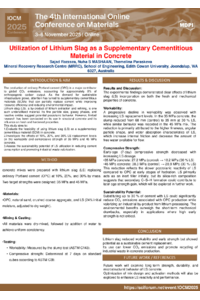
The pursuit of sustainable construction materials has become a central focus in modern civil engineering, largely due to the pressing need to mitigate the environmental impact of ordinary Portland cement (OPC) production. Cement manufacturing is responsible for a significant share of anthropogenic CO₂ emissions, and reducing this dependency is essential for meeting global carbon reduction targets. One promising approach involves the incorporation of supplementary cementitious materials (SCMs), which can partially replace cement while enhancing resource efficiency and promoting the recycling of industrial by-products.
Lithium slag (LS), a by-product generated during the extraction and processing of lithium, represents a relatively underexplored material with potential applicability in cement and concrete systems. Its chemical and mineralogical composition suggests pozzolanic activity, making it a candidate for integration into structural concrete mixtures.
This study investigated the performance of LS, adjusted to its dried weight (accounting for 24% initial moisture content), as a partial replacement for OPC at 10%, 20%, and 30% by mass in 35 MPa and 45 MPa concretes. The incorporation of LS led to a progressive reduction in workability: slump decreased from 68 mm (control) to 35 mm at 30% replacement in 35 MPa mixes. Early-age mechanical tests at 7 days revealed a decline in compressive strength with higher LS dosages. For 35 MPa concrete, strength reduced from 27.2 MPa (control) to 18.2 MPa at 30% LS, while 45 MPa mixes decreased from 38.3 MPa to 28.9 MPa under the same conditions.
By integrating these findings, the study highlights both the potential and limitations of lithium slag as a supplementary cementitious material. While LS incorporation reduces workability and early strength, it offers a viable pathway for valorizing industrial waste and reducing cement consumption, contributing to more sustainable construction practices.
Keywords
Lithium Slag
Supplementary Cementitious Material (SCM)
Sustainable Concrete
Environmental Sustainability
Concrete Performance
Cement Replacement
Circular Economy
Poster
conference poster.pdf
Research on Solid Waste-based Cementitious Materials and the Properties for Solidification of Dredged Sediment with High Moisture Content
Decarbonization and Circular Economy Transition: The Transformative Potential of Eco-Friendly Polymers