Event submissions
Published
This submission belongs to the session S6. Green Materials, Synthesis, Characterization and Recycling of the event The 4th International Online Conference on Materials
Published date
29 Oct, 2025
Academic Editor
'%3e%3cpath%20d='M12.6657%2010.9104C12.4185%2010.325%2012.0599%209.79327%2011.6097%209.34482C11.1609%208.89508%2010.6293%208.5365%2010.0442%208.28888C10.0389%208.28626%2010.0337%208.28495%2010.0285%208.28233C10.8446%207.69279%2011.3752%206.73249%2011.3752%205.64904C11.3752%203.8542%209.92103%202.39999%208.1262%202.39999C6.33136%202.39999%204.87715%203.8542%204.87715%205.64904C4.87715%206.73249%205.40774%207.69279%206.22393%208.28364C6.21869%208.28626%206.21345%208.28757%206.20821%208.29019C5.62129%208.5378%205.09463%208.89284%204.64265%209.34613C4.1929%209.79493%203.83432%2010.3266%203.58671%2010.9117C3.34345%2011.4845%203.21226%2012.0987%203.20023%2012.7209C3.19988%2012.7349%203.20233%2012.7488%203.20744%2012.7619C3.21255%2012.7749%203.22022%2012.7867%203.22998%2012.7968C3.23975%2012.8068%203.25142%2012.8147%203.26431%2012.8202C3.2772%2012.8256%203.29105%2012.8284%203.30504%2012.8284H4.09109C4.14874%2012.8284%204.19459%2012.7825%204.1959%2012.7262C4.2221%2011.7148%204.62823%2010.7676%205.34617%2010.0497C6.08899%209.30683%207.0755%208.89808%208.1262%208.89808C9.17689%208.89808%2010.1634%209.30683%2010.9062%2010.0497C11.6242%2010.7676%2012.0303%2011.7148%2012.0565%2012.7262C12.0578%2012.7838%2012.1037%2012.8284%2012.1613%2012.8284H12.9474C12.9613%2012.8284%2012.9752%2012.8256%2012.9881%2012.8202C13.001%2012.8147%2013.0126%2012.8068%2013.0224%2012.7968C13.0322%2012.7867%2013.0398%2012.7749%2013.0449%2012.7619C13.0501%2012.7488%2013.0525%2012.7349%2013.0522%2012.7209C13.0391%2012.0947%2012.9094%2011.4855%2012.6657%2010.9104ZM8.1262%207.9024C7.52486%207.9024%206.9589%207.6679%206.53312%207.24211C6.10733%206.81633%205.87283%206.25037%205.87283%205.64904C5.87283%205.0477%206.10733%204.48174%206.53312%204.05596C6.9589%203.63018%207.52486%203.39567%208.1262%203.39567C8.72753%203.39567%209.29349%203.63018%209.71927%204.05596C10.1451%204.48174%2010.3796%205.0477%2010.3796%205.64904C10.3796%206.25037%2010.1451%206.81633%209.71927%207.24211C9.29349%207.6679%208.72753%207.9024%208.1262%207.9024Z'%20fill='%235D1EE1'/%3e%3c/g%3e%3c/svg%3e) Konstantinos Salonitis
Konstantinos SalonitisCitation
BEATRIZ CAROLINA ALVEZ TOVAR, JOSÉ MARÇAL DA SILVA, GIOVANNY ANGIOLILLO RODRIGUEZ, LEONARDO RIBEIRO PINTO, PAULO SERGIO SCALIZE, Sustainable Coffee Based Adsorbents for Fluoride Removal, in Proceedings of The 4th International Online Conference on Materials, 3 November–6 November 2025, MDPI: Basel, Switzerland
Share
Email
Facebook
Twitter
LinkedIn
Sustainable Coffee Based Adsorbents for Fluoride Removal

BEATRIZ CAROLINA ALVEZ TOVAR 1

JOSÉ MARÇAL DA SILVA 2
'%3e%3cpath%20d='M12.6647%2010.9104C12.4176%2010.325%2012.0589%209.7933%2011.6088%209.34485C11.16%208.89511%2010.6283%208.53653%2010.0432%208.28891C10.038%208.28629%2010.0327%208.28498%2010.0275%208.28236C10.8437%207.69282%2011.3743%206.73252%2011.3743%205.64907C11.3743%203.85423%209.92005%202.40002%208.12522%202.40002C6.33038%202.40002%204.87618%203.85423%204.87618%205.64907C4.87618%206.73252%205.40677%207.69282%206.22296%208.28367C6.21772%208.28629%206.21248%208.2876%206.20724%208.29022C5.62031%208.53783%205.09365%208.89287%204.64167%209.34616C4.19192%209.79496%203.83334%2010.3266%203.58573%2010.9117C3.34247%2011.4846%203.21128%2012.0987%203.19925%2012.721C3.1989%2012.735%203.20135%2012.7489%203.20646%2012.7619C3.21157%2012.7749%203.21924%2012.7868%203.22901%2012.7968C3.23877%2012.8068%203.25045%2012.8148%203.26334%2012.8202C3.27623%2012.8256%203.29007%2012.8284%203.30406%2012.8284H4.09012C4.14776%2012.8284%204.19362%2012.7825%204.19493%2012.7262C4.22113%2011.7148%204.62726%2010.7676%205.34519%2010.0497C6.08802%209.30686%207.07452%208.89811%208.12522%208.89811C9.17592%208.89811%2010.1624%209.30686%2010.9052%2010.0497C11.6232%2010.7676%2012.0293%2011.7148%2012.0555%2012.7262C12.0568%2012.7839%2012.1027%2012.8284%2012.1603%2012.8284H12.9464C12.9604%2012.8284%2012.9742%2012.8256%2012.9871%2012.8202C13%2012.8148%2013.0117%2012.8068%2013.0214%2012.7968C13.0312%2012.7868%2013.0389%2012.7749%2013.044%2012.7619C13.0491%2012.7489%2013.0515%2012.735%2013.0512%2012.721C13.0381%2012.0947%2012.9084%2011.4856%2012.6647%2010.9104ZM8.12522%207.90243C7.52388%207.90243%206.95792%207.66793%206.53214%207.24215C6.10636%206.81636%205.87185%206.2504%205.87185%205.64907C5.87185%205.04773%206.10636%204.48177%206.53214%204.05599C6.95792%203.63021%207.52388%203.3957%208.12522%203.3957C8.72655%203.3957%209.29252%203.63021%209.7183%204.05599C10.1441%204.48177%2010.3786%205.04773%2010.3786%205.64907C10.3786%206.2504%2010.1441%206.81636%209.7183%207.24215C9.29252%207.66793%208.72655%207.90243%208.12522%207.90243Z'%20fill='%235D1EE1'/%3e%3c/g%3e%3c/svg%3e)
GIOVANNY ANGIOLILLO RODRIGUEZ 1
LEONARDO RIBEIRO PINTO 3

PAULO SERGIO SCALIZE 2
1. Universidad Central de Venezuela – Campus Ciudad Universitária, Instituto de Biologia Experimental, Caracas – Distrito Capital, Venezuela.
2. Universidade Federal de Goiás – Campus Samambaia, Programa de Pós-graduação em Ciências Ambientais, Laboratório de Análise de Água, Goiânia - Goiás, Brazil.
3. Instituto Federal de Goiás - Câmpus Goiânia, Goiás, Brasil.
Abstract
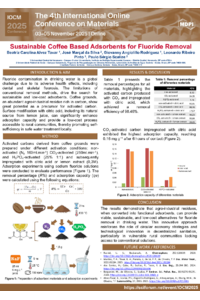
Fluoride contamination in drinking water is a global challenge due to its adverse health effects, including dental and skeletal fluorosis. The limitations of conventional removal methods, such as chemical precipitation and ion exchange, drive the search for sustainable and low-cost adsorbents. Coffee grounds, an abundant agro-industrial residue rich in carbon, show great potential as a precursor for activated carbon. Surface modification with citric acid, including its natural source from lemon juice, can significantly enhance adsorption capacity and provide a low-cost process accessible to rural communities, thereby promoting self-sufficiency in safe water treatment locally.
In this study, activated carbons derived from coffee grounds were prepared under different activation conditions (non-activated, CO₂-activated, and H₃PO₄-activated) and subsequently impregnated with citric acid or lemon extract. Adsorption experiments using sodium fluoride solutions were conducted to evaluate performance. CO₂-activated carbon impregnated with citric acid exhibited the highest adsorption capacity, reaching 0.16 mg g⁻¹ after 6 hours of contact.
The results demonstrate that agro-industrial residues, when converted into functional adsorbents, can provide viable, sustainable, and low-cost alternatives for fluoride removal in drinking water. This innovative approach reinforces the role of circular economy strategies and technological innovation in decentralized sanitation, particularly in vulnerable rural communities lacking access to conventional solutions.
Keywords
Coffee grounds
Activated carbon
Fluoride
Citric acid
Sustainable sanitation
Poster
IOCM 2025 - Beatriz Alvez Poster.pdf
Enhanced Dye Filtration Using PVDF/Green-Synthesized MgO Nanocomposite Membranes: RSM, SOLVER, and ANN Optimization
FABRICATION, MECHANICAL AND ELECTRICAL CHARACTERIZATION OF PINEAPPLE LEAF FIBRE THERMOPLASTIC COMPOSITE.