Event submissions
Published
This submission belongs to the session S7. Materials Manufacturing, Processing and Applications of the event The 4th International Online Conference on Materials
Published date
29 Oct, 2025
Academic Editor
'%3e%3cpath%20d='M12.6657%2010.9104C12.4185%2010.325%2012.0599%209.79327%2011.6097%209.34482C11.1609%208.89508%2010.6293%208.5365%2010.0442%208.28888C10.0389%208.28626%2010.0337%208.28495%2010.0285%208.28233C10.8446%207.69279%2011.3752%206.73249%2011.3752%205.64904C11.3752%203.8542%209.92103%202.39999%208.1262%202.39999C6.33136%202.39999%204.87715%203.8542%204.87715%205.64904C4.87715%206.73249%205.40774%207.69279%206.22393%208.28364C6.21869%208.28626%206.21345%208.28757%206.20821%208.29019C5.62129%208.5378%205.09463%208.89284%204.64265%209.34613C4.1929%209.79493%203.83432%2010.3266%203.58671%2010.9117C3.34345%2011.4845%203.21226%2012.0987%203.20023%2012.7209C3.19988%2012.7349%203.20233%2012.7488%203.20744%2012.7619C3.21255%2012.7749%203.22022%2012.7867%203.22998%2012.7968C3.23975%2012.8068%203.25142%2012.8147%203.26431%2012.8202C3.2772%2012.8256%203.29105%2012.8284%203.30504%2012.8284H4.09109C4.14874%2012.8284%204.19459%2012.7825%204.1959%2012.7262C4.2221%2011.7148%204.62823%2010.7676%205.34617%2010.0497C6.08899%209.30683%207.0755%208.89808%208.1262%208.89808C9.17689%208.89808%2010.1634%209.30683%2010.9062%2010.0497C11.6242%2010.7676%2012.0303%2011.7148%2012.0565%2012.7262C12.0578%2012.7838%2012.1037%2012.8284%2012.1613%2012.8284H12.9474C12.9613%2012.8284%2012.9752%2012.8256%2012.9881%2012.8202C13.001%2012.8147%2013.0126%2012.8068%2013.0224%2012.7968C13.0322%2012.7867%2013.0398%2012.7749%2013.0449%2012.7619C13.0501%2012.7488%2013.0525%2012.7349%2013.0522%2012.7209C13.0391%2012.0947%2012.9094%2011.4855%2012.6657%2010.9104ZM8.1262%207.9024C7.52486%207.9024%206.9589%207.6679%206.53312%207.24211C6.10733%206.81633%205.87283%206.25037%205.87283%205.64904C5.87283%205.0477%206.10733%204.48174%206.53312%204.05596C6.9589%203.63018%207.52486%203.39567%208.1262%203.39567C8.72753%203.39567%209.29349%203.63018%209.71927%204.05596C10.1451%204.48174%2010.3796%205.0477%2010.3796%205.64904C10.3796%206.25037%2010.1451%206.81633%209.71927%207.24211C9.29349%207.6679%208.72753%207.9024%208.1262%207.9024Z'%20fill='%235D1EE1'/%3e%3c/g%3e%3c/svg%3e) Abdollah Saboori
Abdollah SabooriCitation
Joana Lopes, Gabriel Moreira, Artur J. Martins, Pedro Miguel Silva, Rui M. R. Pinto, Michele Michelin, Patrícia C. Sousa, Lorenzo M. Pastrana, Miguel A. Cerqueira, Printability Mapping of HPMC Bioinks for Electrohydrodynamic Jet Printing, in Proceedings of The 4th International Online Conference on Materials, 3 November–6 November 2025, MDPI: Basel, Switzerland
Share
Email
Facebook
Twitter
LinkedIn
Printability Mapping of HPMC Bioinks for Electrohydrodynamic Jet Printing
'%3e%3cpath%20d='M12.6647%2010.9104C12.4176%2010.325%2012.0589%209.7933%2011.6088%209.34485C11.16%208.89511%2010.6283%208.53653%2010.0432%208.28891C10.038%208.28629%2010.0327%208.28498%2010.0275%208.28236C10.8437%207.69282%2011.3743%206.73252%2011.3743%205.64907C11.3743%203.85423%209.92005%202.40002%208.12522%202.40002C6.33038%202.40002%204.87618%203.85423%204.87618%205.64907C4.87618%206.73252%205.40677%207.69282%206.22296%208.28367C6.21772%208.28629%206.21248%208.2876%206.20724%208.29022C5.62031%208.53783%205.09365%208.89287%204.64167%209.34616C4.19192%209.79496%203.83334%2010.3266%203.58573%2010.9117C3.34247%2011.4846%203.21128%2012.0987%203.19925%2012.721C3.1989%2012.735%203.20135%2012.7489%203.20646%2012.7619C3.21157%2012.7749%203.21924%2012.7868%203.22901%2012.7968C3.23877%2012.8068%203.25045%2012.8148%203.26334%2012.8202C3.27623%2012.8256%203.29007%2012.8284%203.30406%2012.8284H4.09012C4.14776%2012.8284%204.19362%2012.7825%204.19493%2012.7262C4.22113%2011.7148%204.62726%2010.7676%205.34519%2010.0497C6.08802%209.30686%207.07452%208.89811%208.12522%208.89811C9.17592%208.89811%2010.1624%209.30686%2010.9052%2010.0497C11.6232%2010.7676%2012.0293%2011.7148%2012.0555%2012.7262C12.0568%2012.7839%2012.1027%2012.8284%2012.1603%2012.8284H12.9464C12.9604%2012.8284%2012.9742%2012.8256%2012.9871%2012.8202C13%2012.8148%2013.0117%2012.8068%2013.0214%2012.7968C13.0312%2012.7868%2013.0389%2012.7749%2013.044%2012.7619C13.0491%2012.7489%2013.0515%2012.735%2013.0512%2012.721C13.0381%2012.0947%2012.9084%2011.4856%2012.6647%2010.9104ZM8.12522%207.90243C7.52388%207.90243%206.95792%207.66793%206.53214%207.24215C6.10636%206.81636%205.87185%206.2504%205.87185%205.64907C5.87185%205.04773%206.10636%204.48177%206.53214%204.05599C6.95792%203.63021%207.52388%203.3957%208.12522%203.3957C8.72655%203.3957%209.29252%203.63021%209.7183%204.05599C10.1441%204.48177%2010.3786%205.04773%2010.3786%205.64907C10.3786%206.2504%2010.1441%206.81636%209.7183%207.24215C9.29252%207.66793%208.72655%207.90243%208.12522%207.90243Z'%20fill='%235D1EE1'/%3e%3c/g%3e%3c/svg%3e)
Joana Lopes 1,2
Gabriel Moreira 1

Artur J. Martins 1
Pedro Miguel Silva 3

Rui M. R. Pinto 3
Michele Michelin 2,4

Patrícia C. Sousa 1

Lorenzo M. Pastrana 3

Miguel A. Cerqueira 3
1. INL- International Iberian Nanotechnology Laboratory, Avenida Mestre José Veiga s/n, 4715-330 Braga, Portugal
2. Centro de Engenharia Biológica, Universidade do Minho, Campus de Gualtar, 4710-057 Braga Portugal
3. INL- International Iberian Nanotechnology Laboratory , Avenida Mestre José Veiga s/n, 4715-330 Braga, Portugal
4. LABBELS- Associate Laboratory, Braga, Guimarães, Portugal
Abstract
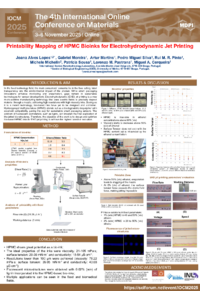
Electrohydrodynamic (EHD) jet printing is a new micro-additive manufacturing technology that uses electric fields to precisely deposit material through a nozzle, achieving high resolutions with high-viscosity inks. Seeing as it is a recent technology, bio-based inks have yet to be designed and optimized. Hydroxypropyl methylcellulose (HPMC) stands out as a biodegradable biopolymer with excellent compatibility, paving the way for sustainable smart packaging sensors.
In this work, solutions with different concentrations of HPMC (1%, 2% and 3%) in ethanol (from 0% to 90%) were evaluated and characterized in terms of viscosity, surface tension and conductivity, and used in printability tests using a home-made EHD jet printer. Certain parameters of the EHD jet printer were fixed, such as the flow rate (28.28 μl h-1, corresponding to a shear rate of 10 s-1 in the nozzle type), working distance (1 mm), substrate (glass with a 100 nm layer of tungsten and titanium) and the nozzle diameter and material (200 μm, stainless steel). The speed was varied between 1 mm s-1 and 15 mm s -1 and the voltage was manipulated between 1.5 kV and 2.5 kV until Taylor’s Cone formation.
Then, a printability ternary graph (water–ethanol–HPMC) was obtained, selecting HPMC- based bioinks that achieved higher resolutions (dots and lines as small as 50 μm, determined by microscopy), with less clogging and reproducible results. The printable zone was obtained from concentrations between 1 and 2% HPMC in 10%-50% ethanol. In this range, the bioinks present viscosities of 13 mPa s to 100 mPa s, a surface tension of 29 mNm to 42 mNm and conductivities of 16 μS cm-1 to 69 μS cm-1.
Overall, the results show the potential of using HPMC to develop bioinks compatible with EHD jet printing, foreseeing their use on food and biomedical applications.
Keywords
Bio-inks
HPMC
EHD jet printing
Additive Manufacturing
Poster
Poster_JoanaLopes.pdf
Sorption of HAsO42- anions on modified layered double hydroxides
Reinforcing L-PBF 316L Stainless Steel with BN: A Strategy for Enhanced Performance