Event submissions
Published
This submission belongs to the session S7. Materials Manufacturing, Processing and Applications of the event The 4th International Online Conference on Materials
Published date
29 Oct, 2025
Academic Editor
'%3e%3cpath%20d='M12.6657%2010.9104C12.4185%2010.325%2012.0599%209.79327%2011.6097%209.34482C11.1609%208.89508%2010.6293%208.5365%2010.0442%208.28888C10.0389%208.28626%2010.0337%208.28495%2010.0285%208.28233C10.8446%207.69279%2011.3752%206.73249%2011.3752%205.64904C11.3752%203.8542%209.92103%202.39999%208.1262%202.39999C6.33136%202.39999%204.87715%203.8542%204.87715%205.64904C4.87715%206.73249%205.40774%207.69279%206.22393%208.28364C6.21869%208.28626%206.21345%208.28757%206.20821%208.29019C5.62129%208.5378%205.09463%208.89284%204.64265%209.34613C4.1929%209.79493%203.83432%2010.3266%203.58671%2010.9117C3.34345%2011.4845%203.21226%2012.0987%203.20023%2012.7209C3.19988%2012.7349%203.20233%2012.7488%203.20744%2012.7619C3.21255%2012.7749%203.22022%2012.7867%203.22998%2012.7968C3.23975%2012.8068%203.25142%2012.8147%203.26431%2012.8202C3.2772%2012.8256%203.29105%2012.8284%203.30504%2012.8284H4.09109C4.14874%2012.8284%204.19459%2012.7825%204.1959%2012.7262C4.2221%2011.7148%204.62823%2010.7676%205.34617%2010.0497C6.08899%209.30683%207.0755%208.89808%208.1262%208.89808C9.17689%208.89808%2010.1634%209.30683%2010.9062%2010.0497C11.6242%2010.7676%2012.0303%2011.7148%2012.0565%2012.7262C12.0578%2012.7838%2012.1037%2012.8284%2012.1613%2012.8284H12.9474C12.9613%2012.8284%2012.9752%2012.8256%2012.9881%2012.8202C13.001%2012.8147%2013.0126%2012.8068%2013.0224%2012.7968C13.0322%2012.7867%2013.0398%2012.7749%2013.0449%2012.7619C13.0501%2012.7488%2013.0525%2012.7349%2013.0522%2012.7209C13.0391%2012.0947%2012.9094%2011.4855%2012.6657%2010.9104ZM8.1262%207.9024C7.52486%207.9024%206.9589%207.6679%206.53312%207.24211C6.10733%206.81633%205.87283%206.25037%205.87283%205.64904C5.87283%205.0477%206.10733%204.48174%206.53312%204.05596C6.9589%203.63018%207.52486%203.39567%208.1262%203.39567C8.72753%203.39567%209.29349%203.63018%209.71927%204.05596C10.1451%204.48174%2010.3796%205.0477%2010.3796%205.64904C10.3796%206.25037%2010.1451%206.81633%209.71927%207.24211C9.29349%207.6679%208.72753%207.9024%208.1262%207.9024Z'%20fill='%235D1EE1'/%3e%3c/g%3e%3c/svg%3e) Mohammad Malekan
Mohammad MalekanCitation
abolfazl heidari, Fluorescent PLA filaments: 3D printing with fluorescent inks, in Proceedings of The 4th International Online Conference on Materials, 3 November–6 November 2025, MDPI: Basel, Switzerland
Share
Email
Facebook
Twitter
LinkedIn
Fluorescent PLA filaments: 3D printing with fluorescent inks

abolfazl heidari 1
1. Department of Chemistry, Faculty of Science, University of Zanjan, P.O. Box 45195-313, Zanjan, Iran
Abstract
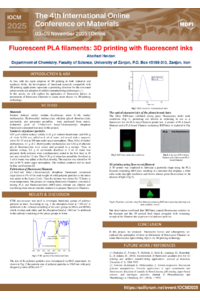
This work presents the synthesis of functional fluorescent latexes and their subsequent application in producing advanced fluorescent filaments for the additive manufacturing of smart and visually responsive objects. The fluorescent latex particles were obtained through a controlled emulsion polymerization involving methyl methacrylate (MMA), 2-hydroxyethyl methacrylate (HEMA), ethylene glycol dimethacrylate (EGDMA), and acrylamide (AAm), with sodium dodecyl sulfate, sodium bicarbonate, and triton X-100 as stabilizers, and potassium persulfate as the free-radical initiator under an inert argon atmosphere. Functionalization of the latex was achieved by incorporating 2,5-bis(5-tert-butyl-2-benzoxazolyl) thiophene (BBT) at 5 wt% of the polymer solids, providing strong optical emission psropertie. FTIR spectroscopy confirmed the presence of characteristic ester and amide functionalities, while dynamic light scattering (DLS) analysis revealed a mean particle diameter of 156.9 nm with a polydispersity index (PDI) of 0.27, indicating a narrow size distribution. The BBT-latex displayed intense green fluorescence in dark environments and was directly blended with polylactic acid (PLA) without dilution to produce composite fluorescent filaments via extrusion. These filaments not only exhibited enhanced fluorescence but also demonstrated improved mechanical strength compared to pure PLA. The 3D printing tests yielded objects that appeared white under daylight yet emitted vivid green luminescence under dark conditions. This study demonstrates the potential of BBT-latex/PLA composites as multifunctional materials for fabricating 3D-printed structures that combine aesthetic, optical, and structural functionalities, opening new opportunities for smart product design.
Keywords
3D Printing Inks
fluorescent latex
Polymeric Inks
Poster
Fluorescent PLA filaments 3D printing with fluorescent inks.pdf
Manufacturing multilayers for clear aligners with tunable thermomechanical properties
Integration of 3D Scanning in the Abrasive Surface Processing of Cast Components