Event submissions
Published
This submission belongs to the session S7. Materials Manufacturing, Processing and Applications of the event The 4th International Online Conference on Materials
Published date
29 Oct, 2025
Academic Editor
'%3e%3cpath%20d='M12.6657%2010.9104C12.4185%2010.325%2012.0599%209.79327%2011.6097%209.34482C11.1609%208.89508%2010.6293%208.5365%2010.0442%208.28888C10.0389%208.28626%2010.0337%208.28495%2010.0285%208.28233C10.8446%207.69279%2011.3752%206.73249%2011.3752%205.64904C11.3752%203.8542%209.92103%202.39999%208.1262%202.39999C6.33136%202.39999%204.87715%203.8542%204.87715%205.64904C4.87715%206.73249%205.40774%207.69279%206.22393%208.28364C6.21869%208.28626%206.21345%208.28757%206.20821%208.29019C5.62129%208.5378%205.09463%208.89284%204.64265%209.34613C4.1929%209.79493%203.83432%2010.3266%203.58671%2010.9117C3.34345%2011.4845%203.21226%2012.0987%203.20023%2012.7209C3.19988%2012.7349%203.20233%2012.7488%203.20744%2012.7619C3.21255%2012.7749%203.22022%2012.7867%203.22998%2012.7968C3.23975%2012.8068%203.25142%2012.8147%203.26431%2012.8202C3.2772%2012.8256%203.29105%2012.8284%203.30504%2012.8284H4.09109C4.14874%2012.8284%204.19459%2012.7825%204.1959%2012.7262C4.2221%2011.7148%204.62823%2010.7676%205.34617%2010.0497C6.08899%209.30683%207.0755%208.89808%208.1262%208.89808C9.17689%208.89808%2010.1634%209.30683%2010.9062%2010.0497C11.6242%2010.7676%2012.0303%2011.7148%2012.0565%2012.7262C12.0578%2012.7838%2012.1037%2012.8284%2012.1613%2012.8284H12.9474C12.9613%2012.8284%2012.9752%2012.8256%2012.9881%2012.8202C13.001%2012.8147%2013.0126%2012.8068%2013.0224%2012.7968C13.0322%2012.7867%2013.0398%2012.7749%2013.0449%2012.7619C13.0501%2012.7488%2013.0525%2012.7349%2013.0522%2012.7209C13.0391%2012.0947%2012.9094%2011.4855%2012.6657%2010.9104ZM8.1262%207.9024C7.52486%207.9024%206.9589%207.6679%206.53312%207.24211C6.10733%206.81633%205.87283%206.25037%205.87283%205.64904C5.87283%205.0477%206.10733%204.48174%206.53312%204.05596C6.9589%203.63018%207.52486%203.39567%208.1262%203.39567C8.72753%203.39567%209.29349%203.63018%209.71927%204.05596C10.1451%204.48174%2010.3796%205.0477%2010.3796%205.64904C10.3796%206.25037%2010.1451%206.81633%209.71927%207.24211C9.29349%207.6679%208.72753%207.9024%208.1262%207.9024Z'%20fill='%235D1EE1'/%3e%3c/g%3e%3c/svg%3e) Abdollah Saboori
Abdollah SabooriCitation
Claudia Retamoso-Llamas, Darío Ramírez-Amaya, Juan Sebastián Ballesteros-Retamoso, Gabriela Fuentes-Rueda, Ana María Galvan-Olave, Juan David Leal-Vargas, Replacing Calcination with Electrochemical Decarbonation: A Life Cycle Perspective for Cement Production, in Proceedings of The 4th International Online Conference on Materials, 3 November–6 November 2025, MDPI: Basel, Switzerland
Share
Email
Facebook
Twitter
LinkedIn
Replacing Calcination with Electrochemical Decarbonation: A Life Cycle Perspective for Cement Production
'%3e%3cpath%20d='M12.6647%2010.9104C12.4176%2010.325%2012.0589%209.7933%2011.6088%209.34485C11.16%208.89511%2010.6283%208.53653%2010.0432%208.28891C10.038%208.28629%2010.0327%208.28498%2010.0275%208.28236C10.8437%207.69282%2011.3743%206.73252%2011.3743%205.64907C11.3743%203.85423%209.92005%202.40002%208.12522%202.40002C6.33038%202.40002%204.87618%203.85423%204.87618%205.64907C4.87618%206.73252%205.40677%207.69282%206.22296%208.28367C6.21772%208.28629%206.21248%208.2876%206.20724%208.29022C5.62031%208.53783%205.09365%208.89287%204.64167%209.34616C4.19192%209.79496%203.83334%2010.3266%203.58573%2010.9117C3.34247%2011.4846%203.21128%2012.0987%203.19925%2012.721C3.1989%2012.735%203.20135%2012.7489%203.20646%2012.7619C3.21157%2012.7749%203.21924%2012.7868%203.22901%2012.7968C3.23877%2012.8068%203.25045%2012.8148%203.26334%2012.8202C3.27623%2012.8256%203.29007%2012.8284%203.30406%2012.8284H4.09012C4.14776%2012.8284%204.19362%2012.7825%204.19493%2012.7262C4.22113%2011.7148%204.62726%2010.7676%205.34519%2010.0497C6.08802%209.30686%207.07452%208.89811%208.12522%208.89811C9.17592%208.89811%2010.1624%209.30686%2010.9052%2010.0497C11.6232%2010.7676%2012.0293%2011.7148%2012.0555%2012.7262C12.0568%2012.7839%2012.1027%2012.8284%2012.1603%2012.8284H12.9464C12.9604%2012.8284%2012.9742%2012.8256%2012.9871%2012.8202C13%2012.8148%2013.0117%2012.8068%2013.0214%2012.7968C13.0312%2012.7868%2013.0389%2012.7749%2013.044%2012.7619C13.0491%2012.7489%2013.0515%2012.735%2013.0512%2012.721C13.0381%2012.0947%2012.9084%2011.4856%2012.6647%2010.9104ZM8.12522%207.90243C7.52388%207.90243%206.95792%207.66793%206.53214%207.24215C6.10636%206.81636%205.87185%206.2504%205.87185%205.64907C5.87185%205.04773%206.10636%204.48177%206.53214%204.05599C6.95792%203.63021%207.52388%203.3957%208.12522%203.3957C8.72655%203.3957%209.29252%203.63021%209.7183%204.05599C10.1441%204.48177%2010.3786%205.04773%2010.3786%205.64907C10.3786%206.2504%2010.1441%206.81636%209.7183%207.24215C9.29252%207.66793%208.72655%207.90243%208.12522%207.90243Z'%20fill='%235D1EE1'/%3e%3c/g%3e%3c/svg%3e)
Claudia Retamoso-Llamas 1
Darío Ramírez-Amaya 2,3
Juan Sebastián Ballesteros-Retamoso 4
Gabriela Fuentes-Rueda 1
Ana María Galvan-Olave 1
Juan David Leal-Vargas 1
1. Civil Engineering Faculty, Universidad Pontificia Bolivariana Bucaramanga, Floridablanca, Santander, ZIP Code 681004, Colombia
2. Department of Civil Engineering, Universidad EAFIT, Medellín, Antioquia, ZIP Code 050022, Colombia,
3. Department of Civil and Construction Management Engineering, Pontificia Universidad Católica de Chile, San Joaquín Campus, Santiago, Metropolitan Region, ZIP Code 7820436, Chile
4. Electronical Engineering Faculty, Universidad Pontificia Bolivariana Bucaramanga, Floridablanca ZIP Code 681004, Colombia
Abstract
Cement manufacturing traditionally relies on the decarbonation of raw materials, mainly calcium carbonate (CaCO₃), obtained from limestone and other calcareous rocks. In conventional processes, this reaction occurs through calcination in high-temperature kilns, releasing large amounts of CO₂, representing nearly 8% of global emissions from the construction sector. In line with the United Nations Sustainable Development Goals, which target net-zero greenhouse gas emissions by 2050, the cement industry is exploring alternative, cleaner production methods for clinker. This study evaluates the potential of replacing the thermal decomposition of materials that provide CaCO3 with an electrochemical decarbonation process carried out in an H-type electrochemical cell equipped with an ion-exchange membrane. Direct current from a regulated power supply drives the reaction, producing Ca(OH)₂ as a solid precipitate, while generating pure streams of H₂, O₂, and CO₂. The gases can be collected using sealed gas sampling systems for subsequent utilization in clean energy applications or industrial processes. This substitution not only reduces the carbon footprint of the cement industry by enabling CO₂ capture at the point of generation but also yields a reactive Ca(OH)₂ suitable for clinker production. The process is currently at the laboratory scale, with ongoing analysis focusing on reaction efficiency, gas yield, and the economic feasibility of producing one ton of cement using this method, thereby delivering valuable insights into its potential large-scale implementation.
Keywords
Electrochemical decarbonation
Life Cycle Assessment
Cement production
Poster
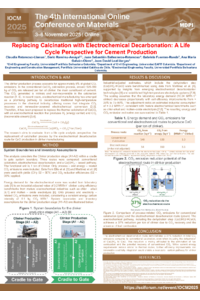
IOCM 2025 - poster template claudia.pdf
Mechanical Property Enhancement of Tool Steel for Solid Expandable Tubular Mandrels
Kinetics of δ-Ferrite to Austenite Transition in Grade 92 Steels Using Dilatometry