Event submissions
Published
This submission belongs to the session S7. Materials Manufacturing, Processing and Applications of the event The 4th International Online Conference on Materials
Published date
29 Oct, 2025
Academic Editor
'%3e%3cpath%20d='M12.6657%2010.9104C12.4185%2010.325%2012.0599%209.79327%2011.6097%209.34482C11.1609%208.89508%2010.6293%208.5365%2010.0442%208.28888C10.0389%208.28626%2010.0337%208.28495%2010.0285%208.28233C10.8446%207.69279%2011.3752%206.73249%2011.3752%205.64904C11.3752%203.8542%209.92103%202.39999%208.1262%202.39999C6.33136%202.39999%204.87715%203.8542%204.87715%205.64904C4.87715%206.73249%205.40774%207.69279%206.22393%208.28364C6.21869%208.28626%206.21345%208.28757%206.20821%208.29019C5.62129%208.5378%205.09463%208.89284%204.64265%209.34613C4.1929%209.79493%203.83432%2010.3266%203.58671%2010.9117C3.34345%2011.4845%203.21226%2012.0987%203.20023%2012.7209C3.19988%2012.7349%203.20233%2012.7488%203.20744%2012.7619C3.21255%2012.7749%203.22022%2012.7867%203.22998%2012.7968C3.23975%2012.8068%203.25142%2012.8147%203.26431%2012.8202C3.2772%2012.8256%203.29105%2012.8284%203.30504%2012.8284H4.09109C4.14874%2012.8284%204.19459%2012.7825%204.1959%2012.7262C4.2221%2011.7148%204.62823%2010.7676%205.34617%2010.0497C6.08899%209.30683%207.0755%208.89808%208.1262%208.89808C9.17689%208.89808%2010.1634%209.30683%2010.9062%2010.0497C11.6242%2010.7676%2012.0303%2011.7148%2012.0565%2012.7262C12.0578%2012.7838%2012.1037%2012.8284%2012.1613%2012.8284H12.9474C12.9613%2012.8284%2012.9752%2012.8256%2012.9881%2012.8202C13.001%2012.8147%2013.0126%2012.8068%2013.0224%2012.7968C13.0322%2012.7867%2013.0398%2012.7749%2013.0449%2012.7619C13.0501%2012.7488%2013.0525%2012.7349%2013.0522%2012.7209C13.0391%2012.0947%2012.9094%2011.4855%2012.6657%2010.9104ZM8.1262%207.9024C7.52486%207.9024%206.9589%207.6679%206.53312%207.24211C6.10733%206.81633%205.87283%206.25037%205.87283%205.64904C5.87283%205.0477%206.10733%204.48174%206.53312%204.05596C6.9589%203.63018%207.52486%203.39567%208.1262%203.39567C8.72753%203.39567%209.29349%203.63018%209.71927%204.05596C10.1451%204.48174%2010.3796%205.0477%2010.3796%205.64904C10.3796%206.25037%2010.1451%206.81633%209.71927%207.24211C9.29349%207.6679%208.72753%207.9024%208.1262%207.9024Z'%20fill='%235D1EE1'/%3e%3c/g%3e%3c/svg%3e) Abdollah Saboori
Abdollah SabooriCitation
Guilherme Andreoli Gil, Maria Filomena Filipe Barreiro, Caroline Casagrande Sipoli, Isabel Patrícia Martins Fernandes, Fabricio Maestá Bezerra, Sustainable Microencapsulation of Limonene via Complex Coacervation with Natural Biopolymers, in Proceedings of The 4th International Online Conference on Materials, 3 November–6 November 2025, MDPI: Basel, Switzerland
Share
Email
Facebook
Twitter
LinkedIn
Sustainable Microencapsulation of Limonene via Complex Coacervation with Natural Biopolymers
'%3e%3cpath%20d='M12.6647%2010.9104C12.4176%2010.325%2012.0589%209.7933%2011.6088%209.34485C11.16%208.89511%2010.6283%208.53653%2010.0432%208.28891C10.038%208.28629%2010.0327%208.28498%2010.0275%208.28236C10.8437%207.69282%2011.3743%206.73252%2011.3743%205.64907C11.3743%203.85423%209.92005%202.40002%208.12522%202.40002C6.33038%202.40002%204.87618%203.85423%204.87618%205.64907C4.87618%206.73252%205.40677%207.69282%206.22296%208.28367C6.21772%208.28629%206.21248%208.2876%206.20724%208.29022C5.62031%208.53783%205.09365%208.89287%204.64167%209.34616C4.19192%209.79496%203.83334%2010.3266%203.58573%2010.9117C3.34247%2011.4846%203.21128%2012.0987%203.19925%2012.721C3.1989%2012.735%203.20135%2012.7489%203.20646%2012.7619C3.21157%2012.7749%203.21924%2012.7868%203.22901%2012.7968C3.23877%2012.8068%203.25045%2012.8148%203.26334%2012.8202C3.27623%2012.8256%203.29007%2012.8284%203.30406%2012.8284H4.09012C4.14776%2012.8284%204.19362%2012.7825%204.19493%2012.7262C4.22113%2011.7148%204.62726%2010.7676%205.34519%2010.0497C6.08802%209.30686%207.07452%208.89811%208.12522%208.89811C9.17592%208.89811%2010.1624%209.30686%2010.9052%2010.0497C11.6232%2010.7676%2012.0293%2011.7148%2012.0555%2012.7262C12.0568%2012.7839%2012.1027%2012.8284%2012.1603%2012.8284H12.9464C12.9604%2012.8284%2012.9742%2012.8256%2012.9871%2012.8202C13%2012.8148%2013.0117%2012.8068%2013.0214%2012.7968C13.0312%2012.7868%2013.0389%2012.7749%2013.044%2012.7619C13.0491%2012.7489%2013.0515%2012.735%2013.0512%2012.721C13.0381%2012.0947%2012.9084%2011.4856%2012.6647%2010.9104ZM8.12522%207.90243C7.52388%207.90243%206.95792%207.66793%206.53214%207.24215C6.10636%206.81636%205.87185%206.2504%205.87185%205.64907C5.87185%205.04773%206.10636%204.48177%206.53214%204.05599C6.95792%203.63021%207.52388%203.3957%208.12522%203.3957C8.72655%203.3957%209.29252%203.63021%209.7183%204.05599C10.1441%204.48177%2010.3786%205.04773%2010.3786%205.64907C10.3786%206.2504%2010.1441%206.81636%209.7183%207.24215C9.29252%207.66793%208.72655%207.90243%208.12522%207.90243Z'%20fill='%235D1EE1'/%3e%3c/g%3e%3c/svg%3e)
Guilherme Andreoli Gil 1

Maria Filomena Filipe Barreiro 2
Caroline Casagrande Sipoli 1

Isabel Patrícia Martins Fernandes 3
Fabricio Maestá Bezerra 4
1. Department of Chemistry Engineering, Federal University of Technology—Paraná (UTFPR), 635 Marcílio Dias St., 86812-460 Apucarana, Paraná, Brazil
2. School of Technology and Management of the Polytechnic Institute of Bragança (ESTiG-IPB), Santa Apolónia Campus, 5300-253 Bragança, Portugal
3. Research and Development Department, Tree Flowers Solutions, Brigantia EcoPark, 506 Cidade de León Ave., Lab. 213, 5300-358 Bragança, Portugal
4. Department of Textile Engineering, Federal University of Technology – Paraná (UTFPR), 635 Marcílio Dias St., 86812-460 Apucarana, Paraná, Brazil
Abstract
Essential oils have been extensively explored across different industrial sectors due to their multiple bioactive properties and health benefits. Among their main constituents, terpenes stand out, with limonene being one of the most abundant in nature, particularly present in citrus essential oils. This compound possesses well-recognized antioxidant, antimicrobial, aromatic, and therapeutic activities, making it a promising candidate for applications in pharmaceuticals, cosmetics, food products, and sustainable materials. However, its high volatility and sensitivity to adverse environmental conditions limit its stability and direct application, making microencapsulation an essential strategy for preserving its functional properties and enabling controlled release. Therefore, the aim of this study was to produce limonene microcapsules via complex coacervation using natural biopolymers, such as chitosan and gum arabic, in order to investigate the effect of biopolymer concentration and limonene content on productivity as well as on the chemical and morphological properties of the particles. The microcapsules were characterized in terms of morphology, solid content, particle size, and encapsulation efficiency. Microscopic analyses revealed predominantly spherical and uniform morphologies, with diameters ranging from 1 to 10 µm. The solid content varied from 2.06% to 5.68% (w/w), influenced by formulation composition and close to the theoretical values calculated. Particle size distribution by laser diffraction showed mean values between 0.74 µm and 1.22 µm. Encapsulation efficiencies were remarkably high, exceeding 99% in all trials. The results confirm the feasibility of complex coacervation with natural biopolymers as a sustainable, versatile, and highly efficient method for limonene microencapsulation. This approach not only ensures the protection and stability of the compound but also enables its incorporation into innovative formulations, driving the development of functional products with high added value across different industrial sectors.
Keywords
Essential oils
Limonene
Microencapsulation
Complex coacervation
Natural biopolymers
Poster
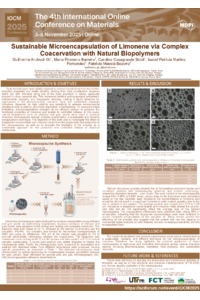
Poster IOCM 2025 - Sustainable Microencapsulation of Limonene via Complex Coacervation with Natural Biopolymers.pdf
Steel–FRP Synergy: Enhancing Serviceability in Hybrid Reinforced Concrete Beams
Thermal modification of black alder wood in an inert atmosphere under pressure