Event submissions
Published
This submission belongs to the session S6. Green Materials, Synthesis, Characterization and Recycling of the event The 4th International Online Conference on Materials
Published date
29 Oct, 2025
Academic Editor
'%3e%3cpath%20d='M12.6657%2010.9104C12.4185%2010.325%2012.0599%209.79327%2011.6097%209.34482C11.1609%208.89508%2010.6293%208.5365%2010.0442%208.28888C10.0389%208.28626%2010.0337%208.28495%2010.0285%208.28233C10.8446%207.69279%2011.3752%206.73249%2011.3752%205.64904C11.3752%203.8542%209.92103%202.39999%208.1262%202.39999C6.33136%202.39999%204.87715%203.8542%204.87715%205.64904C4.87715%206.73249%205.40774%207.69279%206.22393%208.28364C6.21869%208.28626%206.21345%208.28757%206.20821%208.29019C5.62129%208.5378%205.09463%208.89284%204.64265%209.34613C4.1929%209.79493%203.83432%2010.3266%203.58671%2010.9117C3.34345%2011.4845%203.21226%2012.0987%203.20023%2012.7209C3.19988%2012.7349%203.20233%2012.7488%203.20744%2012.7619C3.21255%2012.7749%203.22022%2012.7867%203.22998%2012.7968C3.23975%2012.8068%203.25142%2012.8147%203.26431%2012.8202C3.2772%2012.8256%203.29105%2012.8284%203.30504%2012.8284H4.09109C4.14874%2012.8284%204.19459%2012.7825%204.1959%2012.7262C4.2221%2011.7148%204.62823%2010.7676%205.34617%2010.0497C6.08899%209.30683%207.0755%208.89808%208.1262%208.89808C9.17689%208.89808%2010.1634%209.30683%2010.9062%2010.0497C11.6242%2010.7676%2012.0303%2011.7148%2012.0565%2012.7262C12.0578%2012.7838%2012.1037%2012.8284%2012.1613%2012.8284H12.9474C12.9613%2012.8284%2012.9752%2012.8256%2012.9881%2012.8202C13.001%2012.8147%2013.0126%2012.8068%2013.0224%2012.7968C13.0322%2012.7867%2013.0398%2012.7749%2013.0449%2012.7619C13.0501%2012.7488%2013.0525%2012.7349%2013.0522%2012.7209C13.0391%2012.0947%2012.9094%2011.4855%2012.6657%2010.9104ZM8.1262%207.9024C7.52486%207.9024%206.9589%207.6679%206.53312%207.24211C6.10733%206.81633%205.87283%206.25037%205.87283%205.64904C5.87283%205.0477%206.10733%204.48174%206.53312%204.05596C6.9589%203.63018%207.52486%203.39567%208.1262%203.39567C8.72753%203.39567%209.29349%203.63018%209.71927%204.05596C10.1451%204.48174%2010.3796%205.0477%2010.3796%205.64904C10.3796%206.25037%2010.1451%206.81633%209.71927%207.24211C9.29349%207.6679%208.72753%207.9024%208.1262%207.9024Z'%20fill='%235D1EE1'/%3e%3c/g%3e%3c/svg%3e) Ingo Dierking
Ingo DierkingCitation
Hussam Sabri Musleh, Samy Mansy, Naji AlDahoudi, abdelilah Lahmar, Abdelylah Daoudi, Synthesis and Investigation of Structural, Mechanical and Optical Properties of Porous ZnO Nano Particles Prepared Via Eco-frindly Technique, in Proceedings of The 4th International Online Conference on Materials, 3 November–6 November 2025, MDPI: Basel, Switzerland
Share
Email
Facebook
Twitter
LinkedIn
Synthesis and Investigation of Structural, Mechanical and Optical Properties of Porous ZnO Nano Particles Prepared Via Eco-frindly Technique
'%3e%3cpath%20d='M12.6647%2010.9104C12.4176%2010.325%2012.0589%209.7933%2011.6088%209.34485C11.16%208.89511%2010.6283%208.53653%2010.0432%208.28891C10.038%208.28629%2010.0327%208.28498%2010.0275%208.28236C10.8437%207.69282%2011.3743%206.73252%2011.3743%205.64907C11.3743%203.85423%209.92005%202.40002%208.12522%202.40002C6.33038%202.40002%204.87618%203.85423%204.87618%205.64907C4.87618%206.73252%205.40677%207.69282%206.22296%208.28367C6.21772%208.28629%206.21248%208.2876%206.20724%208.29022C5.62031%208.53783%205.09365%208.89287%204.64167%209.34616C4.19192%209.79496%203.83334%2010.3266%203.58573%2010.9117C3.34247%2011.4846%203.21128%2012.0987%203.19925%2012.721C3.1989%2012.735%203.20135%2012.7489%203.20646%2012.7619C3.21157%2012.7749%203.21924%2012.7868%203.22901%2012.7968C3.23877%2012.8068%203.25045%2012.8148%203.26334%2012.8202C3.27623%2012.8256%203.29007%2012.8284%203.30406%2012.8284H4.09012C4.14776%2012.8284%204.19362%2012.7825%204.19493%2012.7262C4.22113%2011.7148%204.62726%2010.7676%205.34519%2010.0497C6.08802%209.30686%207.07452%208.89811%208.12522%208.89811C9.17592%208.89811%2010.1624%209.30686%2010.9052%2010.0497C11.6232%2010.7676%2012.0293%2011.7148%2012.0555%2012.7262C12.0568%2012.7839%2012.1027%2012.8284%2012.1603%2012.8284H12.9464C12.9604%2012.8284%2012.9742%2012.8256%2012.9871%2012.8202C13%2012.8148%2013.0117%2012.8068%2013.0214%2012.7968C13.0312%2012.7868%2013.0389%2012.7749%2013.044%2012.7619C13.0491%2012.7489%2013.0515%2012.735%2013.0512%2012.721C13.0381%2012.0947%2012.9084%2011.4856%2012.6647%2010.9104ZM8.12522%207.90243C7.52388%207.90243%206.95792%207.66793%206.53214%207.24215C6.10636%206.81636%205.87185%206.2504%205.87185%205.64907C5.87185%205.04773%206.10636%204.48177%206.53214%204.05599C6.95792%203.63021%207.52388%203.3957%208.12522%203.3957C8.72655%203.3957%209.29252%203.63021%209.7183%204.05599C10.1441%204.48177%2010.3786%205.04773%2010.3786%205.64907C10.3786%206.2504%2010.1441%206.81636%209.7183%207.24215C9.29252%207.66793%208.72655%207.90243%208.12522%207.90243Z'%20fill='%235D1EE1'/%3e%3c/g%3e%3c/svg%3e)
Hussam Sabri Musleh 1
Samy Mansy 2

Naji AlDahoudi 3
abdelilah Lahmar 3
Abdelylah Daoudi 4
1. University Littoral Côte d’Opale, UR 4476, UDSMM, Unité de Dynamique et Structure des Matériaux Moléculaires, F-59140 Dunkerque, France
2. University college Science and Technology KanYounis, Dep. of Engendering Sciences and applied arts, KanYounis, Palestine.
3. Condensed Matter Physics Laboratory (LPMC), University of Picardie Jules Verne, 33 Rue Saint Leu,80000 Amines, France
4. University Littoral Côte d’Opale, UR 4476, UDSMM, Unité de Dynamique et Structure des Matériaux Moléculaires, F-59140 Dunkerque, France.
Abstract
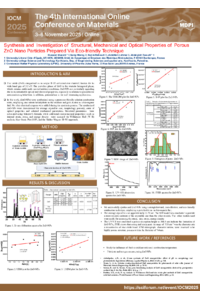
Zinc oxide nanoparticles (ZnO-NPs) were synthesized using a green eco frindly solution combustion route, employing zinc nitrate hexahydrate as the oxidizer and gum Arabic as a bio-organic fuel. No other chemical reagents were added during the synthesis process. The synthesized ZnO-NPs were characterized for average crystallite size, morphology, porosity, some of obtical properties and selected mechanical parameters. XRD analysis confirmed a single-phase hexagonal wurtzite structure, with an average crystallite size of ~14 nm as determined from the Size–Strain Plot (SSP) model, which provided the most consistent results among Debye–Scherrer, Williamson–Hall, and Halder–Wagner models. The average crystallite size, energy density value, micro strain and internal stress were estimated from peak broadening analysis. SEM images revealed a highly porous morphology with an average pore diameter of ~784 nm, implying a high specific surface area calculated from pore distribution analysis. UV–VIS spectroscopy exhibited a sharp excitonic absorption peak around 368.4 nm corresponding to a direct optical band gap of 3.8 eV. Fourier transform infrared spectroscopy (FTIR) confirmed ZnO stretching vibrations between 500–700 cm⁻¹, verifying ZnO formation. Compared with previous literature, this synthesis route offers a sustainable, low-cost, and purely plant-based alternative that yields nanosized ZnO with enhanced surface area and controlled microstructure, suitable for photocatalytic and optoelectronic applications.
Keywords
Zinc oxide nanoparticles (ZnO-NPs)
Gum arabic
Biosynthesis Technique
Williamson Hall Model
Halder–Wagner Model and Size-Strain Plot Model
Poster
IOCM 2025 - poster ok.pdf
Vibration-based Intelligent Monitoring for L-PBF Additive Manufacturing
Computational Fluid Dynamic Simulation of Sedimentation Process; Optimisation of Inclusion Control in Recycled Aluminium Alloys