Event submissions
Published
This submission belongs to the session S5. Application of Spatial Technologies in Cancer Drug Discovery of the event CancersScape: Spatial Biology of the Tumor Ecosystem
Published date
05 Nov, 2025
Academic Editor
'%3e%3cpath%20d='M12.6657%2010.9104C12.4185%2010.325%2012.0599%209.79327%2011.6097%209.34482C11.1609%208.89508%2010.6293%208.5365%2010.0442%208.28888C10.0389%208.28626%2010.0337%208.28495%2010.0285%208.28233C10.8446%207.69279%2011.3752%206.73249%2011.3752%205.64904C11.3752%203.8542%209.92103%202.39999%208.1262%202.39999C6.33136%202.39999%204.87715%203.8542%204.87715%205.64904C4.87715%206.73249%205.40774%207.69279%206.22393%208.28364C6.21869%208.28626%206.21345%208.28757%206.20821%208.29019C5.62129%208.5378%205.09463%208.89284%204.64265%209.34613C4.1929%209.79493%203.83432%2010.3266%203.58671%2010.9117C3.34345%2011.4845%203.21226%2012.0987%203.20023%2012.7209C3.19988%2012.7349%203.20233%2012.7488%203.20744%2012.7619C3.21255%2012.7749%203.22022%2012.7867%203.22998%2012.7968C3.23975%2012.8068%203.25142%2012.8147%203.26431%2012.8202C3.2772%2012.8256%203.29105%2012.8284%203.30504%2012.8284H4.09109C4.14874%2012.8284%204.19459%2012.7825%204.1959%2012.7262C4.2221%2011.7148%204.62823%2010.7676%205.34617%2010.0497C6.08899%209.30683%207.0755%208.89808%208.1262%208.89808C9.17689%208.89808%2010.1634%209.30683%2010.9062%2010.0497C11.6242%2010.7676%2012.0303%2011.7148%2012.0565%2012.7262C12.0578%2012.7838%2012.1037%2012.8284%2012.1613%2012.8284H12.9474C12.9613%2012.8284%2012.9752%2012.8256%2012.9881%2012.8202C13.001%2012.8147%2013.0126%2012.8068%2013.0224%2012.7968C13.0322%2012.7867%2013.0398%2012.7749%2013.0449%2012.7619C13.0501%2012.7488%2013.0525%2012.7349%2013.0522%2012.7209C13.0391%2012.0947%2012.9094%2011.4855%2012.6657%2010.9104ZM8.1262%207.9024C7.52486%207.9024%206.9589%207.6679%206.53312%207.24211C6.10733%206.81633%205.87283%206.25037%205.87283%205.64904C5.87283%205.0477%206.10733%204.48174%206.53312%204.05596C6.9589%203.63018%207.52486%203.39567%208.1262%203.39567C8.72753%203.39567%209.29349%203.63018%209.71927%204.05596C10.1451%204.48174%2010.3796%205.0477%2010.3796%205.64904C10.3796%206.25037%2010.1451%206.81633%209.71927%207.24211C9.29349%207.6679%208.72753%207.9024%208.1262%207.9024Z'%20fill='%235D1EE1'/%3e%3c/g%3e%3c/svg%3e) Samuel Mok
Samuel MokCitation
SANTHIPRIYA P R, Trishala Das, Azhar Tariq Khan, Andrew M Lynn, Nasimul Hoda, Naidu Subbarao, Neelima Mondal, Novel small-molecule MDM2 inhibitor as a potential anticancer agent for gastric and breast cancer, in Proceedings of CancersScape: Spatial Biology of the Tumor Ecosystem, Barcelona, 5 November–7 November 2025, MDPI: Basel, Switzerland
Share
Email
Facebook
Twitter
LinkedIn
Novel small-molecule MDM2 inhibitor as a potential anticancer agent for gastric and breast cancer
'%3e%3cpath%20d='M12.6647%2010.9104C12.4176%2010.325%2012.0589%209.7933%2011.6088%209.34485C11.16%208.89511%2010.6283%208.53653%2010.0432%208.28891C10.038%208.28629%2010.0327%208.28498%2010.0275%208.28236C10.8437%207.69282%2011.3743%206.73252%2011.3743%205.64907C11.3743%203.85423%209.92005%202.40002%208.12522%202.40002C6.33038%202.40002%204.87618%203.85423%204.87618%205.64907C4.87618%206.73252%205.40677%207.69282%206.22296%208.28367C6.21772%208.28629%206.21248%208.2876%206.20724%208.29022C5.62031%208.53783%205.09365%208.89287%204.64167%209.34616C4.19192%209.79496%203.83334%2010.3266%203.58573%2010.9117C3.34247%2011.4846%203.21128%2012.0987%203.19925%2012.721C3.1989%2012.735%203.20135%2012.7489%203.20646%2012.7619C3.21157%2012.7749%203.21924%2012.7868%203.22901%2012.7968C3.23877%2012.8068%203.25045%2012.8148%203.26334%2012.8202C3.27623%2012.8256%203.29007%2012.8284%203.30406%2012.8284H4.09012C4.14776%2012.8284%204.19362%2012.7825%204.19493%2012.7262C4.22113%2011.7148%204.62726%2010.7676%205.34519%2010.0497C6.08802%209.30686%207.07452%208.89811%208.12522%208.89811C9.17592%208.89811%2010.1624%209.30686%2010.9052%2010.0497C11.6232%2010.7676%2012.0293%2011.7148%2012.0555%2012.7262C12.0568%2012.7839%2012.1027%2012.8284%2012.1603%2012.8284H12.9464C12.9604%2012.8284%2012.9742%2012.8256%2012.9871%2012.8202C13%2012.8148%2013.0117%2012.8068%2013.0214%2012.7968C13.0312%2012.7868%2013.0389%2012.7749%2013.044%2012.7619C13.0491%2012.7489%2013.0515%2012.735%2013.0512%2012.721C13.0381%2012.0947%2012.9084%2011.4856%2012.6647%2010.9104ZM8.12522%207.90243C7.52388%207.90243%206.95792%207.66793%206.53214%207.24215C6.10636%206.81636%205.87185%206.2504%205.87185%205.64907C5.87185%205.04773%206.10636%204.48177%206.53214%204.05599C6.95792%203.63021%207.52388%203.3957%208.12522%203.3957C8.72655%203.3957%209.29252%203.63021%209.7183%204.05599C10.1441%204.48177%2010.3786%205.04773%2010.3786%205.64907C10.3786%206.2504%2010.1441%206.81636%209.7183%207.24215C9.29252%207.66793%208.72655%207.90243%208.12522%207.90243Z'%20fill='%235D1EE1'/%3e%3c/g%3e%3c/svg%3e)
SANTHIPRIYA P R 1
Trishala Das 2
Azhar Tariq Khan 3
Andrew M Lynn 4
Nasimul Hoda 5
Naidu Subbarao 4
Neelima Mondal 1
1. School Of Life Sciences, Jawaharlal Nehru University, New Delhi, India
2. School of Computational and Integrative Sciences, Jawaharlal Nehru University, New Delhi, India
3. Department of Chemistry, Jamia Millia Islamia, New Delhi,India
4. School of Computational and Integrative Sciences, Jawaharlal Nehru University,New Delhi,India
5. Department of Chemistry, Jamia Millia Islamia, New Delhi, India
Abstract
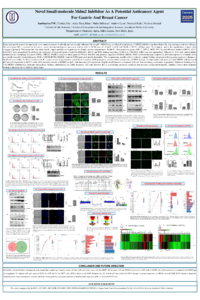
Breast and gastric cancers are among the most common cancers worldwide and are strongly influenced by the p53–MDM2 axis, yet clinical development of MDM2 inhibitors has been limited by drug resistance and poor efficacy. We investigated K1, a quinazoline derivative, which demonstrated potent anticancer activity with an IC50 value of 18.5µM in AGS and 19µM in MCF7 cell lines 72 h post treatment, and it also significantly reduced their clonogenic potential. Transcriptomic data show that K1 targets multiple stress pathways in distinct cellular compartments. In MCF7, ribosomal stress genes (RPL11, RPL23, RPS7, RPL26) and ER stress markers (DDIT3, ATF4, EIF2AK3) were upregulated. In addition, the expression of apoptotic protein mediators (PMAIP1, BBC3) and DNA damage regulators (CDKN1A, CDKN2D, FHIT) was also upregulated, whereas in AGS cells, mitochondrial dysfunction and mitophagy indicators (PINK1, PRDX3, PARK7), oxidative stress genes (CYP1A1, BACH1), and apoptotic regulators (FOXO3, RHOB, STAT1) showed increased expression. Elevated expression of mitotic stress and spindle assembly checkpoint genes (PLK1, CCNB1, CDC20, BUB1, MAD2L) leads to G2/M arrest and spindle disruption. This compartment-specific activity indicates a spatial biology perspective, linking gene expression changes to localized stress within the tumor environment. K1 causes nuclear fragmentation, cytoskeletal disruption, ROS generation, mitochondrial dysfunction, and DNA damage. In vitro studies indicated decreased MDM2 with increased p53 and p21 expression in MCF7, while AGS showed a decline in MDM2 and p53, with increased p21 expression. Despite the differences in response, both cell lines ultimately culminated in apoptosis. Molecular docking of K1 with MDM2 exhibited key molecular interactions, binding conformation, and stable dynamics. Our data identifies K1 as a promising anticancer candidate that activates compartment-specific, spatially distinct stress responses, leading to apoptosis in two distinct cancer types.
Keywords
K1
MDM2 inhibitor
Transcriptomics
Molecular docking
Gastric cancer
Breast cancer
Poster
ONLINE_Santhipriya P R.pdf
Advancing Tissue Biology Research With Weave Software For Spatial Multi-Omics
Navigating personalized cancer treatments using spatial single-cell protemics