Event submissions
Published
This submission belongs to the session S2. Spatial Intra-Tumoral Heterogeneity in the Tumor Microenvironment of the event CancersScape: Spatial Biology of the Tumor Ecosystem
Published date
05 Nov, 2025
Academic Editor
'%3e%3cpath%20d='M12.6657%2010.9104C12.4185%2010.325%2012.0599%209.79327%2011.6097%209.34482C11.1609%208.89508%2010.6293%208.5365%2010.0442%208.28888C10.0389%208.28626%2010.0337%208.28495%2010.0285%208.28233C10.8446%207.69279%2011.3752%206.73249%2011.3752%205.64904C11.3752%203.8542%209.92103%202.39999%208.1262%202.39999C6.33136%202.39999%204.87715%203.8542%204.87715%205.64904C4.87715%206.73249%205.40774%207.69279%206.22393%208.28364C6.21869%208.28626%206.21345%208.28757%206.20821%208.29019C5.62129%208.5378%205.09463%208.89284%204.64265%209.34613C4.1929%209.79493%203.83432%2010.3266%203.58671%2010.9117C3.34345%2011.4845%203.21226%2012.0987%203.20023%2012.7209C3.19988%2012.7349%203.20233%2012.7488%203.20744%2012.7619C3.21255%2012.7749%203.22022%2012.7867%203.22998%2012.7968C3.23975%2012.8068%203.25142%2012.8147%203.26431%2012.8202C3.2772%2012.8256%203.29105%2012.8284%203.30504%2012.8284H4.09109C4.14874%2012.8284%204.19459%2012.7825%204.1959%2012.7262C4.2221%2011.7148%204.62823%2010.7676%205.34617%2010.0497C6.08899%209.30683%207.0755%208.89808%208.1262%208.89808C9.17689%208.89808%2010.1634%209.30683%2010.9062%2010.0497C11.6242%2010.7676%2012.0303%2011.7148%2012.0565%2012.7262C12.0578%2012.7838%2012.1037%2012.8284%2012.1613%2012.8284H12.9474C12.9613%2012.8284%2012.9752%2012.8256%2012.9881%2012.8202C13.001%2012.8147%2013.0126%2012.8068%2013.0224%2012.7968C13.0322%2012.7867%2013.0398%2012.7749%2013.0449%2012.7619C13.0501%2012.7488%2013.0525%2012.7349%2013.0522%2012.7209C13.0391%2012.0947%2012.9094%2011.4855%2012.6657%2010.9104ZM8.1262%207.9024C7.52486%207.9024%206.9589%207.6679%206.53312%207.24211C6.10733%206.81633%205.87283%206.25037%205.87283%205.64904C5.87283%205.0477%206.10733%204.48174%206.53312%204.05596C6.9589%203.63018%207.52486%203.39567%208.1262%203.39567C8.72753%203.39567%209.29349%203.63018%209.71927%204.05596C10.1451%204.48174%2010.3796%205.0477%2010.3796%205.64904C10.3796%206.25037%2010.1451%206.81633%209.71927%207.24211C9.29349%207.6679%208.72753%207.9024%208.1262%207.9024Z'%20fill='%235D1EE1'/%3e%3c/g%3e%3c/svg%3e) Samuel Mok
Samuel MokCitation
SARA FAIK, Imane TABYAOUI, Karima BENDAHHOU, Majda Llbiyi, Mouna Bourhafour, Souha SAHRAOUI, Nadia TAHIRI JOUTI, Comprehensive Sociodemographic, Clinical, and Molecular Profiling of Breast Cancer in Morocco: Insights from 833 Patients at the Mohammed VI Cancer Center, in Proceedings of CancersScape: Spatial Biology of the Tumor Ecosystem, Barcelona, 5 November–7 November 2025, MDPI: Basel, Switzerland
Share
Email
Facebook
Twitter
LinkedIn
Comprehensive Sociodemographic, Clinical, and Molecular Profiling of Breast Cancer in Morocco: Insights from 833 Patients at the Mohammed VI Cancer Center
'%3e%3cpath%20d='M12.6647%2010.9104C12.4176%2010.325%2012.0589%209.7933%2011.6088%209.34485C11.16%208.89511%2010.6283%208.53653%2010.0432%208.28891C10.038%208.28629%2010.0327%208.28498%2010.0275%208.28236C10.8437%207.69282%2011.3743%206.73252%2011.3743%205.64907C11.3743%203.85423%209.92005%202.40002%208.12522%202.40002C6.33038%202.40002%204.87618%203.85423%204.87618%205.64907C4.87618%206.73252%205.40677%207.69282%206.22296%208.28367C6.21772%208.28629%206.21248%208.2876%206.20724%208.29022C5.62031%208.53783%205.09365%208.89287%204.64167%209.34616C4.19192%209.79496%203.83334%2010.3266%203.58573%2010.9117C3.34247%2011.4846%203.21128%2012.0987%203.19925%2012.721C3.1989%2012.735%203.20135%2012.7489%203.20646%2012.7619C3.21157%2012.7749%203.21924%2012.7868%203.22901%2012.7968C3.23877%2012.8068%203.25045%2012.8148%203.26334%2012.8202C3.27623%2012.8256%203.29007%2012.8284%203.30406%2012.8284H4.09012C4.14776%2012.8284%204.19362%2012.7825%204.19493%2012.7262C4.22113%2011.7148%204.62726%2010.7676%205.34519%2010.0497C6.08802%209.30686%207.07452%208.89811%208.12522%208.89811C9.17592%208.89811%2010.1624%209.30686%2010.9052%2010.0497C11.6232%2010.7676%2012.0293%2011.7148%2012.0555%2012.7262C12.0568%2012.7839%2012.1027%2012.8284%2012.1603%2012.8284H12.9464C12.9604%2012.8284%2012.9742%2012.8256%2012.9871%2012.8202C13%2012.8148%2013.0117%2012.8068%2013.0214%2012.7968C13.0312%2012.7868%2013.0389%2012.7749%2013.044%2012.7619C13.0491%2012.7489%2013.0515%2012.735%2013.0512%2012.721C13.0381%2012.0947%2012.9084%2011.4856%2012.6647%2010.9104ZM8.12522%207.90243C7.52388%207.90243%206.95792%207.66793%206.53214%207.24215C6.10636%206.81636%205.87185%206.2504%205.87185%205.64907C5.87185%205.04773%206.10636%204.48177%206.53214%204.05599C6.95792%203.63021%207.52388%203.3957%208.12522%203.3957C8.72655%203.3957%209.29252%203.63021%209.7183%204.05599C10.1441%204.48177%2010.3786%205.04773%2010.3786%205.64907C10.3786%206.2504%2010.1441%206.81636%209.7183%207.24215C9.29252%207.66793%208.72655%207.90243%208.12522%207.90243Z'%20fill='%235D1EE1'/%3e%3c/g%3e%3c/svg%3e)
SARA FAIK 1
Imane TABYAOUI 2
Karima BENDAHHOU 2
Majda Llbiyi 3
Mouna Bourhafour 4
Souha SAHRAOUI 5,6
Nadia TAHIRI JOUTI 2
1. Laboratory ofCellular andMolecularInflammatory,Degenerativeand OncologicPathophysiology-Faculty ofMedicine andPharmacy,University ofHassan II,Casablanca,Morocco.
2. Laboratory of Cellular and Molecular Inflammatory, Degenerative and Oncologic Pathophysiology-Faculty of Medicine and Pharmacy, University Hassan II, Casablanca, Morocco.
3. Laboratory of Cellular and Molecular Inflammatory, Degenerative and Oncologic Pathophysiology-Faculty of Medicine and Pharmacy, University of Hassan II, Casablanca, Morocco.
4. Mohammed VI Cancer Treatment Center, Ibn Rochd University Hospital Center, Casablanca, Morocco
5. Mohammed VI Cancer Treatment Center, Ibn Rochd University Hospital Center, Casablanca, Morocco.
6. Immuno-Genetics and Human Pathology Laboratory - Faculty of Medicine and Pharmacy, Hassan II University of Casablanca, Morocco
Abstract
Abstract
Introduction:
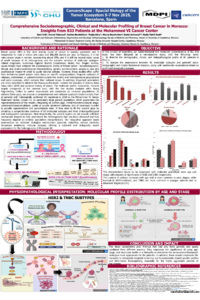
Breast cancer is the most frequent cancer among women worldwide and in Morocco. This study analyzes the socio-demographic, clinical, and molecular characteristics of breast cancer in patients treated at the Mohamed VI Cancer Treatment Center in Casablanca (CM-VI).
Materials and Methods :
This retrospective descriptive study included 833 patients diagnosed with histologically confirmed breast cancer in 2019 at CM-VI. Data were extracted from the center’s digitized medical records.
Results:
The cohort was predominantly female (98.7%), with most patients covered by social health insurance (88.8%) and married (57.8%). Overweight and obesity affected 42.7% of patients. Family history of cancer was noted in 28.6%, while only 2.9% had a personal history of cancer. The right breast was affected in 49.4% of cases. Invasiveductal carcinoma was the predominant histological type (82.6%), with Grade II tumors accounting for 56.2%. Hormonal receptor expression was common in estrogen receptors (75.7%) and progesterone receptors (70.8%), while HER2 was positive in 23% of cases. Stage II disease represented nearly half of cases (48.1%). Regarding molecular subtypes, luminal B was most frequent (50.1%), followed by luminal A (27.3%), triple negative (16.2%), and HER2-enriched (6.4%). Molecular subtype distribution showed significant associations with patient age (p=0.02) and disease stage (p=0.001), but not with sex, family, or personal cancer history, histology, or body mass index.
Conclusion:
These findings align with the international literature and provide the first integrated overview of breast cancer characteristics at the national level in Morocco. Further studies are required to validate and generalize these results to the broader Moroccan population, considering regional specificities.
Impact:
This study highlights the need to explore genetic profiles to support personalized treatment strategies based on age, stage, and molecular subtype; stresses targeting intratumor heterogeneity; and enhancing the screening of high-risk groups.
Keywords
Breast cancer
Tumor staging
Carcinogenesis
Molecular and geneticepidemiology
Cancer disparities
Cancer prevention
Poster
ONLINE_SARA FAIK.pdf
A novel signal amplification technique for multiplex immunofluorescence to detect low-expressed biomarkers in the tumor microenvironment
Spatial Insights into hTERT Promoter Restoration as a Novel Pathway for Cancer Drug Discovery