Event submissions
Published
This submission belongs to the session S2. Spatial Intra-Tumoral Heterogeneity in the Tumor Microenvironment of the event CancersScape: Spatial Biology of the Tumor Ecosystem
Published date
05 Nov, 2025
Academic Editor
'%3e%3cpath%20d='M12.6657%2010.9104C12.4185%2010.325%2012.0599%209.79327%2011.6097%209.34482C11.1609%208.89508%2010.6293%208.5365%2010.0442%208.28888C10.0389%208.28626%2010.0337%208.28495%2010.0285%208.28233C10.8446%207.69279%2011.3752%206.73249%2011.3752%205.64904C11.3752%203.8542%209.92103%202.39999%208.1262%202.39999C6.33136%202.39999%204.87715%203.8542%204.87715%205.64904C4.87715%206.73249%205.40774%207.69279%206.22393%208.28364C6.21869%208.28626%206.21345%208.28757%206.20821%208.29019C5.62129%208.5378%205.09463%208.89284%204.64265%209.34613C4.1929%209.79493%203.83432%2010.3266%203.58671%2010.9117C3.34345%2011.4845%203.21226%2012.0987%203.20023%2012.7209C3.19988%2012.7349%203.20233%2012.7488%203.20744%2012.7619C3.21255%2012.7749%203.22022%2012.7867%203.22998%2012.7968C3.23975%2012.8068%203.25142%2012.8147%203.26431%2012.8202C3.2772%2012.8256%203.29105%2012.8284%203.30504%2012.8284H4.09109C4.14874%2012.8284%204.19459%2012.7825%204.1959%2012.7262C4.2221%2011.7148%204.62823%2010.7676%205.34617%2010.0497C6.08899%209.30683%207.0755%208.89808%208.1262%208.89808C9.17689%208.89808%2010.1634%209.30683%2010.9062%2010.0497C11.6242%2010.7676%2012.0303%2011.7148%2012.0565%2012.7262C12.0578%2012.7838%2012.1037%2012.8284%2012.1613%2012.8284H12.9474C12.9613%2012.8284%2012.9752%2012.8256%2012.9881%2012.8202C13.001%2012.8147%2013.0126%2012.8068%2013.0224%2012.7968C13.0322%2012.7867%2013.0398%2012.7749%2013.0449%2012.7619C13.0501%2012.7488%2013.0525%2012.7349%2013.0522%2012.7209C13.0391%2012.0947%2012.9094%2011.4855%2012.6657%2010.9104ZM8.1262%207.9024C7.52486%207.9024%206.9589%207.6679%206.53312%207.24211C6.10733%206.81633%205.87283%206.25037%205.87283%205.64904C5.87283%205.0477%206.10733%204.48174%206.53312%204.05596C6.9589%203.63018%207.52486%203.39567%208.1262%203.39567C8.72753%203.39567%209.29349%203.63018%209.71927%204.05596C10.1451%204.48174%2010.3796%205.0477%2010.3796%205.64904C10.3796%206.25037%2010.1451%206.81633%209.71927%207.24211C9.29349%207.6679%208.72753%207.9024%208.1262%207.9024Z'%20fill='%235D1EE1'/%3e%3c/g%3e%3c/svg%3e) Samuel Mok
Samuel MokCitation
Eduardo Imanol Agüero, Silvia María Gómez, Ana Belén Peñaherrera-Pazmiño, Matías Tellado, Maximiliano Sebastián Pérez, Betiana Lerner, Denise Belgorosky, Ana María Eiján, Towards Personalized Medicine: Microdevice-Assisted Evaluation of Cancer Stem Cell Dynamics and Treatment Response, in Proceedings of CancersScape: Spatial Biology of the Tumor Ecosystem, Barcelona, 5 November–7 November 2025, MDPI: Basel, Switzerland
Share
Email
Facebook
Twitter
LinkedIn
Towards Personalized Medicine: Microdevice-Assisted Evaluation of Cancer Stem Cell Dynamics and Treatment Response
'%3e%3cpath%20d='M12.6647%2010.9104C12.4176%2010.325%2012.0589%209.7933%2011.6088%209.34485C11.16%208.89511%2010.6283%208.53653%2010.0432%208.28891C10.038%208.28629%2010.0327%208.28498%2010.0275%208.28236C10.8437%207.69282%2011.3743%206.73252%2011.3743%205.64907C11.3743%203.85423%209.92005%202.40002%208.12522%202.40002C6.33038%202.40002%204.87618%203.85423%204.87618%205.64907C4.87618%206.73252%205.40677%207.69282%206.22296%208.28367C6.21772%208.28629%206.21248%208.2876%206.20724%208.29022C5.62031%208.53783%205.09365%208.89287%204.64167%209.34616C4.19192%209.79496%203.83334%2010.3266%203.58573%2010.9117C3.34247%2011.4846%203.21128%2012.0987%203.19925%2012.721C3.1989%2012.735%203.20135%2012.7489%203.20646%2012.7619C3.21157%2012.7749%203.21924%2012.7868%203.22901%2012.7968C3.23877%2012.8068%203.25045%2012.8148%203.26334%2012.8202C3.27623%2012.8256%203.29007%2012.8284%203.30406%2012.8284H4.09012C4.14776%2012.8284%204.19362%2012.7825%204.19493%2012.7262C4.22113%2011.7148%204.62726%2010.7676%205.34519%2010.0497C6.08802%209.30686%207.07452%208.89811%208.12522%208.89811C9.17592%208.89811%2010.1624%209.30686%2010.9052%2010.0497C11.6232%2010.7676%2012.0293%2011.7148%2012.0555%2012.7262C12.0568%2012.7839%2012.1027%2012.8284%2012.1603%2012.8284H12.9464C12.9604%2012.8284%2012.9742%2012.8256%2012.9871%2012.8202C13%2012.8148%2013.0117%2012.8068%2013.0214%2012.7968C13.0312%2012.7868%2013.0389%2012.7749%2013.044%2012.7619C13.0491%2012.7489%2013.0515%2012.735%2013.0512%2012.721C13.0381%2012.0947%2012.9084%2011.4856%2012.6647%2010.9104ZM8.12522%207.90243C7.52388%207.90243%206.95792%207.66793%206.53214%207.24215C6.10636%206.81636%205.87185%206.2504%205.87185%205.64907C5.87185%205.04773%206.10636%204.48177%206.53214%204.05599C6.95792%203.63021%207.52388%203.3957%208.12522%203.3957C8.72655%203.3957%209.29252%203.63021%209.7183%204.05599C10.1441%204.48177%2010.3786%205.04773%2010.3786%205.64907C10.3786%206.2504%2010.1441%206.81636%209.7183%207.24215C9.29252%207.66793%208.72655%207.90243%208.12522%207.90243Z'%20fill='%235D1EE1'/%3e%3c/g%3e%3c/svg%3e)
Eduardo Imanol Agüero 1,2
Silvia María Gómez 1,3

Ana Belén Peñaherrera-Pazmiño 4
Matías Tellado 5
Maximiliano Sebastián Pérez 6,7,8
Betiana Lerner 6,7,8
Denise Belgorosky 1
Ana María Eiján 1,2
1. Universidad de Buenos Aires, Facultad de Medicina, Instituto de Oncología Ángel H. Roffo, Área de Investigación, Buenos Aires C1417DTB, Argentina
2. Consejo Nacional de Investigaciones Científicas y Técnicas (CONICET), Ciudad Autónoma de Buenos Aires C1425FQD, Argentina
3. Agencia Nacional de Promoción de la Investigación, el Desarrollo Tecnológico y la Innovación, Fondo para la investigación Científica y Tecnológica (FONCyT), Ministerio de Innovación, Ciencia y Tecnología (MINCyT), Ciudad Autónoma de Buenos Aires C1425FQD,
4. Universidad UTE, Facultad de Ciencias de la Salud Eugenio Espejo, Centro de Investigación Biomédica (CENBIO), Quito 170527, Ecuador.
5. VetOncologia-Clínica Oncológica Veterinaria, Buenos Aires C1408BGD, Argentina
6. Centro IREN, Universidad Tecnológica Nacional (UTN), Buenos Aires B1706EAH, Argentina
7. Collaborative Research Institute Intelligent Oncology (CRIION), 79117 Freiburg im Breisgau, Germany
8. Department of Electrical and Computer Engineering, Florida International University, Miami, FL 33174, USA
Abstract
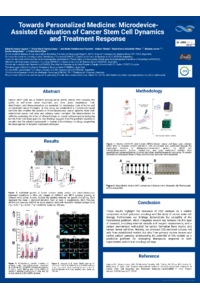
Cancer stem cells (CSCs) represent a critical subpopulation within tumors, endowed with self-renewal and differentiation capacities, and are implicated in tumor initiation, progression, metastasis, therapeutic resistance, and recurrence. This study sought to establish and validate a microfluidic device (MD) for the enrichment, functional assessment, and therapeutic evaluation of CSC populations derived from experimental models and primary tumor samples. Murine (LM38LP) and human (BPR6) breast cancer cell lines were cultured within MDs to promote sphere formation. CSC enrichment was confirmed through the expression analysis of pluripotency-associated genes (Oct4, Sox2, Nanog, and CD44) by means of quantitative PCR (qPCR) and immunofluorescence. Sphere number, size, and gene expression profiles were quantitatively assessed before (control) and after chemotherapeutic exposure. To validate the MD platform against a conventional scale, parallel experiments were performed in 12-well plates. To extend translational relevance, three primary canine tumor samples (solid thyroid carcinoma, simple tubular carcinoma, and reactive lymph node) were mechanically disaggregated and processed within MDs for CSC characterization. The MD platform enabled consistent CSC population enrichment, showing significant sphere growth modulation parameters and stemness marker expression following treatment. A notable reduction in both size and growth rate was observed in spheres treated with Doxorubicin or Paclitaxel after 8 days of culture, compared to controls. These findings are particularly significant, as this technique can be used to assess cell heterogeneity and the potential of cells to form tumors. The MD also supported immunofluorescence staining and allowed for real-time monitoring of individual cell growth. Sphere formation efficiency and CSC marker expression were demonstrated in primary veterinary tumor cultures, highlighting the device’s cross-species applicability. Microfluidic-based sphere assays represent a robust, reproducible, and scalable platform for the functional interrogation of CSC dynamics and therapeutic responses. This methodology holds great promise for advancing CSC-targeted therapies and supporting personalized oncology in both human and veterinary settings.
Keywords
cancer stem cells
sphere formation assay
microfluidic device
chemotherapy response
personalized oncology
tumor-derived spheres
sustainable development goal 3
multiplex immunofluorescence
Poster
Poster Cancers 2025 UTE.pdf
Multi-Omics Flux Modeling for Precision Therapy Design in Colon Cancer: Redefining Tumor Stratification
Integrative Single-Cell and Spatial Transcriptomics Reveal Oncofetal Gene Reactivation and Tumor Microenvironment Heterogeneity in Colorectal Cancer