Event submissions
Published
This submission belongs to the session S1. Hydrological Processes and Modelling of the event The 9th International Electronic Conference on Water Sciences
Published date
06 Nov, 2025
Academic Editor
'%3e%3cpath%20d='M12.6657%2010.9104C12.4185%2010.325%2012.0599%209.79327%2011.6097%209.34482C11.1609%208.89508%2010.6293%208.5365%2010.0442%208.28888C10.0389%208.28626%2010.0337%208.28495%2010.0285%208.28233C10.8446%207.69279%2011.3752%206.73249%2011.3752%205.64904C11.3752%203.8542%209.92103%202.39999%208.1262%202.39999C6.33136%202.39999%204.87715%203.8542%204.87715%205.64904C4.87715%206.73249%205.40774%207.69279%206.22393%208.28364C6.21869%208.28626%206.21345%208.28757%206.20821%208.29019C5.62129%208.5378%205.09463%208.89284%204.64265%209.34613C4.1929%209.79493%203.83432%2010.3266%203.58671%2010.9117C3.34345%2011.4845%203.21226%2012.0987%203.20023%2012.7209C3.19988%2012.7349%203.20233%2012.7488%203.20744%2012.7619C3.21255%2012.7749%203.22022%2012.7867%203.22998%2012.7968C3.23975%2012.8068%203.25142%2012.8147%203.26431%2012.8202C3.2772%2012.8256%203.29105%2012.8284%203.30504%2012.8284H4.09109C4.14874%2012.8284%204.19459%2012.7825%204.1959%2012.7262C4.2221%2011.7148%204.62823%2010.7676%205.34617%2010.0497C6.08899%209.30683%207.0755%208.89808%208.1262%208.89808C9.17689%208.89808%2010.1634%209.30683%2010.9062%2010.0497C11.6242%2010.7676%2012.0303%2011.7148%2012.0565%2012.7262C12.0578%2012.7838%2012.1037%2012.8284%2012.1613%2012.8284H12.9474C12.9613%2012.8284%2012.9752%2012.8256%2012.9881%2012.8202C13.001%2012.8147%2013.0126%2012.8068%2013.0224%2012.7968C13.0322%2012.7867%2013.0398%2012.7749%2013.0449%2012.7619C13.0501%2012.7488%2013.0525%2012.7349%2013.0522%2012.7209C13.0391%2012.0947%2012.9094%2011.4855%2012.6657%2010.9104ZM8.1262%207.9024C7.52486%207.9024%206.9589%207.6679%206.53312%207.24211C6.10733%206.81633%205.87283%206.25037%205.87283%205.64904C5.87283%205.0477%206.10733%204.48174%206.53312%204.05596C6.9589%203.63018%207.52486%203.39567%208.1262%203.39567C8.72753%203.39567%209.29349%203.63018%209.71927%204.05596C10.1451%204.48174%2010.3796%205.0477%2010.3796%205.64904C10.3796%206.25037%2010.1451%206.81633%209.71927%207.24211C9.29349%207.6679%208.72753%207.9024%208.1262%207.9024Z'%20fill='%235D1EE1'/%3e%3c/g%3e%3c/svg%3e) Hossein Bonakdari
Hossein BonakdariCitation
Francisco Martínez-Zambrano, Rafael Soria, Modesto Pérez-Sánchez, Impacts of Hydrological Dimensionality Reduction in Stochastic Energy Modeling of Interconnected Power Systems, in Proceedings of The 9th International Electronic Conference on Water Sciences, 11 November–14 November 2025, MDPI: Basel, Switzerland
Share
Email
Facebook
Twitter
LinkedIn
Impacts of Hydrological Dimensionality Reduction in Stochastic Energy Modeling of Interconnected Power Systems

Francisco Martínez-Zambrano 1,2

Rafael Soria 1

Modesto Pérez-Sánchez 2
1. Institute for Energy and Materials, Department of Mechanical Engineering, Universidad San Francisco de Quito, Diego de Robles y Vía Interoceánica, Quito, P.O. Box 170901, Ecuador
2. Hydraulic Engineering and Enviromental Department, Universitat Politècnica de València, Camino Vera s/n. 46022, Valencia, Spain
Abstract
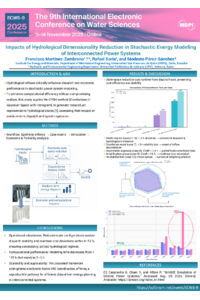
In modeling interconnected electric power systems, the role of input parameters is crucial. For example, when considering the flow series that define the hydrological state of hydroelectric plants, these inputs can directly influence operational economic value and cause variations in generator dispatch to satisfy demand. This study focuses on evaluating the reduction in the dimensionality of the stochastic state space using a CEGH (Correlations in Gaussian Space with Histogram) synthesizer to generate hydrological data. Using advanced electrical modeling techniques, the medium-term modeling of a real interconnected system is analyzed. This system includes wind, solar, and thermal generators, along with four hydroelectric plants and CEGH inputs. Regarding the serial synthesizer, the variation fields are assessed by reducing the state from six to three. Variations in the states are considered with initial ranges such as low (5%–10%), medium (30%–45%), and high (60%–85%), enabling the identification of trend changes and the development of a robust variation matrix. This research develops indicators to assign weights to the simulated cases using the open-source, freely available SimSEE platform. These indicators facilitate the identification of economic impacts resulting from the operating policies derived from the case matrix, with resulting sample variations in MUSD ranging from 4% to 15% in operating costs. Additionally, statistical analysis shows differences in computational costs: cases without reduction require approximately 122 hours of modeling, whereas applying the serial analysis synthesizer reduces this to 2–6 hours, demonstrating significant time savings. Furthermore, the study proposes indicators to assess the flexibility of generators under these hydrological variations.
Keywords
hydroelectric
energy modeling
hydrological series
dimensionality reduction
stochastic
state space
Poster
Martinez-Zambranoetal.pdf
Integrated Assessment of Water-Induced Soil Erosion Risk Using Topographic Wetness and Stream Power Indices in the Idemili Drainage Area, Southeastern Nigeria
Croatian Karst River Flows: Insights from Hurst Exponent Analysis