Event submissions
Published
This submission belongs to the session S1. Hydrological Processes and Modelling of the event The 9th International Electronic Conference on Water Sciences
Published date
06 Nov, 2025
Academic Editor
'%3e%3cpath%20d='M12.6657%2010.9104C12.4185%2010.325%2012.0599%209.79327%2011.6097%209.34482C11.1609%208.89508%2010.6293%208.5365%2010.0442%208.28888C10.0389%208.28626%2010.0337%208.28495%2010.0285%208.28233C10.8446%207.69279%2011.3752%206.73249%2011.3752%205.64904C11.3752%203.8542%209.92103%202.39999%208.1262%202.39999C6.33136%202.39999%204.87715%203.8542%204.87715%205.64904C4.87715%206.73249%205.40774%207.69279%206.22393%208.28364C6.21869%208.28626%206.21345%208.28757%206.20821%208.29019C5.62129%208.5378%205.09463%208.89284%204.64265%209.34613C4.1929%209.79493%203.83432%2010.3266%203.58671%2010.9117C3.34345%2011.4845%203.21226%2012.0987%203.20023%2012.7209C3.19988%2012.7349%203.20233%2012.7488%203.20744%2012.7619C3.21255%2012.7749%203.22022%2012.7867%203.22998%2012.7968C3.23975%2012.8068%203.25142%2012.8147%203.26431%2012.8202C3.2772%2012.8256%203.29105%2012.8284%203.30504%2012.8284H4.09109C4.14874%2012.8284%204.19459%2012.7825%204.1959%2012.7262C4.2221%2011.7148%204.62823%2010.7676%205.34617%2010.0497C6.08899%209.30683%207.0755%208.89808%208.1262%208.89808C9.17689%208.89808%2010.1634%209.30683%2010.9062%2010.0497C11.6242%2010.7676%2012.0303%2011.7148%2012.0565%2012.7262C12.0578%2012.7838%2012.1037%2012.8284%2012.1613%2012.8284H12.9474C12.9613%2012.8284%2012.9752%2012.8256%2012.9881%2012.8202C13.001%2012.8147%2013.0126%2012.8068%2013.0224%2012.7968C13.0322%2012.7867%2013.0398%2012.7749%2013.0449%2012.7619C13.0501%2012.7488%2013.0525%2012.7349%2013.0522%2012.7209C13.0391%2012.0947%2012.9094%2011.4855%2012.6657%2010.9104ZM8.1262%207.9024C7.52486%207.9024%206.9589%207.6679%206.53312%207.24211C6.10733%206.81633%205.87283%206.25037%205.87283%205.64904C5.87283%205.0477%206.10733%204.48174%206.53312%204.05596C6.9589%203.63018%207.52486%203.39567%208.1262%203.39567C8.72753%203.39567%209.29349%203.63018%209.71927%204.05596C10.1451%204.48174%2010.3796%205.0477%2010.3796%205.64904C10.3796%206.25037%2010.1451%206.81633%209.71927%207.24211C9.29349%207.6679%208.72753%207.9024%208.1262%207.9024Z'%20fill='%235D1EE1'/%3e%3c/g%3e%3c/svg%3e) Giuseppe T Aronica
Giuseppe T AronicaCitation
Abel Remache, Modesto Pérez-Sánchez, Helena M. Ramos, Víctor Hugo Hidalgo, Hybrid Optimization Framework for Rotor Design in Hydraulic Turbomachinery: Enhancing Hydraulic Performance through Simulation, Artificial Intelligence, and Experimental Validation, in Proceedings of The 9th International Electronic Conference on Water Sciences, 11 November–14 November 2025, MDPI: Basel, Switzerland
Share
Email
Facebook
Twitter
LinkedIn
Hybrid Optimization Framework for Rotor Design in Hydraulic Turbomachinery: Enhancing Hydraulic Performance through Simulation, Artificial Intelligence, and Experimental Validation

Abel Remache 1

Modesto Pérez-Sánchez 2

Helena M. Ramos 3
'%3e%3cpath%20d='M12.6647%2010.9104C12.4176%2010.325%2012.0589%209.7933%2011.6088%209.34485C11.16%208.89511%2010.6283%208.53653%2010.0432%208.28891C10.038%208.28629%2010.0327%208.28498%2010.0275%208.28236C10.8437%207.69282%2011.3743%206.73252%2011.3743%205.64907C11.3743%203.85423%209.92005%202.40002%208.12522%202.40002C6.33038%202.40002%204.87618%203.85423%204.87618%205.64907C4.87618%206.73252%205.40677%207.69282%206.22296%208.28367C6.21772%208.28629%206.21248%208.2876%206.20724%208.29022C5.62031%208.53783%205.09365%208.89287%204.64167%209.34616C4.19192%209.79496%203.83334%2010.3266%203.58573%2010.9117C3.34247%2011.4846%203.21128%2012.0987%203.19925%2012.721C3.1989%2012.735%203.20135%2012.7489%203.20646%2012.7619C3.21157%2012.7749%203.21924%2012.7868%203.22901%2012.7968C3.23877%2012.8068%203.25045%2012.8148%203.26334%2012.8202C3.27623%2012.8256%203.29007%2012.8284%203.30406%2012.8284H4.09012C4.14776%2012.8284%204.19362%2012.7825%204.19493%2012.7262C4.22113%2011.7148%204.62726%2010.7676%205.34519%2010.0497C6.08802%209.30686%207.07452%208.89811%208.12522%208.89811C9.17592%208.89811%2010.1624%209.30686%2010.9052%2010.0497C11.6232%2010.7676%2012.0293%2011.7148%2012.0555%2012.7262C12.0568%2012.7839%2012.1027%2012.8284%2012.1603%2012.8284H12.9464C12.9604%2012.8284%2012.9742%2012.8256%2012.9871%2012.8202C13%2012.8148%2013.0117%2012.8068%2013.0214%2012.7968C13.0312%2012.7868%2013.0389%2012.7749%2013.044%2012.7619C13.0491%2012.7489%2013.0515%2012.735%2013.0512%2012.721C13.0381%2012.0947%2012.9084%2011.4856%2012.6647%2010.9104ZM8.12522%207.90243C7.52388%207.90243%206.95792%207.66793%206.53214%207.24215C6.10636%206.81636%205.87185%206.2504%205.87185%205.64907C5.87185%205.04773%206.10636%204.48177%206.53214%204.05599C6.95792%203.63021%207.52388%203.3957%208.12522%203.3957C8.72655%203.3957%209.29252%203.63021%209.7183%204.05599C10.1441%204.48177%2010.3786%205.04773%2010.3786%205.64907C10.3786%206.2504%2010.1441%206.81636%209.7183%207.24215C9.29252%207.66793%208.72655%207.90243%208.12522%207.90243Z'%20fill='%235D1EE1'/%3e%3c/g%3e%3c/svg%3e)
Víctor Hugo Hidalgo 4,5
1. Ingeniería en Diseño Industrial e Ingeniería Mecánica, Facultad de Ingeniería y Ciencias Aplicadas, Universidad Central del Ecuador, Quito 170521, Ecuador
2. Hydraulic and Environmental Engineering Department, Universitat Politècnica de València, Valencia, 46022 Spain
3. Civil Engineering Research and Innovation for Sustainability (CERIS), Instituto Superior Técnico, Department of Civil Engineering, Architecture and Environment, University of Lisbon, 1049-001 Lisbon, Portugal
4. Laboratorio de Mecánica – Informática, Departamento de Ingeniería Mecánica, Escuela Politécnica Nacional, Quito 170517, Ecuador
5. Carrera de Pedagogía Técnica de la Mecatrónica, Facultad de Filosofía, Letras y Ciencias de la Educación, Universidad Central del Ecuador, 170902 Quito, Ecuador
Abstract
Impellers are critical components in hydraulic turbomachinery, as they directly influence energy efficiency, structural reliability, and cavitation resistance, factors which are essential to the sustainability of water systems. This study introduces an innovative hybrid optimization framework that combines high-fidelity Computational Fluid Dynamics (CFD) and Finite Element Method (FEM) simulations with AI-based predictive modeling, complemented by evolutionary algorithms such as NSGA-II and advanced statistical techniques including RSM and BBD. A systematic review of over 100 high-impact studies reveals that hybrid approaches can enhance hydraulic efficiency by up to 25%, reduce rotor mass by over 30%, and significantly mitigate cavitation.
The proposed modular framework enables component-specific optimization (of the blades, hub, and casing), effectively balancing simulation accuracy and computational cost. Predictive models based on Artificial Neural Networks (ANNs), XGBoost, and Deep Graph Neural Networks (DGNNs) accelerate the optimization process and support decision-making under uncertainty. Notable strengths include adaptability to various flow regimes (steady and unsteady), integration with open-source tools such as OpenFOAM, and experimental validation through additive manufacturing.
By bridging traditional CFD-driven design and data-centric optimization, the proposed methodology offers a reproducible path for improving rotor performance in water-based turbomachinery. This work not only consolidates the current state of the art but also delivers a scalable and transferable process for applications in hydropower, water treatment, and fluid transport systems.
Keywords
Turbomachinery
Rotor optimization
CFD
FEM
AI
Predictive modeling
Cavitation
Hybrid framework
Poster
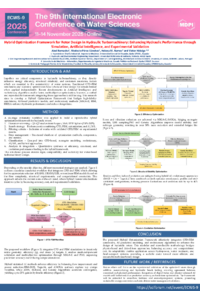
Poster_AR.pdf
Integration of Geological and Hydrological Parameters through a Bayesian Framework to Estimate Flood Likelihood: Case Study of the Ottawa River Basin, Canada
Integrated Hydraulic Modeling of the Lamia Water Distribution Network for Enhanced Resilience