Event submissions
Published
This submission belongs to the session S2. Urban Water Modelling and Management of the event The 9th International Electronic Conference on Water Sciences
Published date
06 Nov, 2025
Academic Editor
'%3e%3cpath%20d='M12.6657%2010.9104C12.4185%2010.325%2012.0599%209.79327%2011.6097%209.34482C11.1609%208.89508%2010.6293%208.5365%2010.0442%208.28888C10.0389%208.28626%2010.0337%208.28495%2010.0285%208.28233C10.8446%207.69279%2011.3752%206.73249%2011.3752%205.64904C11.3752%203.8542%209.92103%202.39999%208.1262%202.39999C6.33136%202.39999%204.87715%203.8542%204.87715%205.64904C4.87715%206.73249%205.40774%207.69279%206.22393%208.28364C6.21869%208.28626%206.21345%208.28757%206.20821%208.29019C5.62129%208.5378%205.09463%208.89284%204.64265%209.34613C4.1929%209.79493%203.83432%2010.3266%203.58671%2010.9117C3.34345%2011.4845%203.21226%2012.0987%203.20023%2012.7209C3.19988%2012.7349%203.20233%2012.7488%203.20744%2012.7619C3.21255%2012.7749%203.22022%2012.7867%203.22998%2012.7968C3.23975%2012.8068%203.25142%2012.8147%203.26431%2012.8202C3.2772%2012.8256%203.29105%2012.8284%203.30504%2012.8284H4.09109C4.14874%2012.8284%204.19459%2012.7825%204.1959%2012.7262C4.2221%2011.7148%204.62823%2010.7676%205.34617%2010.0497C6.08899%209.30683%207.0755%208.89808%208.1262%208.89808C9.17689%208.89808%2010.1634%209.30683%2010.9062%2010.0497C11.6242%2010.7676%2012.0303%2011.7148%2012.0565%2012.7262C12.0578%2012.7838%2012.1037%2012.8284%2012.1613%2012.8284H12.9474C12.9613%2012.8284%2012.9752%2012.8256%2012.9881%2012.8202C13.001%2012.8147%2013.0126%2012.8068%2013.0224%2012.7968C13.0322%2012.7867%2013.0398%2012.7749%2013.0449%2012.7619C13.0501%2012.7488%2013.0525%2012.7349%2013.0522%2012.7209C13.0391%2012.0947%2012.9094%2011.4855%2012.6657%2010.9104ZM8.1262%207.9024C7.52486%207.9024%206.9589%207.6679%206.53312%207.24211C6.10733%206.81633%205.87283%206.25037%205.87283%205.64904C5.87283%205.0477%206.10733%204.48174%206.53312%204.05596C6.9589%203.63018%207.52486%203.39567%208.1262%203.39567C8.72753%203.39567%209.29349%203.63018%209.71927%204.05596C10.1451%204.48174%2010.3796%205.0477%2010.3796%205.64904C10.3796%206.25037%2010.1451%206.81633%209.71927%207.24211C9.29349%207.6679%208.72753%207.9024%208.1262%207.9024Z'%20fill='%235D1EE1'/%3e%3c/g%3e%3c/svg%3e) Abbas Roozbahani
Abbas RoozbahaniCitation
Óscar Javier Burgos, Modesto Pérez-Sánchez, Oscar Enrique Coronado-Hernandez, Helena M. Ramos, Alfonso Arrieta-Pastrana, Historical Evolution and Software Selection Criteria for Transient Hydraulic Analysis with Hydro-Pneumatic Protection, in Proceedings of The 9th International Electronic Conference on Water Sciences, 11 November–14 November 2025, MDPI: Basel, Switzerland
Share
Email
Facebook
Twitter
LinkedIn
Historical Evolution and Software Selection Criteria for Transient Hydraulic Analysis with Hydro-Pneumatic Protection

Óscar Javier Burgos 1

Modesto Pérez-Sánchez 1
'%3e%3cpath%20d='M12.6647%2010.9104C12.4176%2010.325%2012.0589%209.7933%2011.6088%209.34485C11.16%208.89511%2010.6283%208.53653%2010.0432%208.28891C10.038%208.28629%2010.0327%208.28498%2010.0275%208.28236C10.8437%207.69282%2011.3743%206.73252%2011.3743%205.64907C11.3743%203.85423%209.92005%202.40002%208.12522%202.40002C6.33038%202.40002%204.87618%203.85423%204.87618%205.64907C4.87618%206.73252%205.40677%207.69282%206.22296%208.28367C6.21772%208.28629%206.21248%208.2876%206.20724%208.29022C5.62031%208.53783%205.09365%208.89287%204.64167%209.34616C4.19192%209.79496%203.83334%2010.3266%203.58573%2010.9117C3.34247%2011.4846%203.21128%2012.0987%203.19925%2012.721C3.1989%2012.735%203.20135%2012.7489%203.20646%2012.7619C3.21157%2012.7749%203.21924%2012.7868%203.22901%2012.7968C3.23877%2012.8068%203.25045%2012.8148%203.26334%2012.8202C3.27623%2012.8256%203.29007%2012.8284%203.30406%2012.8284H4.09012C4.14776%2012.8284%204.19362%2012.7825%204.19493%2012.7262C4.22113%2011.7148%204.62726%2010.7676%205.34519%2010.0497C6.08802%209.30686%207.07452%208.89811%208.12522%208.89811C9.17592%208.89811%2010.1624%209.30686%2010.9052%2010.0497C11.6232%2010.7676%2012.0293%2011.7148%2012.0555%2012.7262C12.0568%2012.7839%2012.1027%2012.8284%2012.1603%2012.8284H12.9464C12.9604%2012.8284%2012.9742%2012.8256%2012.9871%2012.8202C13%2012.8148%2013.0117%2012.8068%2013.0214%2012.7968C13.0312%2012.7868%2013.0389%2012.7749%2013.044%2012.7619C13.0491%2012.7489%2013.0515%2012.735%2013.0512%2012.721C13.0381%2012.0947%2012.9084%2011.4856%2012.6647%2010.9104ZM8.12522%207.90243C7.52388%207.90243%206.95792%207.66793%206.53214%207.24215C6.10636%206.81636%205.87185%206.2504%205.87185%205.64907C5.87185%205.04773%206.10636%204.48177%206.53214%204.05599C6.95792%203.63021%207.52388%203.3957%208.12522%203.3957C8.72655%203.3957%209.29252%203.63021%209.7183%204.05599C10.1441%204.48177%2010.3786%205.04773%2010.3786%205.64907C10.3786%206.2504%2010.1441%206.81636%209.7183%207.24215C9.29252%207.66793%208.72655%207.90243%208.12522%207.90243Z'%20fill='%235D1EE1'/%3e%3c/g%3e%3c/svg%3e)
Oscar Enrique Coronado-Hernandez 2

Helena M. Ramos 3
Alfonso Arrieta-Pastrana 2
1. Hydraulic and Environmental Engineering Department, Universitat Politècnica de València, 46022 Valencia, Spain
2. Instituto de Hidráulica y Saneamiento Ambiental, Universidad de Cartagena, Cartagena, Colombia
3. Civil Engineering Research and Innovation for Sustainability (CERIS), Instituto Superior Técnico,
Department of Civil Engineering, Architecture and Environment, University of Lisbon, Lisbon, Portugal
Abstract
The analysis of hydraulic transients has progressed substantially over the past three centuries, from early formulations by Newton and Euler to modern numerical models. This work presents a historical synthesis of key theoretical developments in transient flow modelling, including the Method of Characteristics and simplifications such as the Rigid Water Column Model (RWCM).
Building on this foundation, a structured evaluation matrix was developed to support the selection of simulation software for pressurised systems with hydro-pneumatic protection. This method combines technical, operational, and resource-based criteria to assess several software packages and guide engineers in choosing tools suited to complex water networks.
Using this matrix, the ALLIEVI software was selected to simulate a real-world case study with both RWCM and the Elastic Water Column Method (EWCM). Results show that RWCM can reduce computation time by over 70% compared to EWCM, with acceptable accuracy when protective devices are present. However, in unprotected systems, it may underestimate critical conditions.
To complement the simulations, a Coarse Tree machine learning model was trained on the results. It successfully classified risk conditions such as overpressure or sub-atmospheric events, achieving up to 100% accuracy in elastic model scenarios.
These findings offer practical guidance for engineers operating under design or computational constraints and identify scenarios where simplified models remain reliable.
Keywords
Hydraulic transients
Rigid Water Column Model (RWCM)
Elastic Water Column Method (EWCM)
Water hammer
Simulation software
Multi-criteria decision matrix
Hydro-pneumatic tank
Machine learning
Poster
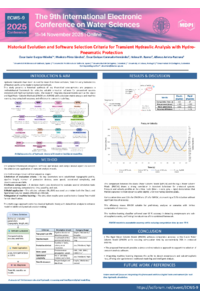
BurgosMendez_ECWS9_Poster.pdf
Hydrological and Pollutant Response of a Ceramic Roof: Implications for Stormwater Reuse
Non-Revenue Water (NRW) and Leakage Management: Global KPIs and Modelling Challenges