Event submissions
Published
This submission belongs to the session S3. River, Lake and Groundwater Hydraulics, Quality and Vulnerability of the event The 9th International Electronic Conference on Water Sciences
Published date
06 Nov, 2025
Academic Editor
'%3e%3cpath%20d='M12.6657%2010.9104C12.4185%2010.325%2012.0599%209.79327%2011.6097%209.34482C11.1609%208.89508%2010.6293%208.5365%2010.0442%208.28888C10.0389%208.28626%2010.0337%208.28495%2010.0285%208.28233C10.8446%207.69279%2011.3752%206.73249%2011.3752%205.64904C11.3752%203.8542%209.92103%202.39999%208.1262%202.39999C6.33136%202.39999%204.87715%203.8542%204.87715%205.64904C4.87715%206.73249%205.40774%207.69279%206.22393%208.28364C6.21869%208.28626%206.21345%208.28757%206.20821%208.29019C5.62129%208.5378%205.09463%208.89284%204.64265%209.34613C4.1929%209.79493%203.83432%2010.3266%203.58671%2010.9117C3.34345%2011.4845%203.21226%2012.0987%203.20023%2012.7209C3.19988%2012.7349%203.20233%2012.7488%203.20744%2012.7619C3.21255%2012.7749%203.22022%2012.7867%203.22998%2012.7968C3.23975%2012.8068%203.25142%2012.8147%203.26431%2012.8202C3.2772%2012.8256%203.29105%2012.8284%203.30504%2012.8284H4.09109C4.14874%2012.8284%204.19459%2012.7825%204.1959%2012.7262C4.2221%2011.7148%204.62823%2010.7676%205.34617%2010.0497C6.08899%209.30683%207.0755%208.89808%208.1262%208.89808C9.17689%208.89808%2010.1634%209.30683%2010.9062%2010.0497C11.6242%2010.7676%2012.0303%2011.7148%2012.0565%2012.7262C12.0578%2012.7838%2012.1037%2012.8284%2012.1613%2012.8284H12.9474C12.9613%2012.8284%2012.9752%2012.8256%2012.9881%2012.8202C13.001%2012.8147%2013.0126%2012.8068%2013.0224%2012.7968C13.0322%2012.7867%2013.0398%2012.7749%2013.0449%2012.7619C13.0501%2012.7488%2013.0525%2012.7349%2013.0522%2012.7209C13.0391%2012.0947%2012.9094%2011.4855%2012.6657%2010.9104ZM8.1262%207.9024C7.52486%207.9024%206.9589%207.6679%206.53312%207.24211C6.10733%206.81633%205.87283%206.25037%205.87283%205.64904C5.87283%205.0477%206.10733%204.48174%206.53312%204.05596C6.9589%203.63018%207.52486%203.39567%208.1262%203.39567C8.72753%203.39567%209.29349%203.63018%209.71927%204.05596C10.1451%204.48174%2010.3796%205.0477%2010.3796%205.64904C10.3796%206.25037%2010.1451%206.81633%209.71927%207.24211C9.29349%207.6679%208.72753%207.9024%208.1262%207.9024Z'%20fill='%235D1EE1'/%3e%3c/g%3e%3c/svg%3e) Nicolò Colombani
Nicolò ColombaniCitation
Mohamed-Amine LAHKIM-BENNANI, Abdelghani Afailal Tribak, Brunella Bonaccorso, Haitam Afilal, Abdelhamid Rossi, Early Hydrochemical Evolution of Groundwater Under Landfill Leachate Influence: Case of the Tangier Municipal Site, in Proceedings of The 9th International Electronic Conference on Water Sciences, 11 November–14 November 2025, MDPI: Basel, Switzerland
Share
Email
Facebook
Twitter
LinkedIn
Early Hydrochemical Evolution of Groundwater Under Landfill Leachate Influence: Case of the Tangier Municipal Site
'%3e%3cpath%20d='M12.6647%2010.9104C12.4176%2010.325%2012.0589%209.7933%2011.6088%209.34485C11.16%208.89511%2010.6283%208.53653%2010.0432%208.28891C10.038%208.28629%2010.0327%208.28498%2010.0275%208.28236C10.8437%207.69282%2011.3743%206.73252%2011.3743%205.64907C11.3743%203.85423%209.92005%202.40002%208.12522%202.40002C6.33038%202.40002%204.87618%203.85423%204.87618%205.64907C4.87618%206.73252%205.40677%207.69282%206.22296%208.28367C6.21772%208.28629%206.21248%208.2876%206.20724%208.29022C5.62031%208.53783%205.09365%208.89287%204.64167%209.34616C4.19192%209.79496%203.83334%2010.3266%203.58573%2010.9117C3.34247%2011.4846%203.21128%2012.0987%203.19925%2012.721C3.1989%2012.735%203.20135%2012.7489%203.20646%2012.7619C3.21157%2012.7749%203.21924%2012.7868%203.22901%2012.7968C3.23877%2012.8068%203.25045%2012.8148%203.26334%2012.8202C3.27623%2012.8256%203.29007%2012.8284%203.30406%2012.8284H4.09012C4.14776%2012.8284%204.19362%2012.7825%204.19493%2012.7262C4.22113%2011.7148%204.62726%2010.7676%205.34519%2010.0497C6.08802%209.30686%207.07452%208.89811%208.12522%208.89811C9.17592%208.89811%2010.1624%209.30686%2010.9052%2010.0497C11.6232%2010.7676%2012.0293%2011.7148%2012.0555%2012.7262C12.0568%2012.7839%2012.1027%2012.8284%2012.1603%2012.8284H12.9464C12.9604%2012.8284%2012.9742%2012.8256%2012.9871%2012.8202C13%2012.8148%2013.0117%2012.8068%2013.0214%2012.7968C13.0312%2012.7868%2013.0389%2012.7749%2013.044%2012.7619C13.0491%2012.7489%2013.0515%2012.735%2013.0512%2012.721C13.0381%2012.0947%2012.9084%2011.4856%2012.6647%2010.9104ZM8.12522%207.90243C7.52388%207.90243%206.95792%207.66793%206.53214%207.24215C6.10636%206.81636%205.87185%206.2504%205.87185%205.64907C5.87185%205.04773%206.10636%204.48177%206.53214%204.05599C6.95792%203.63021%207.52388%203.3957%208.12522%203.3957C8.72655%203.3957%209.29252%203.63021%209.7183%204.05599C10.1441%204.48177%2010.3786%205.04773%2010.3786%205.64907C10.3786%206.2504%2010.1441%206.81636%209.7183%207.24215C9.29252%207.66793%208.72655%207.90243%208.12522%207.90243Z'%20fill='%235D1EE1'/%3e%3c/g%3e%3c/svg%3e)
Mohamed-Amine LAHKIM-BENNANI 1,2
Abdelghani Afailal Tribak 1

Brunella Bonaccorso 2
Haitam Afilal 1

Abdelhamid Rossi 1
1. Research and Development in Applied Geosciences Laboratory, FSTT, Abdelmalek Essaadi University, Tetouan, Morocco
2. Department of Engineering, University of Messina, Villaggio S. Agata, 98166 Messina, Italy
Abstract
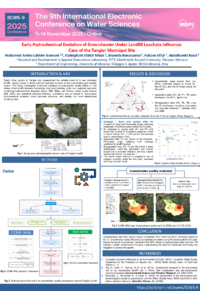
This study evaluates short-term changes in groundwater quality around the new municipal landfill of Tangier, Morocco . In total, 10 sampling sites (8 wells and 2 surface waters) within 2 km were sampled in late summer 2023 (S-23) and late winter 2025 (F-25), alongside the flow gradient. Major ions (ICs), trace metals (ICP-OES) and field parameters were analyzed; data were converted to milliequivalents and quality-checked by ionic balance error (IBE).
S-23 samples were mostly fresh Ca–HCO₃/Cl waters (EC < 1,000 µS cm⁻¹; TDS < 500 mg L⁻¹). By F-25, downgradient wells evolved from Ca–Cl to mixed Ca–Na–Cl–SO₄ facies, with Cl⁻ accounting for > 70% of anions and Ca²⁺ contributing to 20–50% of cations; the Piper diamond collapses toward the strong acid corner. A PCA on major ions (meq L⁻¹) shows PC1 (80.9%) as a salinity/leachate axis, clearly separating F-25 downgradient waters (notably P3–P4–P8) from upgradient S-23 points. PC2 (10.8%) represents hardness vs. alkalinity (SO₄/Mg/Ca vs HCO₃). A simple two-endmember chloride mixing model estimates the leachate fraction fL increasing from (0.0–0.1 upgradient) to (0.2–0.5 at P3–P4) and (0.9–1.0 at P8). Paired Wilcoxon tests (n = 10) on Cl⁻/SO₄²⁻ show non-significant p-values (0.19–0.38), reflecting limited power, yet large effect sizes are captured by PCA, medians and fL. Heavy metal enrichments (e.g., Fe, Mn and Zn) co-locate with high fL and strong acid fractions.
Together, these lines of evidence indicate rapid salinization and leachate intrusion in less than 2 years along the downgradient axis. We outline a monitoring framework (quarterly sampling, sentinel wells P3–P4–P8, trigger thresholds on EC/Cl/SO₄ and IBE), and propose MODFLOW transport modeling constrained by the local stratigraphy and measured heads to forecast plume migration and guide mitigation (drainage capture, liner integrity checks and wellhead protection).
Keywords
Groundwater quality
Leachate contamination
Landfill impact
Piper diagram
Hydrogeochemistry
Poster
Poster_PhD ECWS (final).pdf
Transient Leakage Estimation in Pressure-Reducing Valves: A Comparative Assessment Using RWCM and EPS Models
Fuzzy Triangular Finite Elements Solution for Solving the Nonlinear Boussinesq Equation