Event submissions
Published
This submission belongs to the session S3. River, Lake and Groundwater Hydraulics, Quality and Vulnerability of the event The 9th International Electronic Conference on Water Sciences
Published date
06 Nov, 2025
Academic Editor
'%3e%3cpath%20d='M12.6657%2010.9104C12.4185%2010.325%2012.0599%209.79327%2011.6097%209.34482C11.1609%208.89508%2010.6293%208.5365%2010.0442%208.28888C10.0389%208.28626%2010.0337%208.28495%2010.0285%208.28233C10.8446%207.69279%2011.3752%206.73249%2011.3752%205.64904C11.3752%203.8542%209.92103%202.39999%208.1262%202.39999C6.33136%202.39999%204.87715%203.8542%204.87715%205.64904C4.87715%206.73249%205.40774%207.69279%206.22393%208.28364C6.21869%208.28626%206.21345%208.28757%206.20821%208.29019C5.62129%208.5378%205.09463%208.89284%204.64265%209.34613C4.1929%209.79493%203.83432%2010.3266%203.58671%2010.9117C3.34345%2011.4845%203.21226%2012.0987%203.20023%2012.7209C3.19988%2012.7349%203.20233%2012.7488%203.20744%2012.7619C3.21255%2012.7749%203.22022%2012.7867%203.22998%2012.7968C3.23975%2012.8068%203.25142%2012.8147%203.26431%2012.8202C3.2772%2012.8256%203.29105%2012.8284%203.30504%2012.8284H4.09109C4.14874%2012.8284%204.19459%2012.7825%204.1959%2012.7262C4.2221%2011.7148%204.62823%2010.7676%205.34617%2010.0497C6.08899%209.30683%207.0755%208.89808%208.1262%208.89808C9.17689%208.89808%2010.1634%209.30683%2010.9062%2010.0497C11.6242%2010.7676%2012.0303%2011.7148%2012.0565%2012.7262C12.0578%2012.7838%2012.1037%2012.8284%2012.1613%2012.8284H12.9474C12.9613%2012.8284%2012.9752%2012.8256%2012.9881%2012.8202C13.001%2012.8147%2013.0126%2012.8068%2013.0224%2012.7968C13.0322%2012.7867%2013.0398%2012.7749%2013.0449%2012.7619C13.0501%2012.7488%2013.0525%2012.7349%2013.0522%2012.7209C13.0391%2012.0947%2012.9094%2011.4855%2012.6657%2010.9104ZM8.1262%207.9024C7.52486%207.9024%206.9589%207.6679%206.53312%207.24211C6.10733%206.81633%205.87283%206.25037%205.87283%205.64904C5.87283%205.0477%206.10733%204.48174%206.53312%204.05596C6.9589%203.63018%207.52486%203.39567%208.1262%203.39567C8.72753%203.39567%209.29349%203.63018%209.71927%204.05596C10.1451%204.48174%2010.3796%205.0477%2010.3796%205.64904C10.3796%206.25037%2010.1451%206.81633%209.71927%207.24211C9.29349%207.6679%208.72753%207.9024%208.1262%207.9024Z'%20fill='%235D1EE1'/%3e%3c/g%3e%3c/svg%3e) Nicolò Colombani
Nicolò ColombaniCitation
AIKATERINI PAPADAKI, MANOUSOS VALYRAKIS, Modulating Incipient Entrainment of Coarse Particles: The Impact of Flow Turbulence, in Proceedings of The 9th International Electronic Conference on Water Sciences, 11 November–14 November 2025, MDPI: Basel, Switzerland
Share
Email
Facebook
Twitter
LinkedIn
Modulating Incipient Entrainment of Coarse Particles: The Impact of Flow Turbulence
'%3e%3cpath%20d='M12.6647%2010.9104C12.4176%2010.325%2012.0589%209.7933%2011.6088%209.34485C11.16%208.89511%2010.6283%208.53653%2010.0432%208.28891C10.038%208.28629%2010.0327%208.28498%2010.0275%208.28236C10.8437%207.69282%2011.3743%206.73252%2011.3743%205.64907C11.3743%203.85423%209.92005%202.40002%208.12522%202.40002C6.33038%202.40002%204.87618%203.85423%204.87618%205.64907C4.87618%206.73252%205.40677%207.69282%206.22296%208.28367C6.21772%208.28629%206.21248%208.2876%206.20724%208.29022C5.62031%208.53783%205.09365%208.89287%204.64167%209.34616C4.19192%209.79496%203.83334%2010.3266%203.58573%2010.9117C3.34247%2011.4846%203.21128%2012.0987%203.19925%2012.721C3.1989%2012.735%203.20135%2012.7489%203.20646%2012.7619C3.21157%2012.7749%203.21924%2012.7868%203.22901%2012.7968C3.23877%2012.8068%203.25045%2012.8148%203.26334%2012.8202C3.27623%2012.8256%203.29007%2012.8284%203.30406%2012.8284H4.09012C4.14776%2012.8284%204.19362%2012.7825%204.19493%2012.7262C4.22113%2011.7148%204.62726%2010.7676%205.34519%2010.0497C6.08802%209.30686%207.07452%208.89811%208.12522%208.89811C9.17592%208.89811%2010.1624%209.30686%2010.9052%2010.0497C11.6232%2010.7676%2012.0293%2011.7148%2012.0555%2012.7262C12.0568%2012.7839%2012.1027%2012.8284%2012.1603%2012.8284H12.9464C12.9604%2012.8284%2012.9742%2012.8256%2012.9871%2012.8202C13%2012.8148%2013.0117%2012.8068%2013.0214%2012.7968C13.0312%2012.7868%2013.0389%2012.7749%2013.044%2012.7619C13.0491%2012.7489%2013.0515%2012.735%2013.0512%2012.721C13.0381%2012.0947%2012.9084%2011.4856%2012.6647%2010.9104ZM8.12522%207.90243C7.52388%207.90243%206.95792%207.66793%206.53214%207.24215C6.10636%206.81636%205.87185%206.2504%205.87185%205.64907C5.87185%205.04773%206.10636%204.48177%206.53214%204.05599C6.95792%203.63021%207.52388%203.3957%208.12522%203.3957C8.72655%203.3957%209.29252%203.63021%209.7183%204.05599C10.1441%204.48177%2010.3786%205.04773%2010.3786%205.64907C10.3786%206.2504%2010.1441%206.81636%209.7183%207.24215C9.29252%207.66793%208.72655%207.90243%208.12522%207.90243Z'%20fill='%235D1EE1'/%3e%3c/g%3e%3c/svg%3e)
AIKATERINI PAPADAKI 1

MANOUSOS VALYRAKIS 1
1. Division of Hydraulics & Env. Eng., School of Civil Engineering, Faculty of Engineering, Aristotle University Of Thessaloniki, Thessaloniki, 54124 Greece
Abstract
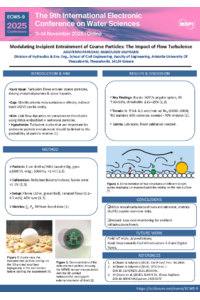
The incipient motion of coarse particles is a cornerstone of bed stability and sediment transport processes in turbulent flows, profoundly influencing riverbed morphodynamics and the resilience of hydraulic infrastructure. While traditional incipient motion criteria rely on steady-state shear stress thresholds, dynamic effects due to the inherent variability of flow turbulence remain poorly linked to the assessment of incipient particle entrainment in the lab or real-world field conditions.
This study aims to examine how alterations in flow conditions modulate the critical hydraulic thresholds for coarse particle entrainment under fully submerged, turbulent regimes. Leveraging instrumented particles integrated with inertial measurement units (IMUs) to capture real-time accelerations and angular velocities [1, 2], we dissect particle responses at the brink of motion. Derived flow--particle interaction metrics illuminate the mechanistic pathways, including torque generation and hydrodynamic lift, that govern entrainment [3, 4].
We hypothesize that flow turbulence can dramatically affect the energy imparted towards particle entrainment. These discoveries underscore the utility of IMU-derived metrics for predictive assessment of destabilization risks in dynamic river systems or scour-vulnerable channels.
References
- Al-Obaidi K, Xu Y, Valyrakis M. The design and calibration of instrumented particles for assessing water infrastructure hazards. J Sens Actuator Netw. 2020;9(3):36. doi:10.3390/jsan9030036.
- Al-Obaidi K, Valyrakis M. A sensory instrumented particle for environmental monitoring applications: development and calibration. IEEE Sens J. 2021;21(8):10153-10166. doi:10.1109/JSEN.2021.3053080.
- Al-Obaidi K, Valyrakis M. Linking the explicit probability of entrainment of instrumented particles to flow hydrodynamics. Earth Surf Process Landf. 2021;46(12):2448-2465. doi:10.1002/esp.5178.
- Al-Obaidi K, Valyrakis M. Coherent flow structures linked to the impulse criterion for incipient motion of coarse sediment. Appl Sci (Basel). 2023;13(19):10656. doi:10.3390/app131910656.
Keywords
Sediment transport
hydraulic engineering
flow turbulence
instrumentation
Poster
Poster 2 MV.pdf
An early warning indicator of hydrological drought for enhancing reservoir operation rules
A Comparative Physical Assessment of intensified Global Flood Susceptibility Assessing Global Flood Susceptibility Through Multi-Parameter Integration