Event submissions
Published
This submission belongs to the session S3. River, Lake and Groundwater Hydraulics, Quality and Vulnerability of the event The 9th International Electronic Conference on Water Sciences
Published date
06 Nov, 2025
Academic Editor
'%3e%3cpath%20d='M12.6657%2010.9104C12.4185%2010.325%2012.0599%209.79327%2011.6097%209.34482C11.1609%208.89508%2010.6293%208.5365%2010.0442%208.28888C10.0389%208.28626%2010.0337%208.28495%2010.0285%208.28233C10.8446%207.69279%2011.3752%206.73249%2011.3752%205.64904C11.3752%203.8542%209.92103%202.39999%208.1262%202.39999C6.33136%202.39999%204.87715%203.8542%204.87715%205.64904C4.87715%206.73249%205.40774%207.69279%206.22393%208.28364C6.21869%208.28626%206.21345%208.28757%206.20821%208.29019C5.62129%208.5378%205.09463%208.89284%204.64265%209.34613C4.1929%209.79493%203.83432%2010.3266%203.58671%2010.9117C3.34345%2011.4845%203.21226%2012.0987%203.20023%2012.7209C3.19988%2012.7349%203.20233%2012.7488%203.20744%2012.7619C3.21255%2012.7749%203.22022%2012.7867%203.22998%2012.7968C3.23975%2012.8068%203.25142%2012.8147%203.26431%2012.8202C3.2772%2012.8256%203.29105%2012.8284%203.30504%2012.8284H4.09109C4.14874%2012.8284%204.19459%2012.7825%204.1959%2012.7262C4.2221%2011.7148%204.62823%2010.7676%205.34617%2010.0497C6.08899%209.30683%207.0755%208.89808%208.1262%208.89808C9.17689%208.89808%2010.1634%209.30683%2010.9062%2010.0497C11.6242%2010.7676%2012.0303%2011.7148%2012.0565%2012.7262C12.0578%2012.7838%2012.1037%2012.8284%2012.1613%2012.8284H12.9474C12.9613%2012.8284%2012.9752%2012.8256%2012.9881%2012.8202C13.001%2012.8147%2013.0126%2012.8068%2013.0224%2012.7968C13.0322%2012.7867%2013.0398%2012.7749%2013.0449%2012.7619C13.0501%2012.7488%2013.0525%2012.7349%2013.0522%2012.7209C13.0391%2012.0947%2012.9094%2011.4855%2012.6657%2010.9104ZM8.1262%207.9024C7.52486%207.9024%206.9589%207.6679%206.53312%207.24211C6.10733%206.81633%205.87283%206.25037%205.87283%205.64904C5.87283%205.0477%206.10733%204.48174%206.53312%204.05596C6.9589%203.63018%207.52486%203.39567%208.1262%203.39567C8.72753%203.39567%209.29349%203.63018%209.71927%204.05596C10.1451%204.48174%2010.3796%205.0477%2010.3796%205.64904C10.3796%206.25037%2010.1451%206.81633%209.71927%207.24211C9.29349%207.6679%208.72753%207.9024%208.1262%207.9024Z'%20fill='%235D1EE1'/%3e%3c/g%3e%3c/svg%3e) Nicolò Colombani
Nicolò ColombaniCitation
Kouassi Jean-Michel Kouassi, Yao Emile Desmond KONAN, Kouamé Jean Olivier KOUADIO, Oi Mangoua Jules MANGOUA, Yvan ROSSIER, Patrick LACHASSAGNE, Brou DIBI, Sustainable management of springs in a crystalline basement context using a coupled hydrogeophysical and hydrodynamic modelling approach (Daloa, Central-Western Côte d’Ivoire), in Proceedings of The 9th International Electronic Conference on Water Sciences, 11 November–14 November 2025, MDPI: Basel, Switzerland
Share
Email
Facebook
Twitter
LinkedIn
Sustainable management of springs in a crystalline basement context using a coupled hydrogeophysical and hydrodynamic modelling approach (Daloa, Central-Western Côte d’Ivoire)
'%3e%3cpath%20d='M12.6647%2010.9104C12.4176%2010.325%2012.0589%209.7933%2011.6088%209.34485C11.16%208.89511%2010.6283%208.53653%2010.0432%208.28891C10.038%208.28629%2010.0327%208.28498%2010.0275%208.28236C10.8437%207.69282%2011.3743%206.73252%2011.3743%205.64907C11.3743%203.85423%209.92005%202.40002%208.12522%202.40002C6.33038%202.40002%204.87618%203.85423%204.87618%205.64907C4.87618%206.73252%205.40677%207.69282%206.22296%208.28367C6.21772%208.28629%206.21248%208.2876%206.20724%208.29022C5.62031%208.53783%205.09365%208.89287%204.64167%209.34616C4.19192%209.79496%203.83334%2010.3266%203.58573%2010.9117C3.34247%2011.4846%203.21128%2012.0987%203.19925%2012.721C3.1989%2012.735%203.20135%2012.7489%203.20646%2012.7619C3.21157%2012.7749%203.21924%2012.7868%203.22901%2012.7968C3.23877%2012.8068%203.25045%2012.8148%203.26334%2012.8202C3.27623%2012.8256%203.29007%2012.8284%203.30406%2012.8284H4.09012C4.14776%2012.8284%204.19362%2012.7825%204.19493%2012.7262C4.22113%2011.7148%204.62726%2010.7676%205.34519%2010.0497C6.08802%209.30686%207.07452%208.89811%208.12522%208.89811C9.17592%208.89811%2010.1624%209.30686%2010.9052%2010.0497C11.6232%2010.7676%2012.0293%2011.7148%2012.0555%2012.7262C12.0568%2012.7839%2012.1027%2012.8284%2012.1603%2012.8284H12.9464C12.9604%2012.8284%2012.9742%2012.8256%2012.9871%2012.8202C13%2012.8148%2013.0117%2012.8068%2013.0214%2012.7968C13.0312%2012.7868%2013.0389%2012.7749%2013.044%2012.7619C13.0491%2012.7489%2013.0515%2012.735%2013.0512%2012.721C13.0381%2012.0947%2012.9084%2011.4856%2012.6647%2010.9104ZM8.12522%207.90243C7.52388%207.90243%206.95792%207.66793%206.53214%207.24215C6.10636%206.81636%205.87185%206.2504%205.87185%205.64907C5.87185%205.04773%206.10636%204.48177%206.53214%204.05599C6.95792%203.63021%207.52388%203.3957%208.12522%203.3957C8.72655%203.3957%209.29252%203.63021%209.7183%204.05599C10.1441%204.48177%2010.3786%205.04773%2010.3786%205.64907C10.3786%206.2504%2010.1441%206.81636%209.7183%207.24215C9.29252%207.66793%208.72655%207.90243%208.12522%207.90243Z'%20fill='%235D1EE1'/%3e%3c/g%3e%3c/svg%3e)
Kouassi Jean-Michel Kouassi 1,2
Yao Emile Desmond KONAN 1
Kouamé Jean Olivier KOUADIO 3
Oi Mangoua Jules MANGOUA 1
Yvan ROSSIER 4
Patrick LACHASSAGNE 2
Brou DIBI 1
1. Laboratory of Environmental Sciences and Technologies, Univ. Jean Lorougnon GUEDE, Daloa, Côte d’Ivoire
2. HSM, Univ. Montpellier, CNRS, IRD, IMT Mines Alès, Montpellier, France
3. Geology and Mineral Resources Laboratory, University of Felix Houphouet Boigny, Abidjan, Côte d’Ivoire
4. IGE, Univ. Grenoble Alpes, CNRS, INRAE, IRD, Grenoble INP, 38000 Grenoble, France
Abstract
Spring management in crystalline basement regions is essential in order to respond to the impacts of climate change and the challenges of supplying drinking water to large urban areas. This study therefore aims to understand the hydrogeological functioning of the aquifer system supplying springs in altered and fractured crystalline basement regions, in order to ensure effective and sustainable protection of springs in these regions. To achieve this objective, the methodological approach first consisted of describing the aquifer system supplying the springs based on drilling and field data in a representative crystalline aquifer (Daloa, Côte d'Ivoire). Next, electrical resistivity tomography was used, after validation of the appropriate inversion method, to develop the Hydrogeological Conceptual Model (HCM) of the springs. This HCM was then used as the basis for developing a groundwater flow model using a finite element numerical code (FEFLOW). The results show that the most productive part of the fractured horizon is located within the first 40 metres below the saprolite, with an average transmissivity of 1.3×10⁻⁴ m²/s. The saprolite has an average hydraulic conductivity of 6.9×10⁻⁶ m/s and an average effective porosity of 5.6%. The estimated direct recharge is 35 mm/year (4% of rainfall, 2022). The cumulative average discharge of the springs is 9 L/s. The conceptual model developed reveals that the springs are mainly fed by isalterites, composed of sands and arenas. The underlying fractured layer, located a few dozen meters deep below the springs, does not contribute directly to their supply. The digital model made it possible to define springs capture zones (0.17 to 1 km²) and protection perimeters (30 meters: immediate perimeter, 130 meters: close perimeter, capture zone for the distant perimeter). These results provide essential information of sustainable management springs in crystalline basement environments and for guiding decision-makers in defining effective action programmes.
Keywords
hydrogeophysical
HCM
hydrodynamic modelling
FEFLOW
capture area
crystalline aquifer
spring
Daloa
Poster
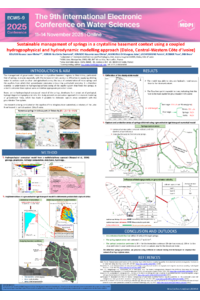
Poster_KOUASSI.pdf
Assessment of Physicochemical Characteristics of River Landzun and River Umaru in Bida, Niger State, Nigeria
Hydrogeological facies evolution in a mining context: the case of the Kankan aquifer (Guinea)