Event submissions
Published
This submission belongs to the session S3. River, Lake and Groundwater Hydraulics, Quality and Vulnerability of the event The 9th International Electronic Conference on Water Sciences
Published date
06 Nov, 2025
Academic Editor
'%3e%3cpath%20d='M12.6657%2010.9104C12.4185%2010.325%2012.0599%209.79327%2011.6097%209.34482C11.1609%208.89508%2010.6293%208.5365%2010.0442%208.28888C10.0389%208.28626%2010.0337%208.28495%2010.0285%208.28233C10.8446%207.69279%2011.3752%206.73249%2011.3752%205.64904C11.3752%203.8542%209.92103%202.39999%208.1262%202.39999C6.33136%202.39999%204.87715%203.8542%204.87715%205.64904C4.87715%206.73249%205.40774%207.69279%206.22393%208.28364C6.21869%208.28626%206.21345%208.28757%206.20821%208.29019C5.62129%208.5378%205.09463%208.89284%204.64265%209.34613C4.1929%209.79493%203.83432%2010.3266%203.58671%2010.9117C3.34345%2011.4845%203.21226%2012.0987%203.20023%2012.7209C3.19988%2012.7349%203.20233%2012.7488%203.20744%2012.7619C3.21255%2012.7749%203.22022%2012.7867%203.22998%2012.7968C3.23975%2012.8068%203.25142%2012.8147%203.26431%2012.8202C3.2772%2012.8256%203.29105%2012.8284%203.30504%2012.8284H4.09109C4.14874%2012.8284%204.19459%2012.7825%204.1959%2012.7262C4.2221%2011.7148%204.62823%2010.7676%205.34617%2010.0497C6.08899%209.30683%207.0755%208.89808%208.1262%208.89808C9.17689%208.89808%2010.1634%209.30683%2010.9062%2010.0497C11.6242%2010.7676%2012.0303%2011.7148%2012.0565%2012.7262C12.0578%2012.7838%2012.1037%2012.8284%2012.1613%2012.8284H12.9474C12.9613%2012.8284%2012.9752%2012.8256%2012.9881%2012.8202C13.001%2012.8147%2013.0126%2012.8068%2013.0224%2012.7968C13.0322%2012.7867%2013.0398%2012.7749%2013.0449%2012.7619C13.0501%2012.7488%2013.0525%2012.7349%2013.0522%2012.7209C13.0391%2012.0947%2012.9094%2011.4855%2012.6657%2010.9104ZM8.1262%207.9024C7.52486%207.9024%206.9589%207.6679%206.53312%207.24211C6.10733%206.81633%205.87283%206.25037%205.87283%205.64904C5.87283%205.0477%206.10733%204.48174%206.53312%204.05596C6.9589%203.63018%207.52486%203.39567%208.1262%203.39567C8.72753%203.39567%209.29349%203.63018%209.71927%204.05596C10.1451%204.48174%2010.3796%205.0477%2010.3796%205.64904C10.3796%206.25037%2010.1451%206.81633%209.71927%207.24211C9.29349%207.6679%208.72753%207.9024%208.1262%207.9024Z'%20fill='%235D1EE1'/%3e%3c/g%3e%3c/svg%3e) Nicolò Colombani
Nicolò ColombaniCitation
Seyni Ndoye, Mathias Diedhiou, Philippe LE Coustumer, Arnaud Gauthier, Assessment of the quality and acquisition of groundwater mineralization in the Mbour Fatick area, central–western Senegal, in Proceedings of The 9th International Electronic Conference on Water Sciences, 11 November–14 November 2025, MDPI: Basel, Switzerland
Share
Email
Facebook
Twitter
LinkedIn
Assessment of the quality and acquisition of groundwater mineralization in the Mbour Fatick area, central–western Senegal
'%3e%3cpath%20d='M12.6647%2010.9104C12.4176%2010.325%2012.0589%209.7933%2011.6088%209.34485C11.16%208.89511%2010.6283%208.53653%2010.0432%208.28891C10.038%208.28629%2010.0327%208.28498%2010.0275%208.28236C10.8437%207.69282%2011.3743%206.73252%2011.3743%205.64907C11.3743%203.85423%209.92005%202.40002%208.12522%202.40002C6.33038%202.40002%204.87618%203.85423%204.87618%205.64907C4.87618%206.73252%205.40677%207.69282%206.22296%208.28367C6.21772%208.28629%206.21248%208.2876%206.20724%208.29022C5.62031%208.53783%205.09365%208.89287%204.64167%209.34616C4.19192%209.79496%203.83334%2010.3266%203.58573%2010.9117C3.34247%2011.4846%203.21128%2012.0987%203.19925%2012.721C3.1989%2012.735%203.20135%2012.7489%203.20646%2012.7619C3.21157%2012.7749%203.21924%2012.7868%203.22901%2012.7968C3.23877%2012.8068%203.25045%2012.8148%203.26334%2012.8202C3.27623%2012.8256%203.29007%2012.8284%203.30406%2012.8284H4.09012C4.14776%2012.8284%204.19362%2012.7825%204.19493%2012.7262C4.22113%2011.7148%204.62726%2010.7676%205.34519%2010.0497C6.08802%209.30686%207.07452%208.89811%208.12522%208.89811C9.17592%208.89811%2010.1624%209.30686%2010.9052%2010.0497C11.6232%2010.7676%2012.0293%2011.7148%2012.0555%2012.7262C12.0568%2012.7839%2012.1027%2012.8284%2012.1603%2012.8284H12.9464C12.9604%2012.8284%2012.9742%2012.8256%2012.9871%2012.8202C13%2012.8148%2013.0117%2012.8068%2013.0214%2012.7968C13.0312%2012.7868%2013.0389%2012.7749%2013.044%2012.7619C13.0491%2012.7489%2013.0515%2012.735%2013.0512%2012.721C13.0381%2012.0947%2012.9084%2011.4856%2012.6647%2010.9104ZM8.12522%207.90243C7.52388%207.90243%206.95792%207.66793%206.53214%207.24215C6.10636%206.81636%205.87185%206.2504%205.87185%205.64907C5.87185%205.04773%206.10636%204.48177%206.53214%204.05599C6.95792%203.63021%207.52388%203.3957%208.12522%203.3957C8.72655%203.3957%209.29252%203.63021%209.7183%204.05599C10.1441%204.48177%2010.3786%205.04773%2010.3786%205.64907C10.3786%206.2504%2010.1441%206.81636%209.7183%207.24215C9.29252%207.66793%208.72655%207.90243%208.12522%207.90243Z'%20fill='%235D1EE1'/%3e%3c/g%3e%3c/svg%3e)
Seyni Ndoye 1
Mathias Diedhiou 2

Philippe LE Coustumer 3
Arnaud Gauthier 4
1. Laboratoire Eau-Energie-Environnement-Procédés industriels (LE3PI), Ecole Supérieure Polytechnique, Université Cheikh Anta DIOP, Dakar, Sénégal
2. Département de Géologie, Faculté des Sciences et Techniques, Université Cheikh Anta Diop, Dakar, Sénégal
3. Bordeaux Imaging Center, Université de Bordeaux, Bordeaux, France
4. Univ. Lille, Univ. Artois, IMT Lille Douai, JUNIA, ULR 4515 – LGCgE, Laboratoire de Génie Civil et Géo-Environnement, F-59000 Lille, France
Abstract
Abstract: Water resource management is one of the major global challenges today, both in terms of agricultural and industrial activities and direct consumption by the population. Access to drinking water is a major priority in the Mbour Fatick area (central–western Senegal), where groundwater resources, the only ones available, are subject to severe climatic and anthropogenic pressures. Several aquifers contain significant groundwater quantities, but the quality does not meet consumption standards due to deterioration caused by natural and/or anthropogenic processes. This work aims to update knowledge on the chemical quality of groundwater. Its main objective is to assess changes in groundwater chemistry, identify the processes responsible for mineralization, and determine the suitability of the water for consumption. The study was based on the results of physicochemical analyses of 42 samples collected during two campaigns conducted in September 2019 (22 wells and 20 boreholes) and May–June 2023 (20 wells and 15 boreholes), as well as data from SARR's work in 1982. The methodological approach used to achieve these objectives incorporates both hydrogeochemistry and multivariate statistical analysis. The results obtained show that pH values range from 6.89 to 8.2, indicating that the waters are neutral to basic. Geochemical analysis shows that water–rock interaction (dissolution and alteration of carbonate and silicate minerals), ion exchange, and evaporation are the main processes regulating the water chemistry. A comparative study of fluoride and chloride ion concentrations between different datasets shows significant spatial and temporal variation. Hierarchical cluster analyses (HCA) revealed the presence of two water groups: highly mineralized waters and moderately mineralized alkaline waters with dominant facies of the mixed Cl-type and mixed HCO3-type, respectively. Calculation of Total Health Index (THI) for fluoride indicates that the health risk is very high, especially in children, with a high probability of diseases such as dental and bone fluorosis.
Keywords
Groundwater
processes
mineralization
spatio-temporal variation
multivariate statistical
fluoride
Mbour-Fatick
Poster
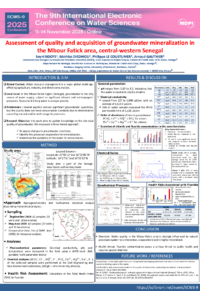
Poster_SND_Abstract_sciforum-151841.pdf
Disinfection of Water for Human Consumption in Rural Communities of Peru Using a UV-C LED Prototype
Evaluation of microplastics abundance in a peri-urban river