Event submissions
Published
This submission belongs to the session S3. River, Lake and Groundwater Hydraulics, Quality and Vulnerability of the event The 9th International Electronic Conference on Water Sciences
Published date
06 Nov, 2025
Academic Editor
'%3e%3cpath%20d='M12.6657%2010.9104C12.4185%2010.325%2012.0599%209.79327%2011.6097%209.34482C11.1609%208.89508%2010.6293%208.5365%2010.0442%208.28888C10.0389%208.28626%2010.0337%208.28495%2010.0285%208.28233C10.8446%207.69279%2011.3752%206.73249%2011.3752%205.64904C11.3752%203.8542%209.92103%202.39999%208.1262%202.39999C6.33136%202.39999%204.87715%203.8542%204.87715%205.64904C4.87715%206.73249%205.40774%207.69279%206.22393%208.28364C6.21869%208.28626%206.21345%208.28757%206.20821%208.29019C5.62129%208.5378%205.09463%208.89284%204.64265%209.34613C4.1929%209.79493%203.83432%2010.3266%203.58671%2010.9117C3.34345%2011.4845%203.21226%2012.0987%203.20023%2012.7209C3.19988%2012.7349%203.20233%2012.7488%203.20744%2012.7619C3.21255%2012.7749%203.22022%2012.7867%203.22998%2012.7968C3.23975%2012.8068%203.25142%2012.8147%203.26431%2012.8202C3.2772%2012.8256%203.29105%2012.8284%203.30504%2012.8284H4.09109C4.14874%2012.8284%204.19459%2012.7825%204.1959%2012.7262C4.2221%2011.7148%204.62823%2010.7676%205.34617%2010.0497C6.08899%209.30683%207.0755%208.89808%208.1262%208.89808C9.17689%208.89808%2010.1634%209.30683%2010.9062%2010.0497C11.6242%2010.7676%2012.0303%2011.7148%2012.0565%2012.7262C12.0578%2012.7838%2012.1037%2012.8284%2012.1613%2012.8284H12.9474C12.9613%2012.8284%2012.9752%2012.8256%2012.9881%2012.8202C13.001%2012.8147%2013.0126%2012.8068%2013.0224%2012.7968C13.0322%2012.7867%2013.0398%2012.7749%2013.0449%2012.7619C13.0501%2012.7488%2013.0525%2012.7349%2013.0522%2012.7209C13.0391%2012.0947%2012.9094%2011.4855%2012.6657%2010.9104ZM8.1262%207.9024C7.52486%207.9024%206.9589%207.6679%206.53312%207.24211C6.10733%206.81633%205.87283%206.25037%205.87283%205.64904C5.87283%205.0477%206.10733%204.48174%206.53312%204.05596C6.9589%203.63018%207.52486%203.39567%208.1262%203.39567C8.72753%203.39567%209.29349%203.63018%209.71927%204.05596C10.1451%204.48174%2010.3796%205.0477%2010.3796%205.64904C10.3796%206.25037%2010.1451%206.81633%209.71927%207.24211C9.29349%207.6679%208.72753%207.9024%208.1262%207.9024Z'%20fill='%235D1EE1'/%3e%3c/g%3e%3c/svg%3e) Nicolò Colombani
Nicolò ColombaniCitation
Elfrida Carstea, Simona I. Dontu, Cristina L. Popa, Daniel Tenciu, Seasonal variability of fluorescence dissolved organic matter in peri-urban rivers, in Proceedings of The 9th International Electronic Conference on Water Sciences, 11 November–14 November 2025, MDPI: Basel, Switzerland
Share
Email
Facebook
Twitter
LinkedIn
Seasonal variability of fluorescence dissolved organic matter in peri-urban rivers
'%3e%3cpath%20d='M12.6647%2010.9104C12.4176%2010.325%2012.0589%209.7933%2011.6088%209.34485C11.16%208.89511%2010.6283%208.53653%2010.0432%208.28891C10.038%208.28629%2010.0327%208.28498%2010.0275%208.28236C10.8437%207.69282%2011.3743%206.73252%2011.3743%205.64907C11.3743%203.85423%209.92005%202.40002%208.12522%202.40002C6.33038%202.40002%204.87618%203.85423%204.87618%205.64907C4.87618%206.73252%205.40677%207.69282%206.22296%208.28367C6.21772%208.28629%206.21248%208.2876%206.20724%208.29022C5.62031%208.53783%205.09365%208.89287%204.64167%209.34616C4.19192%209.79496%203.83334%2010.3266%203.58573%2010.9117C3.34247%2011.4846%203.21128%2012.0987%203.19925%2012.721C3.1989%2012.735%203.20135%2012.7489%203.20646%2012.7619C3.21157%2012.7749%203.21924%2012.7868%203.22901%2012.7968C3.23877%2012.8068%203.25045%2012.8148%203.26334%2012.8202C3.27623%2012.8256%203.29007%2012.8284%203.30406%2012.8284H4.09012C4.14776%2012.8284%204.19362%2012.7825%204.19493%2012.7262C4.22113%2011.7148%204.62726%2010.7676%205.34519%2010.0497C6.08802%209.30686%207.07452%208.89811%208.12522%208.89811C9.17592%208.89811%2010.1624%209.30686%2010.9052%2010.0497C11.6232%2010.7676%2012.0293%2011.7148%2012.0555%2012.7262C12.0568%2012.7839%2012.1027%2012.8284%2012.1603%2012.8284H12.9464C12.9604%2012.8284%2012.9742%2012.8256%2012.9871%2012.8202C13%2012.8148%2013.0117%2012.8068%2013.0214%2012.7968C13.0312%2012.7868%2013.0389%2012.7749%2013.044%2012.7619C13.0491%2012.7489%2013.0515%2012.735%2013.0512%2012.721C13.0381%2012.0947%2012.9084%2011.4856%2012.6647%2010.9104ZM8.12522%207.90243C7.52388%207.90243%206.95792%207.66793%206.53214%207.24215C6.10636%206.81636%205.87185%206.2504%205.87185%205.64907C5.87185%205.04773%206.10636%204.48177%206.53214%204.05599C6.95792%203.63021%207.52388%203.3957%208.12522%203.3957C8.72655%203.3957%209.29252%203.63021%209.7183%204.05599C10.1441%204.48177%2010.3786%205.04773%2010.3786%205.64907C10.3786%206.2504%2010.1441%206.81636%209.7183%207.24215C9.29252%207.66793%208.72655%207.90243%208.12522%207.90243Z'%20fill='%235D1EE1'/%3e%3c/g%3e%3c/svg%3e)
Elfrida Carstea 1
Simona I. Dontu 2
Cristina L. Popa 2
Daniel Tenciu 2
1. Department of Technological and Constructive Engineering, National Institute of R&D for Optoelectronics, INOE 2000, Magurele, Ilfov 077125, Romania
2. National Institute of R&D for Optoelectronics, Atomistilor 409, Magurele, Ilfov, Romania
Abstract
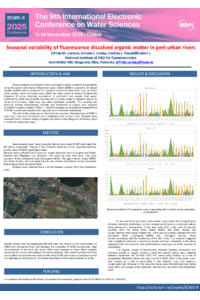
Rivers transport and transform dissolved organic matter, nutrients, and pollutants along the system and beyond. Dissolved organic matter (DOM) is present in all natural aquatic systems and is composed of a complex mixture of compounds, such as amino acids, sugars, and fulvic and humic acids. DOM has been shown to directly influence the presence of active microbial populations in sediments and aquatic food webs. Furthermore, DOM may facilitate the transport of a wide range of pollutants due to its ability to bind heavy metal ions and other persistent pollutants. This modifies the solubility, toxicity, bioavailability, mobility, and distribution of organic and inorganic pollutants in aquatic systems. There is limited knowledge available on the temporal characteristics of DOM in rivers with pollution from agricultural and domestic wastewater. The aim of this study was to determine the seasonal characteristics of DOM in peri-urban rivers and the impact from precipitation and surface runoff. Samples were collected from five locations along the Ciorogarla and Sabar rivers (Magurele, Romania), twice a month, for two years. Measurements were made using the Hanna Instruments HI 255 multimeter, the PF-12Plus photometer, Thermo Fisher Scientific Nanodrop OneC spectrophotometer and the Jasco FP8200 spectrofluorimeter. The results showed that the wastewater effluents have little impact on the concentration of DOM from Ciorogarla River but changed the properties of DOM components. High concentrations of microbial and humic DOM were detected in Sabar River samples caused by the release of municipal and farm wastewater. Dry summer periods led to the accumulation of autochthonous and allochthonous DOM, while autumn precipitations led to a decrease in both fractions. The lowest quantities of DOM were observed in winter.
This research was funded by the Ministry of Education and Research, grant number OPTRONICA VII PN23 05 (11N/2023).
Keywords
rivers
dissolved organic matter
fluorescence spectroscopy
Poster
sciforum-150299.pdf
Evaluation of microplastics abundance in a peri-urban river
Numerical study of turbulent open-channel flow in the presence of emergent vegetation located at the lee side of a single groyne