Event submissions
Published
This submission belongs to the session S3. River, Lake and Groundwater Hydraulics, Quality and Vulnerability of the event The 9th International Electronic Conference on Water Sciences
Published date
06 Nov, 2025
Academic Editor
'%3e%3cpath%20d='M12.6657%2010.9104C12.4185%2010.325%2012.0599%209.79327%2011.6097%209.34482C11.1609%208.89508%2010.6293%208.5365%2010.0442%208.28888C10.0389%208.28626%2010.0337%208.28495%2010.0285%208.28233C10.8446%207.69279%2011.3752%206.73249%2011.3752%205.64904C11.3752%203.8542%209.92103%202.39999%208.1262%202.39999C6.33136%202.39999%204.87715%203.8542%204.87715%205.64904C4.87715%206.73249%205.40774%207.69279%206.22393%208.28364C6.21869%208.28626%206.21345%208.28757%206.20821%208.29019C5.62129%208.5378%205.09463%208.89284%204.64265%209.34613C4.1929%209.79493%203.83432%2010.3266%203.58671%2010.9117C3.34345%2011.4845%203.21226%2012.0987%203.20023%2012.7209C3.19988%2012.7349%203.20233%2012.7488%203.20744%2012.7619C3.21255%2012.7749%203.22022%2012.7867%203.22998%2012.7968C3.23975%2012.8068%203.25142%2012.8147%203.26431%2012.8202C3.2772%2012.8256%203.29105%2012.8284%203.30504%2012.8284H4.09109C4.14874%2012.8284%204.19459%2012.7825%204.1959%2012.7262C4.2221%2011.7148%204.62823%2010.7676%205.34617%2010.0497C6.08899%209.30683%207.0755%208.89808%208.1262%208.89808C9.17689%208.89808%2010.1634%209.30683%2010.9062%2010.0497C11.6242%2010.7676%2012.0303%2011.7148%2012.0565%2012.7262C12.0578%2012.7838%2012.1037%2012.8284%2012.1613%2012.8284H12.9474C12.9613%2012.8284%2012.9752%2012.8256%2012.9881%2012.8202C13.001%2012.8147%2013.0126%2012.8068%2013.0224%2012.7968C13.0322%2012.7867%2013.0398%2012.7749%2013.0449%2012.7619C13.0501%2012.7488%2013.0525%2012.7349%2013.0522%2012.7209C13.0391%2012.0947%2012.9094%2011.4855%2012.6657%2010.9104ZM8.1262%207.9024C7.52486%207.9024%206.9589%207.6679%206.53312%207.24211C6.10733%206.81633%205.87283%206.25037%205.87283%205.64904C5.87283%205.0477%206.10733%204.48174%206.53312%204.05596C6.9589%203.63018%207.52486%203.39567%208.1262%203.39567C8.72753%203.39567%209.29349%203.63018%209.71927%204.05596C10.1451%204.48174%2010.3796%205.0477%2010.3796%205.64904C10.3796%206.25037%2010.1451%206.81633%209.71927%207.24211C9.29349%207.6679%208.72753%207.9024%208.1262%207.9024Z'%20fill='%235D1EE1'/%3e%3c/g%3e%3c/svg%3e) Nicolò Colombani
Nicolò ColombaniCitation
Vassilios Papaioannou, Prinos Panagiotis, Effects of Rayleigh number on thermal siphons in Triangular Water Bodies, in Proceedings of The 9th International Electronic Conference on Water Sciences, 11 November–14 November 2025, MDPI: Basel, Switzerland
Share
Email
Facebook
Twitter
LinkedIn
Effects of Rayleigh number on thermal siphons in Triangular Water Bodies

Vassilios Papaioannou 1

Prinos Panagiotis 2
1. Information Technologies Institute (ITI), Centre for Research and Technology Hellas (CERTH), Thessaloniki, GR-57001, Greece
2. Department of Civil Engineering, School of Civil Engineering, Faculty of Engineering, Aristotle University of Thessaloniki, Thessaloniki, 54124, Greece
Abstract
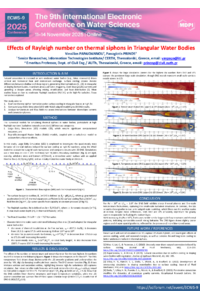
Natural convection, driven by surface cooling, in water bodies (lake, reservoirs etc.) has been investigated in the past with emphasis on the development of thermal siphons (large-scale overturning circulation). The latter is the result of faster cooling of the shallow nearshore regions and the development of horizontal exchange between shallow and deep waters. Initially, the water body is characterized by local, quasi-isotropic convective cells, and, afterwards, a two-layer exchange flow, which characterizes the large-scale circulation, develops. Finally, a quasi-steady state is achieved during which the produced water discharge remains constant.
The numerical models used for simulating thermal siphons in water bodies, especially for high Rayleigh numbers (turbulent natural convection), are limited and belong to two categories: (a) Large Eddy Simulation (LES) models (two- or three-dimensional), which usually require significant computer resources, and (b) Reynolds-Averaged Navier Stokes (RANS) models in conjunction with a turbulence model accounting for turbulence effects.
In this study a Large Eddy Simulation (LES) approach is used for investigating thermal siphons, due to surface cooling, in water bodies for high Ra numbers. The Wall-Adapting Local Eddy Viscosity (WALE) model is selected to compute subgrid-scale turbulence effects, offering improved accuracy over classical models for domains with laminar zones. In addition, a Navier–Stokes approach, considered as “Two-Dimensional Direct Numerical Simulation”, has provided results for comparison purposes from a previous study. Temperature and stream-function fields, based on both approaches, are presented and show features of the developed thermal siphons and the interaction between downslope gravity currents and downflowing convective plumes. Comparison of the results from the two approaches indicates important differences in the development of thermal siphons and the interaction between bottom gravity currents and convective plumes.
Keywords
gravity currents
surface cooling
natural convection
thermal siphon
triangular water bodies
Rayleigh number
Poster
sciforum_149098_S3_slides_ECWS_9_MDPI_Nov_2025.pdf
Developing a Data Warehouse Tool for Analyzing the Water Quality in the Great Lakes
Nitrate Vulnerability of the Almyros Aquifer (Thessaly, Greece) under Climate Change Using DRASTIC and a Bias-Corrected Med-CORDEX-Driven Integrated Modeling System