Event submissions
Published
This submission belongs to the session S8. Wastewater Treatment and Reuse of the event The 9th International Electronic Conference on Water Sciences
Published date
06 Nov, 2025
Academic Editor
'%3e%3cpath%20d='M12.6657%2010.9104C12.4185%2010.325%2012.0599%209.79327%2011.6097%209.34482C11.1609%208.89508%2010.6293%208.5365%2010.0442%208.28888C10.0389%208.28626%2010.0337%208.28495%2010.0285%208.28233C10.8446%207.69279%2011.3752%206.73249%2011.3752%205.64904C11.3752%203.8542%209.92103%202.39999%208.1262%202.39999C6.33136%202.39999%204.87715%203.8542%204.87715%205.64904C4.87715%206.73249%205.40774%207.69279%206.22393%208.28364C6.21869%208.28626%206.21345%208.28757%206.20821%208.29019C5.62129%208.5378%205.09463%208.89284%204.64265%209.34613C4.1929%209.79493%203.83432%2010.3266%203.58671%2010.9117C3.34345%2011.4845%203.21226%2012.0987%203.20023%2012.7209C3.19988%2012.7349%203.20233%2012.7488%203.20744%2012.7619C3.21255%2012.7749%203.22022%2012.7867%203.22998%2012.7968C3.23975%2012.8068%203.25142%2012.8147%203.26431%2012.8202C3.2772%2012.8256%203.29105%2012.8284%203.30504%2012.8284H4.09109C4.14874%2012.8284%204.19459%2012.7825%204.1959%2012.7262C4.2221%2011.7148%204.62823%2010.7676%205.34617%2010.0497C6.08899%209.30683%207.0755%208.89808%208.1262%208.89808C9.17689%208.89808%2010.1634%209.30683%2010.9062%2010.0497C11.6242%2010.7676%2012.0303%2011.7148%2012.0565%2012.7262C12.0578%2012.7838%2012.1037%2012.8284%2012.1613%2012.8284H12.9474C12.9613%2012.8284%2012.9752%2012.8256%2012.9881%2012.8202C13.001%2012.8147%2013.0126%2012.8068%2013.0224%2012.7968C13.0322%2012.7867%2013.0398%2012.7749%2013.0449%2012.7619C13.0501%2012.7488%2013.0525%2012.7349%2013.0522%2012.7209C13.0391%2012.0947%2012.9094%2011.4855%2012.6657%2010.9104ZM8.1262%207.9024C7.52486%207.9024%206.9589%207.6679%206.53312%207.24211C6.10733%206.81633%205.87283%206.25037%205.87283%205.64904C5.87283%205.0477%206.10733%204.48174%206.53312%204.05596C6.9589%203.63018%207.52486%203.39567%208.1262%203.39567C8.72753%203.39567%209.29349%203.63018%209.71927%204.05596C10.1451%204.48174%2010.3796%205.0477%2010.3796%205.64904C10.3796%206.25037%2010.1451%206.81633%209.71927%207.24211C9.29349%207.6679%208.72753%207.9024%208.1262%207.9024Z'%20fill='%235D1EE1'/%3e%3c/g%3e%3c/svg%3e) Carmen Teodosiu
Carmen TeodosiuCitation
Stefania Patsialou, Iliana Pla, Dimitris V. Vayenas, Athanasia G. Tekerlekopoulou, Treatment of raw mixed dairy wastewater using an attached-growth biological filter, in Proceedings of The 9th International Electronic Conference on Water Sciences, 11 November–14 November 2025, MDPI: Basel, Switzerland
Share
Email
Facebook
Twitter
LinkedIn
Treatment of raw mixed dairy wastewater using an attached-growth biological filter
'%3e%3cpath%20d='M12.6647%2010.9104C12.4176%2010.325%2012.0589%209.7933%2011.6088%209.34485C11.16%208.89511%2010.6283%208.53653%2010.0432%208.28891C10.038%208.28629%2010.0327%208.28498%2010.0275%208.28236C10.8437%207.69282%2011.3743%206.73252%2011.3743%205.64907C11.3743%203.85423%209.92005%202.40002%208.12522%202.40002C6.33038%202.40002%204.87618%203.85423%204.87618%205.64907C4.87618%206.73252%205.40677%207.69282%206.22296%208.28367C6.21772%208.28629%206.21248%208.2876%206.20724%208.29022C5.62031%208.53783%205.09365%208.89287%204.64167%209.34616C4.19192%209.79496%203.83334%2010.3266%203.58573%2010.9117C3.34247%2011.4846%203.21128%2012.0987%203.19925%2012.721C3.1989%2012.735%203.20135%2012.7489%203.20646%2012.7619C3.21157%2012.7749%203.21924%2012.7868%203.22901%2012.7968C3.23877%2012.8068%203.25045%2012.8148%203.26334%2012.8202C3.27623%2012.8256%203.29007%2012.8284%203.30406%2012.8284H4.09012C4.14776%2012.8284%204.19362%2012.7825%204.19493%2012.7262C4.22113%2011.7148%204.62726%2010.7676%205.34519%2010.0497C6.08802%209.30686%207.07452%208.89811%208.12522%208.89811C9.17592%208.89811%2010.1624%209.30686%2010.9052%2010.0497C11.6232%2010.7676%2012.0293%2011.7148%2012.0555%2012.7262C12.0568%2012.7839%2012.1027%2012.8284%2012.1603%2012.8284H12.9464C12.9604%2012.8284%2012.9742%2012.8256%2012.9871%2012.8202C13%2012.8148%2013.0117%2012.8068%2013.0214%2012.7968C13.0312%2012.7868%2013.0389%2012.7749%2013.044%2012.7619C13.0491%2012.7489%2013.0515%2012.735%2013.0512%2012.721C13.0381%2012.0947%2012.9084%2011.4856%2012.6647%2010.9104ZM8.12522%207.90243C7.52388%207.90243%206.95792%207.66793%206.53214%207.24215C6.10636%206.81636%205.87185%206.2504%205.87185%205.64907C5.87185%205.04773%206.10636%204.48177%206.53214%204.05599C6.95792%203.63021%207.52388%203.3957%208.12522%203.3957C8.72655%203.3957%209.29252%203.63021%209.7183%204.05599C10.1441%204.48177%2010.3786%205.04773%2010.3786%205.64907C10.3786%206.2504%2010.1441%206.81636%209.7183%207.24215C9.29252%207.66793%208.72655%207.90243%208.12522%207.90243Z'%20fill='%235D1EE1'/%3e%3c/g%3e%3c/svg%3e)
Stefania Patsialou 1
Iliana Pla 1
Dimitris V. Vayenas 2,3

Athanasia G. Tekerlekopoulou 1
1. Department of Sustainable Agriculture, School of Agricultural Sciences, University of Patras, 30100 Agrinio, Greece
2. Department of Chemical Engineering, School of Engineering, University of Patras, 26500 Patras, Greece
3. Institute of Chemical Engineering Sciences (ICE-HT), Stadiou Str., Platani, 26504 Patras, Greece
Abstract
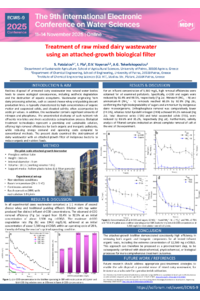
The bioremediation of mixed dairy wastewater was examined using an attached-growth aerobic biological filter. The influent consisted of two distinct dairy wastewater streams in equal proportions: second cheese whey (SCW) and traditional Greek pudding dessert wastewater (PDW). Both streams had similar initial organic loads and were used in their raw, non-sterilized form.
A pilot-scale attached growth bioreactor, inoculated with indigenous microorganisms, was used with a working volume of 7 L. The batch reactor operated in recirculation mode at a flow rate of 1.0 L min-1 and was tested under five different initial concentrations of dissolved chemical oxygen demand (d-COD), ranging from 1000 to 12500 mg L-1.
The removal of both organic and inorganic components was investigated, including d-COD, sugars, nitrogen species, phosphorus and solids. The d-COD removal rates ranged from 115.5 to 194.6 mg L-1 h-1, while d-COD removal of 81.4% to 92.3% was achieved. N-NH4 exhibited exceptionally high removal efficiencies, up to 99,9 %, while N-NO3- removal was more variable, ranging from 29.4% to 89.3%. Significant reductions in solids were also observed, with removal efficiencies of 92.8% for total dissolved solids and 93.9% for total suspended solids.
Notably, the final d-COD concentration in the experiment with an initial 1000 mg L⁻¹ d-COD was below the regulatory limit for discharge into natural water bodies (125 mg L⁻¹ COD). In all other cases, the final d-COD remained about or below 1000 mg L⁻¹, even at the highest initial load, indicating suitability for disposal into municipal sewage systems. These findings confirm the effectiveness of the proposed biological method in significantly reducing organic load and solids. The use of mixed dairy wastewater enhances microbial activity and process stability due to its balanced nutrient profile. This demonstrates the system’s adaptability to diverse and variable real-world dairy effluents.
Keywords
dairy wastewater
biological treatment
attached-growth biofilter
indigenous microorganisms
Poster
Patsialou_poster ECWS-9 2025 mdpi.pdf
Sustainable Water Disinfection Using Light-Activated Magnetic Nanoparticles
Cost-effective hybrid system for wastewater treatment: The State of the Art