Event submissions
Published
This submission belongs to the session S8. Wastewater Treatment and Reuse of the event The 9th International Electronic Conference on Water Sciences
Published date
06 Nov, 2025
Academic Editor
'%3e%3cpath%20d='M12.6657%2010.9104C12.4185%2010.325%2012.0599%209.79327%2011.6097%209.34482C11.1609%208.89508%2010.6293%208.5365%2010.0442%208.28888C10.0389%208.28626%2010.0337%208.28495%2010.0285%208.28233C10.8446%207.69279%2011.3752%206.73249%2011.3752%205.64904C11.3752%203.8542%209.92103%202.39999%208.1262%202.39999C6.33136%202.39999%204.87715%203.8542%204.87715%205.64904C4.87715%206.73249%205.40774%207.69279%206.22393%208.28364C6.21869%208.28626%206.21345%208.28757%206.20821%208.29019C5.62129%208.5378%205.09463%208.89284%204.64265%209.34613C4.1929%209.79493%203.83432%2010.3266%203.58671%2010.9117C3.34345%2011.4845%203.21226%2012.0987%203.20023%2012.7209C3.19988%2012.7349%203.20233%2012.7488%203.20744%2012.7619C3.21255%2012.7749%203.22022%2012.7867%203.22998%2012.7968C3.23975%2012.8068%203.25142%2012.8147%203.26431%2012.8202C3.2772%2012.8256%203.29105%2012.8284%203.30504%2012.8284H4.09109C4.14874%2012.8284%204.19459%2012.7825%204.1959%2012.7262C4.2221%2011.7148%204.62823%2010.7676%205.34617%2010.0497C6.08899%209.30683%207.0755%208.89808%208.1262%208.89808C9.17689%208.89808%2010.1634%209.30683%2010.9062%2010.0497C11.6242%2010.7676%2012.0303%2011.7148%2012.0565%2012.7262C12.0578%2012.7838%2012.1037%2012.8284%2012.1613%2012.8284H12.9474C12.9613%2012.8284%2012.9752%2012.8256%2012.9881%2012.8202C13.001%2012.8147%2013.0126%2012.8068%2013.0224%2012.7968C13.0322%2012.7867%2013.0398%2012.7749%2013.0449%2012.7619C13.0501%2012.7488%2013.0525%2012.7349%2013.0522%2012.7209C13.0391%2012.0947%2012.9094%2011.4855%2012.6657%2010.9104ZM8.1262%207.9024C7.52486%207.9024%206.9589%207.6679%206.53312%207.24211C6.10733%206.81633%205.87283%206.25037%205.87283%205.64904C5.87283%205.0477%206.10733%204.48174%206.53312%204.05596C6.9589%203.63018%207.52486%203.39567%208.1262%203.39567C8.72753%203.39567%209.29349%203.63018%209.71927%204.05596C10.1451%204.48174%2010.3796%205.0477%2010.3796%205.64904C10.3796%206.25037%2010.1451%206.81633%209.71927%207.24211C9.29349%207.6679%208.72753%207.9024%208.1262%207.9024Z'%20fill='%235D1EE1'/%3e%3c/g%3e%3c/svg%3e) Carmen Teodosiu
Carmen TeodosiuCitation
Kosmas Lalas, Alexandra Ioannidi, Giorgos Louka, Konstantinos Kalogiannis, Maria Antonopoulou, Zacharias Frontistis, Solar-activated persulfate degradation of bisphenol-S: Kinetics in laboratory and pilot scale, transformation products and phytotoxicity, in Proceedings of The 9th International Electronic Conference on Water Sciences, 11 November–14 November 2025, MDPI: Basel, Switzerland
Share
Email
Facebook
Twitter
LinkedIn
Solar-activated persulfate degradation of bisphenol-S: Kinetics in laboratory and pilot scale, transformation products and phytotoxicity
'%3e%3cpath%20d='M12.6647%2010.9104C12.4176%2010.325%2012.0589%209.7933%2011.6088%209.34485C11.16%208.89511%2010.6283%208.53653%2010.0432%208.28891C10.038%208.28629%2010.0327%208.28498%2010.0275%208.28236C10.8437%207.69282%2011.3743%206.73252%2011.3743%205.64907C11.3743%203.85423%209.92005%202.40002%208.12522%202.40002C6.33038%202.40002%204.87618%203.85423%204.87618%205.64907C4.87618%206.73252%205.40677%207.69282%206.22296%208.28367C6.21772%208.28629%206.21248%208.2876%206.20724%208.29022C5.62031%208.53783%205.09365%208.89287%204.64167%209.34616C4.19192%209.79496%203.83334%2010.3266%203.58573%2010.9117C3.34247%2011.4846%203.21128%2012.0987%203.19925%2012.721C3.1989%2012.735%203.20135%2012.7489%203.20646%2012.7619C3.21157%2012.7749%203.21924%2012.7868%203.22901%2012.7968C3.23877%2012.8068%203.25045%2012.8148%203.26334%2012.8202C3.27623%2012.8256%203.29007%2012.8284%203.30406%2012.8284H4.09012C4.14776%2012.8284%204.19362%2012.7825%204.19493%2012.7262C4.22113%2011.7148%204.62726%2010.7676%205.34519%2010.0497C6.08802%209.30686%207.07452%208.89811%208.12522%208.89811C9.17592%208.89811%2010.1624%209.30686%2010.9052%2010.0497C11.6232%2010.7676%2012.0293%2011.7148%2012.0555%2012.7262C12.0568%2012.7839%2012.1027%2012.8284%2012.1603%2012.8284H12.9464C12.9604%2012.8284%2012.9742%2012.8256%2012.9871%2012.8202C13%2012.8148%2013.0117%2012.8068%2013.0214%2012.7968C13.0312%2012.7868%2013.0389%2012.7749%2013.044%2012.7619C13.0491%2012.7489%2013.0515%2012.735%2013.0512%2012.721C13.0381%2012.0947%2012.9084%2011.4856%2012.6647%2010.9104ZM8.12522%207.90243C7.52388%207.90243%206.95792%207.66793%206.53214%207.24215C6.10636%206.81636%205.87185%206.2504%205.87185%205.64907C5.87185%205.04773%206.10636%204.48177%206.53214%204.05599C6.95792%203.63021%207.52388%203.3957%208.12522%203.3957C8.72655%203.3957%209.29252%203.63021%209.7183%204.05599C10.1441%204.48177%2010.3786%205.04773%2010.3786%205.64907C10.3786%206.2504%2010.1441%206.81636%209.7183%207.24215C9.29252%207.66793%208.72655%207.90243%208.12522%207.90243Z'%20fill='%235D1EE1'/%3e%3c/g%3e%3c/svg%3e)
Kosmas Lalas 1

Alexandra Ioannidi 2
Giorgos Louka 2

Konstantinos Kalogiannis 1

Maria Antonopoulou 3

Zacharias Frontistis 1
1. Department of Chemical Engineering, University of Western Macedonia, Kozani, Greece
2. Department of Chemical Engineering, University of Patras, Patras, Greece
3. Department of Sustainable Agriculture, University of Patras, Agrinio, Greece
Abstract
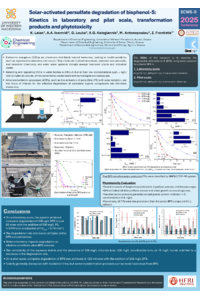
Endocrine-disrupting chemicals (EDCs) are pervasive synthetic or natural substances that interfere with the endocrine system, leading to serious health problems. EDCs enter aquatic environments through pharmaceuticals, personal care products and industrial discharges, posing significant ecological and human health risks. Their detection and regulation are challenging due to their trace concentrations and structural diversity. Thus, the inadequacy of conventional wastewater treatment technologies dictates the urgency of developing more efficient and sustainable methods.
Advanced oxidation processes (AOPs) have emerged as promising solutions due to their ability to convert persistent organic pollutants into harmless molecules through the production of highly active reactive species. In particular, processes that produce sulfate radicals (SO4•–) have been shown to be effective against various EDCs. The present study investigates the use of solar radiation to activate sodium persulfate (SPS) for the degradation of bisphenol-S (BPS).
In batch scale, 500 μg/L BPS was completely degraded in 60 minutes with 500 mg/L SPS, and the kinetic constant was calculated 0.19 min-¹.Higher SPS concentrations accelerate the contaminant removal. However, increased BPS, alkaline pH, and the presence of anions and complex water matrices inhibit degradation. The process was evaluated on a pilot scale and achieved complete BPS depletion in 120 minutes, with the addition of 250 mg/L SPS.
Five BPS transformation products (TPs) were identified using a UHPLC/TOF-MS system. Two of them had higher molecular weights than the original compound, two underwent ring opening reactions and one involved aromatic ring detachment. A decomposition pathway for BPS was proposed.
The phytotoxicity of BPS and its products was examined using Sorghum saccharatum, Lepidium sativum and Brassica nigra seeds. In all cases, BPS showed an inhibitory effect on root and shoot growth. The TPs generally showed greater inhibition in S. saccharatum and B. nigra. Notably, all TPs were less phytotoxic than BPS for L. sativum.
Keywords
Αdvanced oxidation processes
solar radiation
persulfate
micropollutants
pilot scale
phytotoxicity
Poster
9th iecws-poster.pdf
Sonochemical Degradation of the Anticancer Pharmaceutical Anastrozole Using Low-Frequency Ultrasound: Kinetic and Mechanistic Study
Energy-Positive Wastewater Treatment and Nutrient Recovery in a Combined Hydroponics and Microbial Electrochemical System