Event submissions
Published
This submission belongs to the session S8. Wastewater Treatment and Reuse of the event The 9th International Electronic Conference on Water Sciences
Published date
06 Nov, 2025
Academic Editor
'%3e%3cpath%20d='M12.6657%2010.9104C12.4185%2010.325%2012.0599%209.79327%2011.6097%209.34482C11.1609%208.89508%2010.6293%208.5365%2010.0442%208.28888C10.0389%208.28626%2010.0337%208.28495%2010.0285%208.28233C10.8446%207.69279%2011.3752%206.73249%2011.3752%205.64904C11.3752%203.8542%209.92103%202.39999%208.1262%202.39999C6.33136%202.39999%204.87715%203.8542%204.87715%205.64904C4.87715%206.73249%205.40774%207.69279%206.22393%208.28364C6.21869%208.28626%206.21345%208.28757%206.20821%208.29019C5.62129%208.5378%205.09463%208.89284%204.64265%209.34613C4.1929%209.79493%203.83432%2010.3266%203.58671%2010.9117C3.34345%2011.4845%203.21226%2012.0987%203.20023%2012.7209C3.19988%2012.7349%203.20233%2012.7488%203.20744%2012.7619C3.21255%2012.7749%203.22022%2012.7867%203.22998%2012.7968C3.23975%2012.8068%203.25142%2012.8147%203.26431%2012.8202C3.2772%2012.8256%203.29105%2012.8284%203.30504%2012.8284H4.09109C4.14874%2012.8284%204.19459%2012.7825%204.1959%2012.7262C4.2221%2011.7148%204.62823%2010.7676%205.34617%2010.0497C6.08899%209.30683%207.0755%208.89808%208.1262%208.89808C9.17689%208.89808%2010.1634%209.30683%2010.9062%2010.0497C11.6242%2010.7676%2012.0303%2011.7148%2012.0565%2012.7262C12.0578%2012.7838%2012.1037%2012.8284%2012.1613%2012.8284H12.9474C12.9613%2012.8284%2012.9752%2012.8256%2012.9881%2012.8202C13.001%2012.8147%2013.0126%2012.8068%2013.0224%2012.7968C13.0322%2012.7867%2013.0398%2012.7749%2013.0449%2012.7619C13.0501%2012.7488%2013.0525%2012.7349%2013.0522%2012.7209C13.0391%2012.0947%2012.9094%2011.4855%2012.6657%2010.9104ZM8.1262%207.9024C7.52486%207.9024%206.9589%207.6679%206.53312%207.24211C6.10733%206.81633%205.87283%206.25037%205.87283%205.64904C5.87283%205.0477%206.10733%204.48174%206.53312%204.05596C6.9589%203.63018%207.52486%203.39567%208.1262%203.39567C8.72753%203.39567%209.29349%203.63018%209.71927%204.05596C10.1451%204.48174%2010.3796%205.0477%2010.3796%205.64904C10.3796%206.25037%2010.1451%206.81633%209.71927%207.24211C9.29349%207.6679%208.72753%207.9024%208.1262%207.9024Z'%20fill='%235D1EE1'/%3e%3c/g%3e%3c/svg%3e) Carmen Teodosiu
Carmen TeodosiuCitation
Adetunji Ayorinde Ojediran, Sofia Almeida Pereira, Paulo Rosa-Santos, Ana Cristina Rodrigues, Cristina Calheiros, Constructed Wetland: Multi-Functional Benefits of an Ecological Engineered System, in Proceedings of The 9th International Electronic Conference on Water Sciences, 11 November–14 November 2025, MDPI: Basel, Switzerland
Share
Email
Facebook
Twitter
LinkedIn
Constructed Wetland: Multi-Functional Benefits of an Ecological Engineered System

Adetunji Ayorinde Ojediran 1,2,3

Sofia Almeida Pereira 2

Paulo Rosa-Santos 3

Ana Cristina Rodrigues 4

Cristina Calheiros 1
1. CIIMAR/CIMAR LA, Interdisciplinary Centre of Marine and Environmental Research, Porto, Portugal
2. Universidade Católica Portuguesa, CBQF - Centro de Biotecnologia e Química Fina – Laboratório Associado, Escola Superior de Biotecnologia, Rua de Diogo Botelho 1327, 4169-005, Porto, Portugal
3. Department of Civil and Georesources Engineering, Faculty of Engineering, University of Porto, Porto, Portugal
4. PROMETHEUS, ESA—Escola Superior Agrária, IPVC, 4900-347 Viana do Castelo, Portugal
Abstract
Introduction: Constructed wetlands (CWs) are engineered systems that are inspired by natural wetlands [1]. They are often applied for decentralized wastewater treatment, but while their performance in pollutant removal is well established, other potential ecosystem services are often underappreciated. This study aims to bring attention to the broader multifunctional benefits of CWs—beyond treatment—by exploring a real-scale horizontal subsurface flow CW (HSSF-CW) located at a tourism facility in northern Portugal. Method: The CW, in operation since 2010, serves a rural guesthouse in Calheiros and consistently treats domestic wastewater generated from the guesthouse’s occupancy of between 6 and 40 people. The system covers an area of 40.5 m² and is vegetated with a polyculture of ornamental species, which is primarily for wastewater treatment at the facility but has also served aesthetic purposes.. The CW operates under Mediterranean climatic conditions and discharges into a small polishing pond. Previous studies at this site have focused on pathogen removal and microbial communities [2], [3]. The current investigation builds on this foundation by identifying and evaluating other potential ecosystem functions. Results: The system’s stable operation provides a unique opportunity to assess additional services such as carbon sequestration (using biomass and substrate), energy recovery (from microbial fuel cell), soil amendments (biomass composting), safe water reuse for irrigation, and possibility of enhanced wastewater treatment (using photocatalytic modules and nanostructured filters). These aspects are now being explored to better understand the full value of CWs in multifunctional, real-world contexts. Conclusion: Recognizing the broader ecosystem functions of CWs is essential to reposition them as more than just wastewater treatment technologies. This study uses a successful, long-running HSSF-CW as a platform to investigate underexplored multifunctional benefits to show CWs's role as valuable ecosystem infrastructure—especially in decentralized settings like tourism where aesthetics, sustainability, and recovery of resources are essential.
References
[1] http://dx.doi.org/10.1016/j.ecoleng.2015.03.001
Keywords
Constructed wetlands
Nature-based solution
Circularity
Resource Recovery
Climate Action
Poster
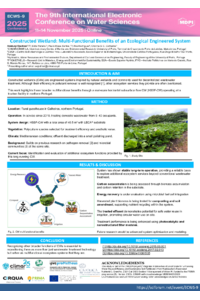
ECWS Poster_Adetunji.pdf
Microplastic as a pollutant that poses challenges in the treatment of stormwater
Ultrasound-Assisted Adsorption for Efficient and Sustainable Removal of Micropollutants from Wastewater