Event submissions
Published
This submission belongs to the session S8. Wastewater Treatment and Reuse of the event The 9th International Electronic Conference on Water Sciences
Published date
06 Nov, 2025
Academic Editor
'%3e%3cpath%20d='M12.6657%2010.9104C12.4185%2010.325%2012.0599%209.79327%2011.6097%209.34482C11.1609%208.89508%2010.6293%208.5365%2010.0442%208.28888C10.0389%208.28626%2010.0337%208.28495%2010.0285%208.28233C10.8446%207.69279%2011.3752%206.73249%2011.3752%205.64904C11.3752%203.8542%209.92103%202.39999%208.1262%202.39999C6.33136%202.39999%204.87715%203.8542%204.87715%205.64904C4.87715%206.73249%205.40774%207.69279%206.22393%208.28364C6.21869%208.28626%206.21345%208.28757%206.20821%208.29019C5.62129%208.5378%205.09463%208.89284%204.64265%209.34613C4.1929%209.79493%203.83432%2010.3266%203.58671%2010.9117C3.34345%2011.4845%203.21226%2012.0987%203.20023%2012.7209C3.19988%2012.7349%203.20233%2012.7488%203.20744%2012.7619C3.21255%2012.7749%203.22022%2012.7867%203.22998%2012.7968C3.23975%2012.8068%203.25142%2012.8147%203.26431%2012.8202C3.2772%2012.8256%203.29105%2012.8284%203.30504%2012.8284H4.09109C4.14874%2012.8284%204.19459%2012.7825%204.1959%2012.7262C4.2221%2011.7148%204.62823%2010.7676%205.34617%2010.0497C6.08899%209.30683%207.0755%208.89808%208.1262%208.89808C9.17689%208.89808%2010.1634%209.30683%2010.9062%2010.0497C11.6242%2010.7676%2012.0303%2011.7148%2012.0565%2012.7262C12.0578%2012.7838%2012.1037%2012.8284%2012.1613%2012.8284H12.9474C12.9613%2012.8284%2012.9752%2012.8256%2012.9881%2012.8202C13.001%2012.8147%2013.0126%2012.8068%2013.0224%2012.7968C13.0322%2012.7867%2013.0398%2012.7749%2013.0449%2012.7619C13.0501%2012.7488%2013.0525%2012.7349%2013.0522%2012.7209C13.0391%2012.0947%2012.9094%2011.4855%2012.6657%2010.9104ZM8.1262%207.9024C7.52486%207.9024%206.9589%207.6679%206.53312%207.24211C6.10733%206.81633%205.87283%206.25037%205.87283%205.64904C5.87283%205.0477%206.10733%204.48174%206.53312%204.05596C6.9589%203.63018%207.52486%203.39567%208.1262%203.39567C8.72753%203.39567%209.29349%203.63018%209.71927%204.05596C10.1451%204.48174%2010.3796%205.0477%2010.3796%205.64904C10.3796%206.25037%2010.1451%206.81633%209.71927%207.24211C9.29349%207.6679%208.72753%207.9024%208.1262%207.9024Z'%20fill='%235D1EE1'/%3e%3c/g%3e%3c/svg%3e) Carmen Teodosiu
Carmen TeodosiuCitation
Marwa Rammal, Dalia Massoud, Akram Hijazi, Chaden Haidar, Salem Darwich, Water Treatment by Adsorption on Sage-Based Adsorbents: Removal of Pollutants and Phytotoxicity, in Proceedings of The 9th International Electronic Conference on Water Sciences, 11 November–14 November 2025, MDPI: Basel, Switzerland
Share
Email
Facebook
Twitter
LinkedIn
Water Treatment by Adsorption on Sage-Based Adsorbents: Removal of Pollutants and Phytotoxicity
'%3e%3cpath%20d='M12.6647%2010.9104C12.4176%2010.325%2012.0589%209.7933%2011.6088%209.34485C11.16%208.89511%2010.6283%208.53653%2010.0432%208.28891C10.038%208.28629%2010.0327%208.28498%2010.0275%208.28236C10.8437%207.69282%2011.3743%206.73252%2011.3743%205.64907C11.3743%203.85423%209.92005%202.40002%208.12522%202.40002C6.33038%202.40002%204.87618%203.85423%204.87618%205.64907C4.87618%206.73252%205.40677%207.69282%206.22296%208.28367C6.21772%208.28629%206.21248%208.2876%206.20724%208.29022C5.62031%208.53783%205.09365%208.89287%204.64167%209.34616C4.19192%209.79496%203.83334%2010.3266%203.58573%2010.9117C3.34247%2011.4846%203.21128%2012.0987%203.19925%2012.721C3.1989%2012.735%203.20135%2012.7489%203.20646%2012.7619C3.21157%2012.7749%203.21924%2012.7868%203.22901%2012.7968C3.23877%2012.8068%203.25045%2012.8148%203.26334%2012.8202C3.27623%2012.8256%203.29007%2012.8284%203.30406%2012.8284H4.09012C4.14776%2012.8284%204.19362%2012.7825%204.19493%2012.7262C4.22113%2011.7148%204.62726%2010.7676%205.34519%2010.0497C6.08802%209.30686%207.07452%208.89811%208.12522%208.89811C9.17592%208.89811%2010.1624%209.30686%2010.9052%2010.0497C11.6232%2010.7676%2012.0293%2011.7148%2012.0555%2012.7262C12.0568%2012.7839%2012.1027%2012.8284%2012.1603%2012.8284H12.9464C12.9604%2012.8284%2012.9742%2012.8256%2012.9871%2012.8202C13%2012.8148%2013.0117%2012.8068%2013.0214%2012.7968C13.0312%2012.7868%2013.0389%2012.7749%2013.044%2012.7619C13.0491%2012.7489%2013.0515%2012.735%2013.0512%2012.721C13.0381%2012.0947%2012.9084%2011.4856%2012.6647%2010.9104ZM8.12522%207.90243C7.52388%207.90243%206.95792%207.66793%206.53214%207.24215C6.10636%206.81636%205.87185%206.2504%205.87185%205.64907C5.87185%205.04773%206.10636%204.48177%206.53214%204.05599C6.95792%203.63021%207.52388%203.3957%208.12522%203.3957C8.72655%203.3957%209.29252%203.63021%209.7183%204.05599C10.1441%204.48177%2010.3786%205.04773%2010.3786%205.64907C10.3786%206.2504%2010.1441%206.81636%209.7183%207.24215C9.29252%207.66793%208.72655%207.90243%208.12522%207.90243Z'%20fill='%235D1EE1'/%3e%3c/g%3e%3c/svg%3e)
Marwa Rammal 1
Dalia Massoud 2
Akram Hijazi 3
Chaden Haidar 4
Salem Darwich 5
1. Department of Food Sciences and Technology, Faculty of Agronomy, Lebanese University, Beirut P.O. Box 146404, Lebanon
2. Lebanese University, Beirut, Laboratory Sciences , Faculty of Public Health , Lebanese University, Hadath , Lebanon
3. Plateforme de recherche et d'analyse en sciences de l'environnement (EDST-PRASE), Lebanese University, Beirut P.O. Box 6573/14, Lebanon
4. Department of Chemistry and Biochemistry, Islamic University of Lebanon (IUL), Khalde P.O. Box 30014, Lebanon
5. Department of Economy, Faculty of Agronomy, Lebanese University, P.O. Box 146404, Lebanon
Abstract
Water pollution is a critical global issue that endangers ecosystems and human health. The development of eco-friendly and sustainable adsorbent materials is essential for removing various contaminants, including synthetic dyes, nitrates, phosphates, and pathogenic microorganisms from water sources. In this study, we explored the adsorption efficiency and phytotoxicity of three bioadsorbents derived from Salvia officinalis (sage): (1) untreated sage powder (S), (2) sage-derived biochar produced by pyrolysis at 300 °C (C), and (3) activated charcoal (AC) prepared by chemical activation with phosphoric acid followed by pyrolysis at 450 °C. The materials were tested for their capacity to remove methylene blue dye, nitrates, phosphates, and bacterial contaminants (Escherichia coli, total coliforms, and Streptococcus D) under controlled laboratory conditions. Results showed that activated charcoal (AC) had the highest removal efficiency for phosphates (0.122 mg/g, 49%) and nitrates (1.72 mg/g), along with the most significant reduction in bacterial concentrations. Interestingly, the untreated sage powder (S) displayed the greatest capacity for methylene blue adsorption (4.34 mg/g), suggesting its potential for dye-contaminated water treatment. Phytotoxicity assays using Eruca vesicaria (arugula) indicated that AC exhibited low toxicity in aqueous conditions, and both S and AC supported plant growth in solid (soil-like) media. These findings suggest that sage-derived bioadsorbents, particularly activated charcoal, offer a promising, low-cost, and sustainable solution for integrated water treatment. Their dual capacity to remove chemical and biological pollutants while maintaining low phytotoxicity makes them attractive candidates for eco-friendly environmental remediation strategies.
Keywords
Keywords: adsorbent methylene blue
charcoal
activated charcoal
sage
nitrate
phosphate
bacteria
phytotoxicity
Poster
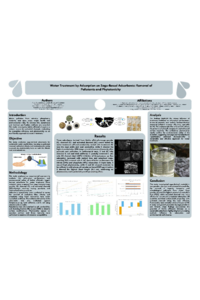
Water Treatment by Adsorption on Sage-Based Adsorbents Poster.pdf
Enhanced Removal of Micropollutants from Secondary Effluents Using UV/Sulfite and Biochar-Coupled Advanced Oxidation Processes
Assessment of Trombidiidae (Acari) as Biondicators for Wasterwater Treatment in a Constructed Wetland