Event submissions
Published
This submission belongs to the session S8. Wastewater Treatment and Reuse of the event The 9th International Electronic Conference on Water Sciences
Published date
06 Nov, 2025
Academic Editor
'%3e%3cpath%20d='M12.6657%2010.9104C12.4185%2010.325%2012.0599%209.79327%2011.6097%209.34482C11.1609%208.89508%2010.6293%208.5365%2010.0442%208.28888C10.0389%208.28626%2010.0337%208.28495%2010.0285%208.28233C10.8446%207.69279%2011.3752%206.73249%2011.3752%205.64904C11.3752%203.8542%209.92103%202.39999%208.1262%202.39999C6.33136%202.39999%204.87715%203.8542%204.87715%205.64904C4.87715%206.73249%205.40774%207.69279%206.22393%208.28364C6.21869%208.28626%206.21345%208.28757%206.20821%208.29019C5.62129%208.5378%205.09463%208.89284%204.64265%209.34613C4.1929%209.79493%203.83432%2010.3266%203.58671%2010.9117C3.34345%2011.4845%203.21226%2012.0987%203.20023%2012.7209C3.19988%2012.7349%203.20233%2012.7488%203.20744%2012.7619C3.21255%2012.7749%203.22022%2012.7867%203.22998%2012.7968C3.23975%2012.8068%203.25142%2012.8147%203.26431%2012.8202C3.2772%2012.8256%203.29105%2012.8284%203.30504%2012.8284H4.09109C4.14874%2012.8284%204.19459%2012.7825%204.1959%2012.7262C4.2221%2011.7148%204.62823%2010.7676%205.34617%2010.0497C6.08899%209.30683%207.0755%208.89808%208.1262%208.89808C9.17689%208.89808%2010.1634%209.30683%2010.9062%2010.0497C11.6242%2010.7676%2012.0303%2011.7148%2012.0565%2012.7262C12.0578%2012.7838%2012.1037%2012.8284%2012.1613%2012.8284H12.9474C12.9613%2012.8284%2012.9752%2012.8256%2012.9881%2012.8202C13.001%2012.8147%2013.0126%2012.8068%2013.0224%2012.7968C13.0322%2012.7867%2013.0398%2012.7749%2013.0449%2012.7619C13.0501%2012.7488%2013.0525%2012.7349%2013.0522%2012.7209C13.0391%2012.0947%2012.9094%2011.4855%2012.6657%2010.9104ZM8.1262%207.9024C7.52486%207.9024%206.9589%207.6679%206.53312%207.24211C6.10733%206.81633%205.87283%206.25037%205.87283%205.64904C5.87283%205.0477%206.10733%204.48174%206.53312%204.05596C6.9589%203.63018%207.52486%203.39567%208.1262%203.39567C8.72753%203.39567%209.29349%203.63018%209.71927%204.05596C10.1451%204.48174%2010.3796%205.0477%2010.3796%205.64904C10.3796%206.25037%2010.1451%206.81633%209.71927%207.24211C9.29349%207.6679%208.72753%207.9024%208.1262%207.9024Z'%20fill='%235D1EE1'/%3e%3c/g%3e%3c/svg%3e) Carmen Teodosiu
Carmen TeodosiuCitation
Diogo José Horst, Andre Pscheidt, Charles Adriano Duvoisin, Rigoberto Eleazar Melgarejo Morales, Moisés Alves Marcelino Neto, Luís Felipe Silveira Botton, Eduardo Nunes Santos, Design of an Electrocoalescer Cell for Oil–Water Separation: Comparison of Droplet Distribution, in Proceedings of The 9th International Electronic Conference on Water Sciences, 11 November–14 November 2025, MDPI: Basel, Switzerland
Share
Email
Facebook
Twitter
LinkedIn
Design of an Electrocoalescer Cell for Oil–Water Separation: Comparison of Droplet Distribution

Diogo José Horst 1
'%3e%3cpath%20d='M12.6647%2010.9104C12.4176%2010.325%2012.0589%209.7933%2011.6088%209.34485C11.16%208.89511%2010.6283%208.53653%2010.0432%208.28891C10.038%208.28629%2010.0327%208.28498%2010.0275%208.28236C10.8437%207.69282%2011.3743%206.73252%2011.3743%205.64907C11.3743%203.85423%209.92005%202.40002%208.12522%202.40002C6.33038%202.40002%204.87618%203.85423%204.87618%205.64907C4.87618%206.73252%205.40677%207.69282%206.22296%208.28367C6.21772%208.28629%206.21248%208.2876%206.20724%208.29022C5.62031%208.53783%205.09365%208.89287%204.64167%209.34616C4.19192%209.79496%203.83334%2010.3266%203.58573%2010.9117C3.34247%2011.4846%203.21128%2012.0987%203.19925%2012.721C3.1989%2012.735%203.20135%2012.7489%203.20646%2012.7619C3.21157%2012.7749%203.21924%2012.7868%203.22901%2012.7968C3.23877%2012.8068%203.25045%2012.8148%203.26334%2012.8202C3.27623%2012.8256%203.29007%2012.8284%203.30406%2012.8284H4.09012C4.14776%2012.8284%204.19362%2012.7825%204.19493%2012.7262C4.22113%2011.7148%204.62726%2010.7676%205.34519%2010.0497C6.08802%209.30686%207.07452%208.89811%208.12522%208.89811C9.17592%208.89811%2010.1624%209.30686%2010.9052%2010.0497C11.6232%2010.7676%2012.0293%2011.7148%2012.0555%2012.7262C12.0568%2012.7839%2012.1027%2012.8284%2012.1603%2012.8284H12.9464C12.9604%2012.8284%2012.9742%2012.8256%2012.9871%2012.8202C13%2012.8148%2013.0117%2012.8068%2013.0214%2012.7968C13.0312%2012.7868%2013.0389%2012.7749%2013.044%2012.7619C13.0491%2012.7489%2013.0515%2012.735%2013.0512%2012.721C13.0381%2012.0947%2012.9084%2011.4856%2012.6647%2010.9104ZM8.12522%207.90243C7.52388%207.90243%206.95792%207.66793%206.53214%207.24215C6.10636%206.81636%205.87185%206.2504%205.87185%205.64907C5.87185%205.04773%206.10636%204.48177%206.53214%204.05599C6.95792%203.63021%207.52388%203.3957%208.12522%203.3957C8.72655%203.3957%209.29252%203.63021%209.7183%204.05599C10.1441%204.48177%2010.3786%205.04773%2010.3786%205.64907C10.3786%206.2504%2010.1441%206.81636%209.7183%207.24215C9.29252%207.66793%208.72655%207.90243%208.12522%207.90243Z'%20fill='%235D1EE1'/%3e%3c/g%3e%3c/svg%3e)
Andre Pscheidt 1
Charles Adriano Duvoisin 1
Rigoberto Eleazar Melgarejo Morales 1
Moisés Alves Marcelino Neto 1
Luís Felipe Silveira Botton 1
Eduardo Nunes Santos 1
1. Multiphase Flow Research Center, Federal University of Technology - Paraná, Curitiba - Paraná State 81280-350, Brazil
Abstract
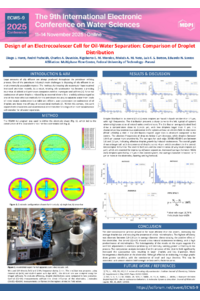
The oil industry faces significant challenges in the treatment and disposal of oily effluents, as large volumes are generated during refining. Oil–water separation methods have received increasing attention, particularly electrocoalescence, which uses external electric fields to induce the coalescence of water droplets in oil–water emulsions, favoring separation. This work presents an experimental and simulation study focused on the design of an electrostatic oil–water separation cell, evaluating the influence of the electric field on the droplet size distribution.
he experimental setup conditions are as follows:
Simulation tool: FEMM 4.2 to define the electrode shape; emulsion composed of 60% mineral oil + 40% distilled water with dye. Applied electric field: 1 kV, 1 kHz, for 1 minute; droplet size analysis using ImageJ software.
The experimental comparison is as follows:
Control (C1–C4): without direct action of the electrodes. Electrodes (EDGE1–EDGE4): regions under the influence of the electric field.
According to the results, the distribution in the control is the predominance of droplets <1.5 µm, characterizing low spontaneous coalescence; reduction in the frequency of microdroplets (<1 µm); greater presence of droplets between 1.6 and 3 µm; increase in the average diameter to 1.6–2.6 µm; occurrence of larger droplets (>6 µm), absent in the control; Increased separation efficiency due to the reduction of critical microdroplets; greater heterogeneity in the distribution near the electrodes, possibly due to irregularities in the electric field and local turbulence.
The electrocoalescence process proved to be efficient in oil–water separation, promoting increases in the average droplet diameter and reduction in the microdroplet fraction, favoring decantation. Improvement in overall process efficiency compared to the control. However, the observed heterogeneity suggests the need for optimizations in electrode positioning and electric field intensity to standardize the coalescent action.
Keywords
Electrocoalescence
Oil-Water separation
Water Recovery
Oily Effluents.
Poster
water poster Horst_2025.pdf
Correlation of the catalytic behavior with the TOF and TON indices of three bimetallic alloy nanoparticles assisted by a NaBH4/visible irradiation system for phenolic compounds in their aqueous solutions
Investigation of urea behavior in water treatment and wastewater reuse plants as potential sources for ultrapure water