Event submissions
Published
This submission belongs to the session S8. Wastewater Treatment and Reuse of the event The 9th International Electronic Conference on Water Sciences
Published date
06 Nov, 2025
Academic Editor
'%3e%3cpath%20d='M12.6657%2010.9104C12.4185%2010.325%2012.0599%209.79327%2011.6097%209.34482C11.1609%208.89508%2010.6293%208.5365%2010.0442%208.28888C10.0389%208.28626%2010.0337%208.28495%2010.0285%208.28233C10.8446%207.69279%2011.3752%206.73249%2011.3752%205.64904C11.3752%203.8542%209.92103%202.39999%208.1262%202.39999C6.33136%202.39999%204.87715%203.8542%204.87715%205.64904C4.87715%206.73249%205.40774%207.69279%206.22393%208.28364C6.21869%208.28626%206.21345%208.28757%206.20821%208.29019C5.62129%208.5378%205.09463%208.89284%204.64265%209.34613C4.1929%209.79493%203.83432%2010.3266%203.58671%2010.9117C3.34345%2011.4845%203.21226%2012.0987%203.20023%2012.7209C3.19988%2012.7349%203.20233%2012.7488%203.20744%2012.7619C3.21255%2012.7749%203.22022%2012.7867%203.22998%2012.7968C3.23975%2012.8068%203.25142%2012.8147%203.26431%2012.8202C3.2772%2012.8256%203.29105%2012.8284%203.30504%2012.8284H4.09109C4.14874%2012.8284%204.19459%2012.7825%204.1959%2012.7262C4.2221%2011.7148%204.62823%2010.7676%205.34617%2010.0497C6.08899%209.30683%207.0755%208.89808%208.1262%208.89808C9.17689%208.89808%2010.1634%209.30683%2010.9062%2010.0497C11.6242%2010.7676%2012.0303%2011.7148%2012.0565%2012.7262C12.0578%2012.7838%2012.1037%2012.8284%2012.1613%2012.8284H12.9474C12.9613%2012.8284%2012.9752%2012.8256%2012.9881%2012.8202C13.001%2012.8147%2013.0126%2012.8068%2013.0224%2012.7968C13.0322%2012.7867%2013.0398%2012.7749%2013.0449%2012.7619C13.0501%2012.7488%2013.0525%2012.7349%2013.0522%2012.7209C13.0391%2012.0947%2012.9094%2011.4855%2012.6657%2010.9104ZM8.1262%207.9024C7.52486%207.9024%206.9589%207.6679%206.53312%207.24211C6.10733%206.81633%205.87283%206.25037%205.87283%205.64904C5.87283%205.0477%206.10733%204.48174%206.53312%204.05596C6.9589%203.63018%207.52486%203.39567%208.1262%203.39567C8.72753%203.39567%209.29349%203.63018%209.71927%204.05596C10.1451%204.48174%2010.3796%205.0477%2010.3796%205.64904C10.3796%206.25037%2010.1451%206.81633%209.71927%207.24211C9.29349%207.6679%208.72753%207.9024%208.1262%207.9024Z'%20fill='%235D1EE1'/%3e%3c/g%3e%3c/svg%3e) Carmen Teodosiu
Carmen TeodosiuCitation
Marcela P. Spaolonzi, Cátia A. L. Graça, Catalytic Performance of Carbon Nanotubes on Glass Frits for Oxalic Acid Degradation by Ozonation, in Proceedings of The 9th International Electronic Conference on Water Sciences, 11 November–14 November 2025, MDPI: Basel, Switzerland
Share
Email
Facebook
Twitter
LinkedIn
Catalytic Performance of Carbon Nanotubes on Glass Frits for Oxalic Acid Degradation by Ozonation

Marcela P. Spaolonzi 1

Cátia A. L. Graça 1
1. LSRE-LCM, ALiCE, Faculty of Engineering, University of Porto, Rua Dr. Roberto Frias, 4200-465 Porto, Portugal
Abstract
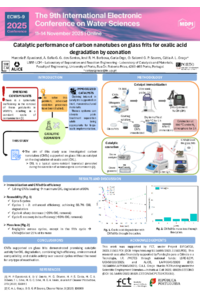
Emerging contaminants are increasingly detected in aquatic environments due to the limited removal efficiency of conventional treatment processes, highlighting the need for more advanced tertiary treatments. Among these, catalytic ozonation has shown particular relevance, as it enables the degradation of even highly recalcitrant byproducts. Within this framework, catalysts immobilized on inert, macrostructured supports have attracted attention since they eliminate the need for post-treatment separation steps, thereby enhancing the applicability of heterogeneous catalytic reactions in full-scale water treatment. In this study, carbon nanotubes (CNTs) supported on glass frits were investigated as catalysts for the degradation of oxalic acid (OXL), a typical ozone-resistant byproduct generated during the ozonation of various organic pollutants. Carbon nanotubes (CNTs) were immobilized on glass frits through successive impregnation in a solution with the CNTs dispersed in ultrapure water containing Triton X-100, followed by ultrasonication and thermal treatment at 550 °C under N₂. The glass frits were impregnated five times (CNTs@5x). Catalytic ozonation experiments were conducted in a recirculating batch reactor, where ozone (O3) was continuously bubbled. The CNTs@5x resulted in a CNTs loading of 1.9 mg and enabled 93% OXL degradation within 3 h of catalytic ozonation. This same material was reused for five cycles to evaluate its activity after consecutive reactions. A decline in efficiency was observed in the fourth cycle (20% OXL removal), followed by recovery in the fifth cycle (80% OXL removal). No significant CNTs loss was detected across the cycles, except in the fifth cycle, where CNTs@5x lost 21% of its mass. Overall, CNTs supported on glass frits demonstrated promising catalytic activity for OXL degradation, combining high efficiency, environmental compatibility, and stable activity over several cycles without the need for any type of reactivation.
Keywords
catalytic ozonation
water treatment
macrostructured catalyst
Poster
Poster1.pdf
Aqueous Two-Phase Extraction Using Choline Salts: A Green Strategy for Tackling Pharmaceutical Pollution in Water
Tertiary Treatment of Wine Distillery Wastewater at Near-Neutral pH using the Chelate-modified Fenton Process