Event submissions
Published
This submission belongs to the session S8. Wastewater Treatment and Reuse of the event The 9th International Electronic Conference on Water Sciences
Published date
06 Nov, 2025
Academic Editor
'%3e%3cpath%20d='M12.6657%2010.9104C12.4185%2010.325%2012.0599%209.79327%2011.6097%209.34482C11.1609%208.89508%2010.6293%208.5365%2010.0442%208.28888C10.0389%208.28626%2010.0337%208.28495%2010.0285%208.28233C10.8446%207.69279%2011.3752%206.73249%2011.3752%205.64904C11.3752%203.8542%209.92103%202.39999%208.1262%202.39999C6.33136%202.39999%204.87715%203.8542%204.87715%205.64904C4.87715%206.73249%205.40774%207.69279%206.22393%208.28364C6.21869%208.28626%206.21345%208.28757%206.20821%208.29019C5.62129%208.5378%205.09463%208.89284%204.64265%209.34613C4.1929%209.79493%203.83432%2010.3266%203.58671%2010.9117C3.34345%2011.4845%203.21226%2012.0987%203.20023%2012.7209C3.19988%2012.7349%203.20233%2012.7488%203.20744%2012.7619C3.21255%2012.7749%203.22022%2012.7867%203.22998%2012.7968C3.23975%2012.8068%203.25142%2012.8147%203.26431%2012.8202C3.2772%2012.8256%203.29105%2012.8284%203.30504%2012.8284H4.09109C4.14874%2012.8284%204.19459%2012.7825%204.1959%2012.7262C4.2221%2011.7148%204.62823%2010.7676%205.34617%2010.0497C6.08899%209.30683%207.0755%208.89808%208.1262%208.89808C9.17689%208.89808%2010.1634%209.30683%2010.9062%2010.0497C11.6242%2010.7676%2012.0303%2011.7148%2012.0565%2012.7262C12.0578%2012.7838%2012.1037%2012.8284%2012.1613%2012.8284H12.9474C12.9613%2012.8284%2012.9752%2012.8256%2012.9881%2012.8202C13.001%2012.8147%2013.0126%2012.8068%2013.0224%2012.7968C13.0322%2012.7867%2013.0398%2012.7749%2013.0449%2012.7619C13.0501%2012.7488%2013.0525%2012.7349%2013.0522%2012.7209C13.0391%2012.0947%2012.9094%2011.4855%2012.6657%2010.9104ZM8.1262%207.9024C7.52486%207.9024%206.9589%207.6679%206.53312%207.24211C6.10733%206.81633%205.87283%206.25037%205.87283%205.64904C5.87283%205.0477%206.10733%204.48174%206.53312%204.05596C6.9589%203.63018%207.52486%203.39567%208.1262%203.39567C8.72753%203.39567%209.29349%203.63018%209.71927%204.05596C10.1451%204.48174%2010.3796%205.0477%2010.3796%205.64904C10.3796%206.25037%2010.1451%206.81633%209.71927%207.24211C9.29349%207.6679%208.72753%207.9024%208.1262%207.9024Z'%20fill='%235D1EE1'/%3e%3c/g%3e%3c/svg%3e) Carmen Teodosiu
Carmen TeodosiuCitation
João Lemos, Anabela Nogueira, Carmen Rodrigues, Luis Miguel Madeira, Tertiary Treatment of Wine Distillery Wastewater at Near-Neutral pH using the Chelate-modified Fenton Process, in Proceedings of The 9th International Electronic Conference on Water Sciences, 11 November–14 November 2025, MDPI: Basel, Switzerland
Share
Email
Facebook
Twitter
LinkedIn
Tertiary Treatment of Wine Distillery Wastewater at Near-Neutral pH using the Chelate-modified Fenton Process
'%3e%3cpath%20d='M12.6647%2010.9104C12.4176%2010.325%2012.0589%209.7933%2011.6088%209.34485C11.16%208.89511%2010.6283%208.53653%2010.0432%208.28891C10.038%208.28629%2010.0327%208.28498%2010.0275%208.28236C10.8437%207.69282%2011.3743%206.73252%2011.3743%205.64907C11.3743%203.85423%209.92005%202.40002%208.12522%202.40002C6.33038%202.40002%204.87618%203.85423%204.87618%205.64907C4.87618%206.73252%205.40677%207.69282%206.22296%208.28367C6.21772%208.28629%206.21248%208.2876%206.20724%208.29022C5.62031%208.53783%205.09365%208.89287%204.64167%209.34616C4.19192%209.79496%203.83334%2010.3266%203.58573%2010.9117C3.34247%2011.4846%203.21128%2012.0987%203.19925%2012.721C3.1989%2012.735%203.20135%2012.7489%203.20646%2012.7619C3.21157%2012.7749%203.21924%2012.7868%203.22901%2012.7968C3.23877%2012.8068%203.25045%2012.8148%203.26334%2012.8202C3.27623%2012.8256%203.29007%2012.8284%203.30406%2012.8284H4.09012C4.14776%2012.8284%204.19362%2012.7825%204.19493%2012.7262C4.22113%2011.7148%204.62726%2010.7676%205.34519%2010.0497C6.08802%209.30686%207.07452%208.89811%208.12522%208.89811C9.17592%208.89811%2010.1624%209.30686%2010.9052%2010.0497C11.6232%2010.7676%2012.0293%2011.7148%2012.0555%2012.7262C12.0568%2012.7839%2012.1027%2012.8284%2012.1603%2012.8284H12.9464C12.9604%2012.8284%2012.9742%2012.8256%2012.9871%2012.8202C13%2012.8148%2013.0117%2012.8068%2013.0214%2012.7968C13.0312%2012.7868%2013.0389%2012.7749%2013.044%2012.7619C13.0491%2012.7489%2013.0515%2012.735%2013.0512%2012.721C13.0381%2012.0947%2012.9084%2011.4856%2012.6647%2010.9104ZM8.12522%207.90243C7.52388%207.90243%206.95792%207.66793%206.53214%207.24215C6.10636%206.81636%205.87185%206.2504%205.87185%205.64907C5.87185%205.04773%206.10636%204.48177%206.53214%204.05599C6.95792%203.63021%207.52388%203.3957%208.12522%203.3957C8.72655%203.3957%209.29252%203.63021%209.7183%204.05599C10.1441%204.48177%2010.3786%205.04773%2010.3786%205.64907C10.3786%206.2504%2010.1441%206.81636%209.7183%207.24215C9.29252%207.66793%208.72655%207.90243%208.12522%207.90243Z'%20fill='%235D1EE1'/%3e%3c/g%3e%3c/svg%3e)
João Lemos 1
Anabela Nogueira 2

Carmen Rodrigues 1

Luis Miguel Madeira 1
1. LEPABE, ALiCE, Faculty of Engineering, University of Porto, Rua Dr. Roberto Frias, 4200-465 Porto, Portugal
2. Adventech – Advanced Environmental Technologies, Lda. Rua de Fundões 151, 3700-121 São João da Madeira, Portugal
Abstract
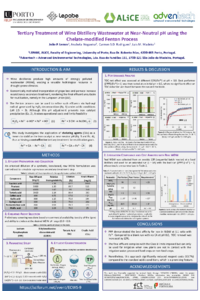
This study investigates the application of chelate-modified homogeneous Fenton oxidation as a tertiary treatment for wine distillery wastewater (WDW) at near-neutral pH, proposing an alternative to costly pH correction steps (Zhang et al., 2019) currently employed.
Four biodegradable chelating agents (CAs) were used, including sodiumpyrophosphate (PPP), oxalic acid (OA), tartaric acid (TA), and ethylenediamine-N,N'-disuccinic acid (EDDS), at different CA-to-catalyst molar ratios ([CA]:[Fe²⁺]) and pHs (6.0 – 8.0). A characterization of the final effluent according to APHA (1998) was carried out to assess Class A reuse standards in the European Legislation (Regulation 2020/741).
The results obtained for PPP were deemed more satisfactory. For an equimolar to Fe²⁺ ratio, hydrogen peroxide and catalyst concentrations of 8.7 g/L and 0.87 g/L were used, respectively, at pH 8.0, and a total organic carbon (TOC) removal of 31.2% was obtained after a 2-hour experiment at 35 ºC. This represented a 12% increase compared to a blank run without the chelant. A 5-hour run with real, biologically treated WDW validated this result, with a similar TOC reduction of 37.4%.
In the face of reutilization purposes in the European Union, i) the treatment was able to get the effluent’s biological oxygen demand (BOD5) below 10 mg O2/L, thus inside quality standards; ii) the process was not able to reduce the effluent’s final turbidity below the legislation’s threshold (5 NTU); and iii) total phosphorus was considerably increased by the addition of PPP.
PPP was deemed the most promising chelating agent due to its affinity with iron ions at the desired pH range and its inorganic characteristic, which is not a major target for hydroxyl radicals and does not add to the wastewater’s organic load.
The development of an optimized catalyst settling step to reduce leftover haziness in colloidal chelated species could enable water reutilization perspectives. An additional step to remove excess phosphorus might also be necessary for some applications.
Keywords
Fenton-like process
chelating agent
wastewater treatment
water reutilization
wine distillery
Poster
ECWS9_Poster_Joao_Lemos.pdf
Catalytic Performance of Carbon Nanotubes on Glass Frits for Oxalic Acid Degradation by Ozonation
The comparison of fresh and dry duckweed to remove Cr, Cd and Zn from wastewater