Event submissions
Published
This submission belongs to the session S8. Wastewater Treatment and Reuse of the event The 9th International Electronic Conference on Water Sciences
Published date
06 Nov, 2025
Academic Editor
'%3e%3cpath%20d='M12.6657%2010.9104C12.4185%2010.325%2012.0599%209.79327%2011.6097%209.34482C11.1609%208.89508%2010.6293%208.5365%2010.0442%208.28888C10.0389%208.28626%2010.0337%208.28495%2010.0285%208.28233C10.8446%207.69279%2011.3752%206.73249%2011.3752%205.64904C11.3752%203.8542%209.92103%202.39999%208.1262%202.39999C6.33136%202.39999%204.87715%203.8542%204.87715%205.64904C4.87715%206.73249%205.40774%207.69279%206.22393%208.28364C6.21869%208.28626%206.21345%208.28757%206.20821%208.29019C5.62129%208.5378%205.09463%208.89284%204.64265%209.34613C4.1929%209.79493%203.83432%2010.3266%203.58671%2010.9117C3.34345%2011.4845%203.21226%2012.0987%203.20023%2012.7209C3.19988%2012.7349%203.20233%2012.7488%203.20744%2012.7619C3.21255%2012.7749%203.22022%2012.7867%203.22998%2012.7968C3.23975%2012.8068%203.25142%2012.8147%203.26431%2012.8202C3.2772%2012.8256%203.29105%2012.8284%203.30504%2012.8284H4.09109C4.14874%2012.8284%204.19459%2012.7825%204.1959%2012.7262C4.2221%2011.7148%204.62823%2010.7676%205.34617%2010.0497C6.08899%209.30683%207.0755%208.89808%208.1262%208.89808C9.17689%208.89808%2010.1634%209.30683%2010.9062%2010.0497C11.6242%2010.7676%2012.0303%2011.7148%2012.0565%2012.7262C12.0578%2012.7838%2012.1037%2012.8284%2012.1613%2012.8284H12.9474C12.9613%2012.8284%2012.9752%2012.8256%2012.9881%2012.8202C13.001%2012.8147%2013.0126%2012.8068%2013.0224%2012.7968C13.0322%2012.7867%2013.0398%2012.7749%2013.0449%2012.7619C13.0501%2012.7488%2013.0525%2012.7349%2013.0522%2012.7209C13.0391%2012.0947%2012.9094%2011.4855%2012.6657%2010.9104ZM8.1262%207.9024C7.52486%207.9024%206.9589%207.6679%206.53312%207.24211C6.10733%206.81633%205.87283%206.25037%205.87283%205.64904C5.87283%205.0477%206.10733%204.48174%206.53312%204.05596C6.9589%203.63018%207.52486%203.39567%208.1262%203.39567C8.72753%203.39567%209.29349%203.63018%209.71927%204.05596C10.1451%204.48174%2010.3796%205.0477%2010.3796%205.64904C10.3796%206.25037%2010.1451%206.81633%209.71927%207.24211C9.29349%207.6679%208.72753%207.9024%208.1262%207.9024Z'%20fill='%235D1EE1'/%3e%3c/g%3e%3c/svg%3e) Carmen Teodosiu
Carmen TeodosiuCitation
Aderemi Timothy Adeleye, Md Mezbaul Bahar, Mallavarapu Megharaj, Mohammad Mahmudur Rahman, Oxidative Aging of Polyvinyl chloride (PVC) Microplastics: Implications for Vector Potential toward Methylene Blue, in Proceedings of The 9th International Electronic Conference on Water Sciences, 11 November–14 November 2025, MDPI: Basel, Switzerland
Share
Email
Facebook
Twitter
LinkedIn
Oxidative Aging of Polyvinyl chloride (PVC) Microplastics: Implications for Vector Potential toward Methylene Blue
'%3e%3cpath%20d='M12.6647%2010.9104C12.4176%2010.325%2012.0589%209.7933%2011.6088%209.34485C11.16%208.89511%2010.6283%208.53653%2010.0432%208.28891C10.038%208.28629%2010.0327%208.28498%2010.0275%208.28236C10.8437%207.69282%2011.3743%206.73252%2011.3743%205.64907C11.3743%203.85423%209.92005%202.40002%208.12522%202.40002C6.33038%202.40002%204.87618%203.85423%204.87618%205.64907C4.87618%206.73252%205.40677%207.69282%206.22296%208.28367C6.21772%208.28629%206.21248%208.2876%206.20724%208.29022C5.62031%208.53783%205.09365%208.89287%204.64167%209.34616C4.19192%209.79496%203.83334%2010.3266%203.58573%2010.9117C3.34247%2011.4846%203.21128%2012.0987%203.19925%2012.721C3.1989%2012.735%203.20135%2012.7489%203.20646%2012.7619C3.21157%2012.7749%203.21924%2012.7868%203.22901%2012.7968C3.23877%2012.8068%203.25045%2012.8148%203.26334%2012.8202C3.27623%2012.8256%203.29007%2012.8284%203.30406%2012.8284H4.09012C4.14776%2012.8284%204.19362%2012.7825%204.19493%2012.7262C4.22113%2011.7148%204.62726%2010.7676%205.34519%2010.0497C6.08802%209.30686%207.07452%208.89811%208.12522%208.89811C9.17592%208.89811%2010.1624%209.30686%2010.9052%2010.0497C11.6232%2010.7676%2012.0293%2011.7148%2012.0555%2012.7262C12.0568%2012.7839%2012.1027%2012.8284%2012.1603%2012.8284H12.9464C12.9604%2012.8284%2012.9742%2012.8256%2012.9871%2012.8202C13%2012.8148%2013.0117%2012.8068%2013.0214%2012.7968C13.0312%2012.7868%2013.0389%2012.7749%2013.044%2012.7619C13.0491%2012.7489%2013.0515%2012.735%2013.0512%2012.721C13.0381%2012.0947%2012.9084%2011.4856%2012.6647%2010.9104ZM8.12522%207.90243C7.52388%207.90243%206.95792%207.66793%206.53214%207.24215C6.10636%206.81636%205.87185%206.2504%205.87185%205.64907C5.87185%205.04773%206.10636%204.48177%206.53214%204.05599C6.95792%203.63021%207.52388%203.3957%208.12522%203.3957C8.72655%203.3957%209.29252%203.63021%209.7183%204.05599C10.1441%204.48177%2010.3786%205.04773%2010.3786%205.64907C10.3786%206.2504%2010.1441%206.81636%209.7183%207.24215C9.29252%207.66793%208.72655%207.90243%208.12522%207.90243Z'%20fill='%235D1EE1'/%3e%3c/g%3e%3c/svg%3e)
Aderemi Timothy Adeleye 1
Md Mezbaul Bahar 1,2

Mallavarapu Megharaj 1,2

Mohammad Mahmudur Rahman 1,2
1. Global Centre for Environmental Remediation (GCER), School of Environmental and Life Sciences, College of Engineering, Science and Environment, The University of Newcastle, Callaghan, NSW 2308, Australia
2. crc for Contamination Assessment and Remediation of the Environment (crcCARE), University Drive, Callaghan, NSW 2308, Australia
Abstract
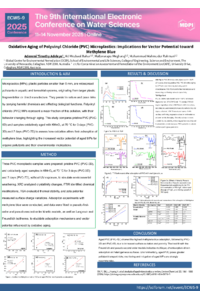
Polyvinyl chloride (PVC) microplastics (MPs) and methylene blue (MB) frequently co-exist in sewage effluents, raising concerns regarding their interactions and combined impacts during wastewater treatment. To explore the vector potential of PVC, MPs were subjected to controlled aging using potassium permanganate (KMnO₄) for two and five days under different operating conditions (pH, oxidant dosage, and reaction time) to simulate environmental oxidation. Surface characterization revealed the formation of manganese oxides (MnO₂) on aged PVC, which significantly modified its physicochemical properties. Scanning electron microscopy coupled with EDS (SEM-EDS) confirmed surface roughening and Mn deposition, while FTIR analysis identified the introduction of oxygen-containing functional groups, highlighting chemical transformation during aging. XRD provided evidence of MnO₂ crystallite deposition, and BET surface analysis demonstrated changes in surface area and porosity, both of which contributed to modified adsorption behavior.
Adsorption experiments showed that pristine PVC displayed minimal uptake of MB, whereas KMnO₄-aged PVC, particularly after oxidation, exhibited enhanced MB affinity due to MnO₂ nanoparticle coating. Furthermore, the desorption studies indicated reduced release of MB, suggesting strong MnO₂–dye interactions and greater persistence of pollutant–polymer complexes. Therefore, these results highlight the aging role of KMnO₄ in PVC which facilitated its affinity for MB, increasing their vector role potential and revealing corresponding associated environmental risks.
Overall, these findings offer mechanistic insights into how oxidative aging alters MPs’ structure and reactivity. Therefore, the findings not only contribute to understanding the fate and transport behaviour of MPs with contaminants in aqueous systems but also inform sustainable remediation strategies for mitigating microplastic–pollutant risks in aquatic environments.
Keywords
Microplastics
Vector potentials
Methylene blue
Wastewater
Oxidative aging
Poster
sciforum_151357_S8_slides_ADELEYE_poster_presentation.pdf
Liquid Biphasic Systems: Principles and Potential for Wastewater Treatment
Hybrid Ultrasonic-Oxidative Treatment of PFASs in Firefighting Foams and Enriched Foam Waste