Event submissions
Published
This submission belongs to the session S8. Wastewater Treatment and Reuse of the event The 9th International Electronic Conference on Water Sciences
Published date
06 Nov, 2025
Academic Editor
'%3e%3cpath%20d='M12.6657%2010.9104C12.4185%2010.325%2012.0599%209.79327%2011.6097%209.34482C11.1609%208.89508%2010.6293%208.5365%2010.0442%208.28888C10.0389%208.28626%2010.0337%208.28495%2010.0285%208.28233C10.8446%207.69279%2011.3752%206.73249%2011.3752%205.64904C11.3752%203.8542%209.92103%202.39999%208.1262%202.39999C6.33136%202.39999%204.87715%203.8542%204.87715%205.64904C4.87715%206.73249%205.40774%207.69279%206.22393%208.28364C6.21869%208.28626%206.21345%208.28757%206.20821%208.29019C5.62129%208.5378%205.09463%208.89284%204.64265%209.34613C4.1929%209.79493%203.83432%2010.3266%203.58671%2010.9117C3.34345%2011.4845%203.21226%2012.0987%203.20023%2012.7209C3.19988%2012.7349%203.20233%2012.7488%203.20744%2012.7619C3.21255%2012.7749%203.22022%2012.7867%203.22998%2012.7968C3.23975%2012.8068%203.25142%2012.8147%203.26431%2012.8202C3.2772%2012.8256%203.29105%2012.8284%203.30504%2012.8284H4.09109C4.14874%2012.8284%204.19459%2012.7825%204.1959%2012.7262C4.2221%2011.7148%204.62823%2010.7676%205.34617%2010.0497C6.08899%209.30683%207.0755%208.89808%208.1262%208.89808C9.17689%208.89808%2010.1634%209.30683%2010.9062%2010.0497C11.6242%2010.7676%2012.0303%2011.7148%2012.0565%2012.7262C12.0578%2012.7838%2012.1037%2012.8284%2012.1613%2012.8284H12.9474C12.9613%2012.8284%2012.9752%2012.8256%2012.9881%2012.8202C13.001%2012.8147%2013.0126%2012.8068%2013.0224%2012.7968C13.0322%2012.7867%2013.0398%2012.7749%2013.0449%2012.7619C13.0501%2012.7488%2013.0525%2012.7349%2013.0522%2012.7209C13.0391%2012.0947%2012.9094%2011.4855%2012.6657%2010.9104ZM8.1262%207.9024C7.52486%207.9024%206.9589%207.6679%206.53312%207.24211C6.10733%206.81633%205.87283%206.25037%205.87283%205.64904C5.87283%205.0477%206.10733%204.48174%206.53312%204.05596C6.9589%203.63018%207.52486%203.39567%208.1262%203.39567C8.72753%203.39567%209.29349%203.63018%209.71927%204.05596C10.1451%204.48174%2010.3796%205.0477%2010.3796%205.64904C10.3796%206.25037%2010.1451%206.81633%209.71927%207.24211C9.29349%207.6679%208.72753%207.9024%208.1262%207.9024Z'%20fill='%235D1EE1'/%3e%3c/g%3e%3c/svg%3e) Carmen Teodosiu
Carmen TeodosiuCitation
Amanda Fujita, André Torres-Pinto, Adrián M.T. Silva, Removal of Organic Contaminants via Electro-Activated Biochar Suspensions, in Proceedings of The 9th International Electronic Conference on Water Sciences, 11 November–14 November 2025, MDPI: Basel, Switzerland
Share
Email
Facebook
Twitter
LinkedIn
Removal of Organic Contaminants via Electro-Activated Biochar Suspensions
'%3e%3cpath%20d='M12.6647%2010.9104C12.4176%2010.325%2012.0589%209.7933%2011.6088%209.34485C11.16%208.89511%2010.6283%208.53653%2010.0432%208.28891C10.038%208.28629%2010.0327%208.28498%2010.0275%208.28236C10.8437%207.69282%2011.3743%206.73252%2011.3743%205.64907C11.3743%203.85423%209.92005%202.40002%208.12522%202.40002C6.33038%202.40002%204.87618%203.85423%204.87618%205.64907C4.87618%206.73252%205.40677%207.69282%206.22296%208.28367C6.21772%208.28629%206.21248%208.2876%206.20724%208.29022C5.62031%208.53783%205.09365%208.89287%204.64167%209.34616C4.19192%209.79496%203.83334%2010.3266%203.58573%2010.9117C3.34247%2011.4846%203.21128%2012.0987%203.19925%2012.721C3.1989%2012.735%203.20135%2012.7489%203.20646%2012.7619C3.21157%2012.7749%203.21924%2012.7868%203.22901%2012.7968C3.23877%2012.8068%203.25045%2012.8148%203.26334%2012.8202C3.27623%2012.8256%203.29007%2012.8284%203.30406%2012.8284H4.09012C4.14776%2012.8284%204.19362%2012.7825%204.19493%2012.7262C4.22113%2011.7148%204.62726%2010.7676%205.34519%2010.0497C6.08802%209.30686%207.07452%208.89811%208.12522%208.89811C9.17592%208.89811%2010.1624%209.30686%2010.9052%2010.0497C11.6232%2010.7676%2012.0293%2011.7148%2012.0555%2012.7262C12.0568%2012.7839%2012.1027%2012.8284%2012.1603%2012.8284H12.9464C12.9604%2012.8284%2012.9742%2012.8256%2012.9871%2012.8202C13%2012.8148%2013.0117%2012.8068%2013.0214%2012.7968C13.0312%2012.7868%2013.0389%2012.7749%2013.044%2012.7619C13.0491%2012.7489%2013.0515%2012.735%2013.0512%2012.721C13.0381%2012.0947%2012.9084%2011.4856%2012.6647%2010.9104ZM8.12522%207.90243C7.52388%207.90243%206.95792%207.66793%206.53214%207.24215C6.10636%206.81636%205.87185%206.2504%205.87185%205.64907C5.87185%205.04773%206.10636%204.48177%206.53214%204.05599C6.95792%203.63021%207.52388%203.3957%208.12522%203.3957C8.72655%203.3957%209.29252%203.63021%209.7183%204.05599C10.1441%204.48177%2010.3786%205.04773%2010.3786%205.64907C10.3786%206.2504%2010.1441%206.81636%209.7183%207.24215C9.29252%207.66793%208.72655%207.90243%208.12522%207.90243Z'%20fill='%235D1EE1'/%3e%3c/g%3e%3c/svg%3e)
Amanda Fujita 1

André Torres-Pinto 1

Adrián M.T. Silva 1
1. LSRE-LCM, ALiCE, Faculty of Engineering, University of Porto, Rua Dr. Roberto Frias, 4200-465 Porto, Portugal
Abstract
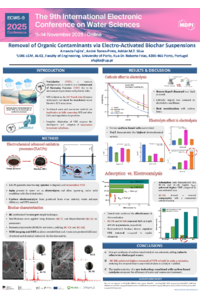
Conventional water and wastewater treatment methods are often inadequate for the complete elimination of persistent contaminants of emerging concern (CECs), which can cause risks to human health and ecosystems. Given that clean water is fundamental, the development of new sustainable technologies to ensure both access to clean water and its safe discharge has become an urgent priority.
Electrochemical-advanced oxidation processes (EAOPs) have emerged as a promising alternative. EAOPs operate under mild conditions to produce reactive oxidants (e.g., •OH) that oxidize and mineralize pollutants into less harmful species. In addition, to improve reaction efficiency, carbon-based catalysts were added into EAOPs. For the synthesis of these materials, grape pomace was used as biomass for the biochar (BC), thiourea and dicyandiamide were used as functionalizers (BC-T and BC-D) and potassium hydroxide was used for activation (BC-TK and BC-DK).
This study focused on the degradation of venlafaxine (VFX), a common CEC found in wastewater by assessing different cathodes (i.e., Nickel, Stainless Steel, Titanium and Carbon Foam) paired with boron-doped diamond (BDD) as an anode for the EAOPs. Also, for electrolytes, sodium-based salts were assessed. Adsorption tests showed that after 2 hours BC-DK and BC-TK removed 35% and 87% of VFX, respectively, improving efficiency when compared to non-activated ones. However, when BDD was paired with a nickel cathode in a solution of 6 mM of NaCl; as a result, VFX removal increased significantly, with BC-T reaching 80% and BC-DK 95% within 5 minutes, whereas electrolysis without catalysts removed less than 20% within the same period of treatment. These findings highlight the potential of combining EAOPs with carbon-based catalysts as a sustainable and highly efficient approach for water and wastewater treatment, while valorising solid waste that would otherwise be discarded.
This work was supported by FCT/MCTES (PIDDAC) under projects DRopH2O - 2022.08738.PTDC (DOI: 10.54499/2022.08738.PTDC), LSRE-LCM, UID/50020/2025; and ALiCE, LA/P/0045/2020 (DOI: 10.54499/LA/P/0045/2020).
Keywords
Biochar
Venlafaxine
Electrocatalysis
Electrochemical advanced oxidation processes
Poster
Poster_ECWS-9_sciforum-152364.pdf
Three-Dimensional-Alumina-Supported Activated Carbon for Water Treatment and In Situ Regeneration Through Catalytic Wet Peroxide Oxidation
Eco-Friendly Chitosan (CTS) Films for Indigo Carmine Removal and Wastewater Treatment