Event submissions
Published
This submission belongs to the session S8. Wastewater Treatment and Reuse of the event The 9th International Electronic Conference on Water Sciences
Published date
06 Nov, 2025
Academic Editor
'%3e%3cpath%20d='M12.6657%2010.9104C12.4185%2010.325%2012.0599%209.79327%2011.6097%209.34482C11.1609%208.89508%2010.6293%208.5365%2010.0442%208.28888C10.0389%208.28626%2010.0337%208.28495%2010.0285%208.28233C10.8446%207.69279%2011.3752%206.73249%2011.3752%205.64904C11.3752%203.8542%209.92103%202.39999%208.1262%202.39999C6.33136%202.39999%204.87715%203.8542%204.87715%205.64904C4.87715%206.73249%205.40774%207.69279%206.22393%208.28364C6.21869%208.28626%206.21345%208.28757%206.20821%208.29019C5.62129%208.5378%205.09463%208.89284%204.64265%209.34613C4.1929%209.79493%203.83432%2010.3266%203.58671%2010.9117C3.34345%2011.4845%203.21226%2012.0987%203.20023%2012.7209C3.19988%2012.7349%203.20233%2012.7488%203.20744%2012.7619C3.21255%2012.7749%203.22022%2012.7867%203.22998%2012.7968C3.23975%2012.8068%203.25142%2012.8147%203.26431%2012.8202C3.2772%2012.8256%203.29105%2012.8284%203.30504%2012.8284H4.09109C4.14874%2012.8284%204.19459%2012.7825%204.1959%2012.7262C4.2221%2011.7148%204.62823%2010.7676%205.34617%2010.0497C6.08899%209.30683%207.0755%208.89808%208.1262%208.89808C9.17689%208.89808%2010.1634%209.30683%2010.9062%2010.0497C11.6242%2010.7676%2012.0303%2011.7148%2012.0565%2012.7262C12.0578%2012.7838%2012.1037%2012.8284%2012.1613%2012.8284H12.9474C12.9613%2012.8284%2012.9752%2012.8256%2012.9881%2012.8202C13.001%2012.8147%2013.0126%2012.8068%2013.0224%2012.7968C13.0322%2012.7867%2013.0398%2012.7749%2013.0449%2012.7619C13.0501%2012.7488%2013.0525%2012.7349%2013.0522%2012.7209C13.0391%2012.0947%2012.9094%2011.4855%2012.6657%2010.9104ZM8.1262%207.9024C7.52486%207.9024%206.9589%207.6679%206.53312%207.24211C6.10733%206.81633%205.87283%206.25037%205.87283%205.64904C5.87283%205.0477%206.10733%204.48174%206.53312%204.05596C6.9589%203.63018%207.52486%203.39567%208.1262%203.39567C8.72753%203.39567%209.29349%203.63018%209.71927%204.05596C10.1451%204.48174%2010.3796%205.0477%2010.3796%205.64904C10.3796%206.25037%2010.1451%206.81633%209.71927%207.24211C9.29349%207.6679%208.72753%207.9024%208.1262%207.9024Z'%20fill='%235D1EE1'/%3e%3c/g%3e%3c/svg%3e) Carmen Teodosiu
Carmen TeodosiuCitation
Sepideh Dadashi, Gabriele Giancane, Giuseppe Mele, Eco-Friendly Chitosan (CTS) Films for Indigo Carmine Removal and Wastewater Treatment, in Proceedings of The 9th International Electronic Conference on Water Sciences, 11 November–14 November 2025, MDPI: Basel, Switzerland
Share
Email
Facebook
Twitter
LinkedIn
Eco-Friendly Chitosan (CTS) Films for Indigo Carmine Removal and Wastewater Treatment
'%3e%3cpath%20d='M12.6647%2010.9104C12.4176%2010.325%2012.0589%209.7933%2011.6088%209.34485C11.16%208.89511%2010.6283%208.53653%2010.0432%208.28891C10.038%208.28629%2010.0327%208.28498%2010.0275%208.28236C10.8437%207.69282%2011.3743%206.73252%2011.3743%205.64907C11.3743%203.85423%209.92005%202.40002%208.12522%202.40002C6.33038%202.40002%204.87618%203.85423%204.87618%205.64907C4.87618%206.73252%205.40677%207.69282%206.22296%208.28367C6.21772%208.28629%206.21248%208.2876%206.20724%208.29022C5.62031%208.53783%205.09365%208.89287%204.64167%209.34616C4.19192%209.79496%203.83334%2010.3266%203.58573%2010.9117C3.34247%2011.4846%203.21128%2012.0987%203.19925%2012.721C3.1989%2012.735%203.20135%2012.7489%203.20646%2012.7619C3.21157%2012.7749%203.21924%2012.7868%203.22901%2012.7968C3.23877%2012.8068%203.25045%2012.8148%203.26334%2012.8202C3.27623%2012.8256%203.29007%2012.8284%203.30406%2012.8284H4.09012C4.14776%2012.8284%204.19362%2012.7825%204.19493%2012.7262C4.22113%2011.7148%204.62726%2010.7676%205.34519%2010.0497C6.08802%209.30686%207.07452%208.89811%208.12522%208.89811C9.17592%208.89811%2010.1624%209.30686%2010.9052%2010.0497C11.6232%2010.7676%2012.0293%2011.7148%2012.0555%2012.7262C12.0568%2012.7839%2012.1027%2012.8284%2012.1603%2012.8284H12.9464C12.9604%2012.8284%2012.9742%2012.8256%2012.9871%2012.8202C13%2012.8148%2013.0117%2012.8068%2013.0214%2012.7968C13.0312%2012.7868%2013.0389%2012.7749%2013.044%2012.7619C13.0491%2012.7489%2013.0515%2012.735%2013.0512%2012.721C13.0381%2012.0947%2012.9084%2011.4856%2012.6647%2010.9104ZM8.12522%207.90243C7.52388%207.90243%206.95792%207.66793%206.53214%207.24215C6.10636%206.81636%205.87185%206.2504%205.87185%205.64907C5.87185%205.04773%206.10636%204.48177%206.53214%204.05599C6.95792%203.63021%207.52388%203.3957%208.12522%203.3957C8.72655%203.3957%209.29252%203.63021%209.7183%204.05599C10.1441%204.48177%2010.3786%205.04773%2010.3786%205.64907C10.3786%206.2504%2010.1441%206.81636%209.7183%207.24215C9.29252%207.66793%208.72655%207.90243%208.12522%207.90243Z'%20fill='%235D1EE1'/%3e%3c/g%3e%3c/svg%3e)
Sepideh Dadashi 1

Gabriele Giancane 2

Giuseppe Mele 1
1. Department of Engineering for Innovation, University of Salento, 73100, Lecce, Italy
2. Department of Cultural Heritage, University of Salento, I-73100, Lecce, Italy
Abstract
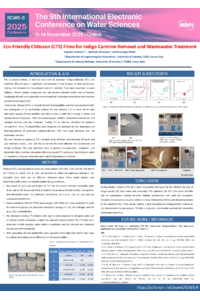
The discharge of synthetic dyes such as indigo carmine (IC) into industrial effluents poses serious environmental risks due to their persistence, toxicity, and resistance to conventional treatment. This study developed chitosan (CTS)-based films as biodegradable, eco-friendly adsorbents for IC removal and wastewater reuse. CTS was dissolved in acetic acid (AA) solutions (0.05%, 1.5%, and 3%), and homogenized hydrogels were prepared by stirring in sealed vials at ambient temperature for 3 h. In our trials, casting on glass and watch glass at 73 °C for 35 min caused irreversible adhesion, whereas polyethylene (PE) at ambient temperature produced homogeneous, transparent, and detachable films. The optimized formulation (1% CTS in 1.5% AA) on PE plates yielded stable, transparent films used for further experiments. Fourier-transform infrared (FTIR) spectroscopy of CTS, AA, the homogenized hydrogel, and dried CTS–1.5%AA/PE films confirmed structural interactions. Adsorption tests were carried out with IC solutions (16 mg/mL) prepared in ultrapure water and secondary treated wastewater supplied by Aquasoil Company (Italy). Full decolorization of the solutions occurred within the first hour, accompanied by a visible change as the initially transparent CTS films turned blue, confirming rapid dye uptake. Subsequent irradiation with a UV lamp (365 nm, UV-A range) promoted photodegradation; after 2 hours, the films lost their blue coloration and exhibited a light yellow tone. The films remained structurally stable and could be readily removed. These findings confirm a dual adsorption–photodegradation mechanism, demonstrating the promise of CTS–1.5%AA/PE films as low-cost, biodegradable, and scalable materials for sustainable wastewater treatment. Further studies on biodegradation, reusability, and large-scale application are recommended to validate their industrial potential. Acknowledgment: This project was supported by S.D. through a Doctoral Fellowship funded by the National Operational Programme Research and Innovation 2014–2020 (grant CCI2014IT16M2OP005).
Keywords
Chitosan
Biodegradable films
Wastewater treatment
Dye removal
Environmental remediation
Photodegradation
Poster
Sepideh Dadashi.pdf
Removal of Organic Contaminants via Electro-Activated Biochar Suspensions
Integrating Hybrid Nature-Based Solutions for Pollutant Reduction and Biodiversity Promotion