Event submissions
Published
This submission belongs to the session S10. Glacier Hydrology and Climate Change of the event The 9th International Electronic Conference on Water Sciences
Published date
06 Nov, 2025
Academic Editor
'%3e%3cpath%20d='M12.6657%2010.9104C12.4185%2010.325%2012.0599%209.79327%2011.6097%209.34482C11.1609%208.89508%2010.6293%208.5365%2010.0442%208.28888C10.0389%208.28626%2010.0337%208.28495%2010.0285%208.28233C10.8446%207.69279%2011.3752%206.73249%2011.3752%205.64904C11.3752%203.8542%209.92103%202.39999%208.1262%202.39999C6.33136%202.39999%204.87715%203.8542%204.87715%205.64904C4.87715%206.73249%205.40774%207.69279%206.22393%208.28364C6.21869%208.28626%206.21345%208.28757%206.20821%208.29019C5.62129%208.5378%205.09463%208.89284%204.64265%209.34613C4.1929%209.79493%203.83432%2010.3266%203.58671%2010.9117C3.34345%2011.4845%203.21226%2012.0987%203.20023%2012.7209C3.19988%2012.7349%203.20233%2012.7488%203.20744%2012.7619C3.21255%2012.7749%203.22022%2012.7867%203.22998%2012.7968C3.23975%2012.8068%203.25142%2012.8147%203.26431%2012.8202C3.2772%2012.8256%203.29105%2012.8284%203.30504%2012.8284H4.09109C4.14874%2012.8284%204.19459%2012.7825%204.1959%2012.7262C4.2221%2011.7148%204.62823%2010.7676%205.34617%2010.0497C6.08899%209.30683%207.0755%208.89808%208.1262%208.89808C9.17689%208.89808%2010.1634%209.30683%2010.9062%2010.0497C11.6242%2010.7676%2012.0303%2011.7148%2012.0565%2012.7262C12.0578%2012.7838%2012.1037%2012.8284%2012.1613%2012.8284H12.9474C12.9613%2012.8284%2012.9752%2012.8256%2012.9881%2012.8202C13.001%2012.8147%2013.0126%2012.8068%2013.0224%2012.7968C13.0322%2012.7867%2013.0398%2012.7749%2013.0449%2012.7619C13.0501%2012.7488%2013.0525%2012.7349%2013.0522%2012.7209C13.0391%2012.0947%2012.9094%2011.4855%2012.6657%2010.9104ZM8.1262%207.9024C7.52486%207.9024%206.9589%207.6679%206.53312%207.24211C6.10733%206.81633%205.87283%206.25037%205.87283%205.64904C5.87283%205.0477%206.10733%204.48174%206.53312%204.05596C6.9589%203.63018%207.52486%203.39567%208.1262%203.39567C8.72753%203.39567%209.29349%203.63018%209.71927%204.05596C10.1451%204.48174%2010.3796%205.0477%2010.3796%205.64904C10.3796%206.25037%2010.1451%206.81633%209.71927%207.24211C9.29349%207.6679%208.72753%207.9024%208.1262%207.9024Z'%20fill='%235D1EE1'/%3e%3c/g%3e%3c/svg%3e) ATHANASIOS LOUKAS
ATHANASIOS LOUKASCitation
Fahim Shakil Rahman, The Melting Cradle: Climate Change and the Unraveling of Glacial Hydrological Systems, in Proceedings of The 9th International Electronic Conference on Water Sciences, 11 November–14 November 2025, MDPI: Basel, Switzerland
Share
Email
Facebook
Twitter
LinkedIn
The Melting Cradle: Climate Change and the Unraveling of Glacial Hydrological Systems

Fahim Shakil Rahman 1
1. Department of Agricultural Science, Daffodil International University, Dhaka, Bangladesh
Abstract
Glaciers are fundamental components of the global cryosphere, acting as critical freshwater reservoirs that regulate river discharge, support ecosystems, and sustain billions of people downstream. This project investigates the profound impacts of anthropogenic climate change on glacial hydrology, arguing that rising global temperatures are not merely causing ice melt, but are systematically dismantling a stable, natural water-regulation system. This research employs a case study analysis of the Himalayan region, combining a review of the current scientific literature with trend analysis of satellite imagery (Landsat, 1990-2020) to visualize decadal-scale glacier retreat.
The findings confirm a direct correlation between increasing regional temperatures and accelerated glacial mass loss, leading to a shift in hydrological regimes. This manifests as a dangerous transition from a period of increased meltwater (peak water) to an eventual state of significant water scarcity. The project further analyzes the cascading consequences of this shift, including heightened risks of glacial lake outburst floods (GLOFs), altered sediment transport, and severe threats to agricultural and municipal water security downstream.
This unraveling of a millennia-old hydrological balance presents a paramount challenge for the 21st century. This study concludes that while immediate local adaptation strategies such as enhanced water management and early warning systems are urgently required, they are ultimately insufficient. The only permanent solution to mitigating long-term, catastrophic water loss lies in global commitment to aggressive climate change mitigation policies aimed at reducing greenhouse gas emissions and preserving the remaining cryosphere.
Keywords
Glacier Hydrology
Climate Change
Mass Balance
Peak Water
Remote Sensing
Water security
Adaptation
Himalayas
Poster
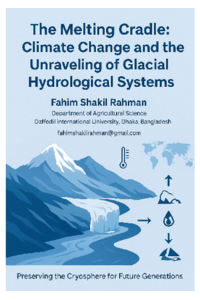
file_00000000d1d46208a7a18b6c383555b2.pdf
Sustainable and digitalized water management in rural areas of the SUDOE region: the GestEAUr project
Morphological Characteristics and Influencing Factors of Mercury Occurrence and in Typical Lakes in Cold and Arid Areas