Event submissions
Published
This submission belongs to the session S1. Neurodegeneration and Neuroinflammation Across the Motor and Spinal Axis (including Multiple Sclerosis, ALS, Huntington’s Disease, and Spinal Cord Injury) of the event The 2nd International Electronic Conference on Medicine
Published date
06 Nov, 2025
Academic Editor
'%3e%3cpath%20d='M12.6657%2010.9104C12.4185%2010.325%2012.0599%209.79327%2011.6097%209.34482C11.1609%208.89508%2010.6293%208.5365%2010.0442%208.28888C10.0389%208.28626%2010.0337%208.28495%2010.0285%208.28233C10.8446%207.69279%2011.3752%206.73249%2011.3752%205.64904C11.3752%203.8542%209.92103%202.39999%208.1262%202.39999C6.33136%202.39999%204.87715%203.8542%204.87715%205.64904C4.87715%206.73249%205.40774%207.69279%206.22393%208.28364C6.21869%208.28626%206.21345%208.28757%206.20821%208.29019C5.62129%208.5378%205.09463%208.89284%204.64265%209.34613C4.1929%209.79493%203.83432%2010.3266%203.58671%2010.9117C3.34345%2011.4845%203.21226%2012.0987%203.20023%2012.7209C3.19988%2012.7349%203.20233%2012.7488%203.20744%2012.7619C3.21255%2012.7749%203.22022%2012.7867%203.22998%2012.7968C3.23975%2012.8068%203.25142%2012.8147%203.26431%2012.8202C3.2772%2012.8256%203.29105%2012.8284%203.30504%2012.8284H4.09109C4.14874%2012.8284%204.19459%2012.7825%204.1959%2012.7262C4.2221%2011.7148%204.62823%2010.7676%205.34617%2010.0497C6.08899%209.30683%207.0755%208.89808%208.1262%208.89808C9.17689%208.89808%2010.1634%209.30683%2010.9062%2010.0497C11.6242%2010.7676%2012.0303%2011.7148%2012.0565%2012.7262C12.0578%2012.7838%2012.1037%2012.8284%2012.1613%2012.8284H12.9474C12.9613%2012.8284%2012.9752%2012.8256%2012.9881%2012.8202C13.001%2012.8147%2013.0126%2012.8068%2013.0224%2012.7968C13.0322%2012.7867%2013.0398%2012.7749%2013.0449%2012.7619C13.0501%2012.7488%2013.0525%2012.7349%2013.0522%2012.7209C13.0391%2012.0947%2012.9094%2011.4855%2012.6657%2010.9104ZM8.1262%207.9024C7.52486%207.9024%206.9589%207.6679%206.53312%207.24211C6.10733%206.81633%205.87283%206.25037%205.87283%205.64904C5.87283%205.0477%206.10733%204.48174%206.53312%204.05596C6.9589%203.63018%207.52486%203.39567%208.1262%203.39567C8.72753%203.39567%209.29349%203.63018%209.71927%204.05596C10.1451%204.48174%2010.3796%205.0477%2010.3796%205.64904C10.3796%206.25037%2010.1451%206.81633%209.71927%207.24211C9.29349%207.6679%208.72753%207.9024%208.1262%207.9024Z'%20fill='%235D1EE1'/%3e%3c/g%3e%3c/svg%3e) Allison B. Reiss
Allison B. ReissCitation
Ioannis Pantelis Adamopoulos, Niki Syrou, Multiple Sclerosis during COVID-19 and Occupational Hazards, in Proceedings of The 2nd International Electronic Conference on Medicine, 11 November–13 November 2025, MDPI: Basel, Switzerland
Share
Email
Facebook
Twitter
LinkedIn
Multiple Sclerosis during COVID-19 and Occupational Hazards

Ioannis Pantelis Adamopoulos 1

Niki Syrou 2
1. Department of Public Health Policy, Sector of Occupational & Environmental Health, School of Public Health, University of West Attica, Alexandras Ave. 196, Athens, Attica 11521, Greece
2. Department of Physical Education and Sport Science, University of Thessaly, Karies, Trikala, Greece, 42100
Abstract
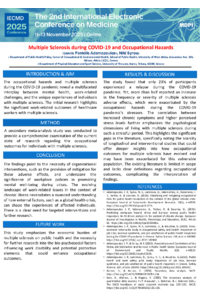
The occupational hazards and multiple sclerosis (MS) during the COVID-19 pandemic reveal a multifaceted interplay between mental health, work-related challenges, and the unique experiences of individuals with MS. The initial research highlights the significant work-related outcomes of healthcare workers with multiple sclerosis. A secondary meta-analysis study was conducted to provide a comprehensive examination of the current state of research regarding the occupational outcomes for individuals with multiple sclerosis. The study found that only 23% of participants experienced a relapse during the pandemic, yet more than half reported an increase in the frequency or severity of adverse MS symptoms, which were exacerbated by the occupational hazards during the COVID-19 pandemic's stressors. The correlation between increased chronic symptoms and higher perceived stress levels further emphasizes the psychological dimensions of living with MS during such a stressful period. This highlight the significant gaps in the literature, specifically noting the scarcity of longitudinal and interventional studies that could offer deeper insights into how occupational outcomes for MS have evolved and may have been exacerbated for this vulnerable population. The existing literature is limited in scope and lacks clear definitions regarding occupational outcomes, complicating the interpretation of findings. This study emphasizes the economic burden of MS on public health and the necessity for further research into the bio-psychosocial factors influencing work disability and potential protective elements that could enhance occupational outcomes. The findings point to the necessity of organizational interventions, such as the provision to mitigate these adverse effects, and underscore the significance of workplace policies in promoting mental well-being during crises. The evolving landscape of work-related issues in the context of chronic illness necessitates a nuanced understanding of how external factors, such as a global health crisis, can shape the experiences of affected individuals. There is a clear need for targeted interventions and further research.
Keywords
Pandemics
Multiple Sclerosis
COVID-19
Occupational Hazards
Public Health
Poster
POSTER-IDsciforum-112440.pdf
Age- and Hypertension-Related Neurochemical Remodeling in the Jugular–Nodose Ganglion Complex of Rats: Asymmetry and Plasticity of CGRP, nNOS, and TTN3 Expression
Magnetic resonance imaging as a non-invasive method to assess pyramidotomy