Event submissions
Published
This submission belongs to the session S1. Neurodegeneration and Neuroinflammation Across the Motor and Spinal Axis (including Multiple Sclerosis, ALS, Huntington’s Disease, and Spinal Cord Injury) of the event The 2nd International Electronic Conference on Medicine
Published date
06 Nov, 2025
Academic Editor
'%3e%3cpath%20d='M12.6657%2010.9104C12.4185%2010.325%2012.0599%209.79327%2011.6097%209.34482C11.1609%208.89508%2010.6293%208.5365%2010.0442%208.28888C10.0389%208.28626%2010.0337%208.28495%2010.0285%208.28233C10.8446%207.69279%2011.3752%206.73249%2011.3752%205.64904C11.3752%203.8542%209.92103%202.39999%208.1262%202.39999C6.33136%202.39999%204.87715%203.8542%204.87715%205.64904C4.87715%206.73249%205.40774%207.69279%206.22393%208.28364C6.21869%208.28626%206.21345%208.28757%206.20821%208.29019C5.62129%208.5378%205.09463%208.89284%204.64265%209.34613C4.1929%209.79493%203.83432%2010.3266%203.58671%2010.9117C3.34345%2011.4845%203.21226%2012.0987%203.20023%2012.7209C3.19988%2012.7349%203.20233%2012.7488%203.20744%2012.7619C3.21255%2012.7749%203.22022%2012.7867%203.22998%2012.7968C3.23975%2012.8068%203.25142%2012.8147%203.26431%2012.8202C3.2772%2012.8256%203.29105%2012.8284%203.30504%2012.8284H4.09109C4.14874%2012.8284%204.19459%2012.7825%204.1959%2012.7262C4.2221%2011.7148%204.62823%2010.7676%205.34617%2010.0497C6.08899%209.30683%207.0755%208.89808%208.1262%208.89808C9.17689%208.89808%2010.1634%209.30683%2010.9062%2010.0497C11.6242%2010.7676%2012.0303%2011.7148%2012.0565%2012.7262C12.0578%2012.7838%2012.1037%2012.8284%2012.1613%2012.8284H12.9474C12.9613%2012.8284%2012.9752%2012.8256%2012.9881%2012.8202C13.001%2012.8147%2013.0126%2012.8068%2013.0224%2012.7968C13.0322%2012.7867%2013.0398%2012.7749%2013.0449%2012.7619C13.0501%2012.7488%2013.0525%2012.7349%2013.0522%2012.7209C13.0391%2012.0947%2012.9094%2011.4855%2012.6657%2010.9104ZM8.1262%207.9024C7.52486%207.9024%206.9589%207.6679%206.53312%207.24211C6.10733%206.81633%205.87283%206.25037%205.87283%205.64904C5.87283%205.0477%206.10733%204.48174%206.53312%204.05596C6.9589%203.63018%207.52486%203.39567%208.1262%203.39567C8.72753%203.39567%209.29349%203.63018%209.71927%204.05596C10.1451%204.48174%2010.3796%205.0477%2010.3796%205.64904C10.3796%206.25037%2010.1451%206.81633%209.71927%207.24211C9.29349%207.6679%208.72753%207.9024%208.1262%207.9024Z'%20fill='%235D1EE1'/%3e%3c/g%3e%3c/svg%3e) Alberto Ouro
Alberto OuroCitation
Radka Bartová, Monika Ďurfinová, Darina Slezáková, Changes of Glycine-Aspartate Metabolism at Glutamatergic Synapses in Multiple Sclerosis: Evidence from Cerebrospinal Fluid, in Proceedings of The 2nd International Electronic Conference on Medicine, 11 November–13 November 2025, MDPI: Basel, Switzerland
Share
Email
Facebook
Twitter
LinkedIn
Changes of Glycine-Aspartate Metabolism at Glutamatergic Synapses in Multiple Sclerosis: Evidence from Cerebrospinal Fluid
'%3e%3cpath%20d='M12.6647%2010.9104C12.4176%2010.325%2012.0589%209.7933%2011.6088%209.34485C11.16%208.89511%2010.6283%208.53653%2010.0432%208.28891C10.038%208.28629%2010.0327%208.28498%2010.0275%208.28236C10.8437%207.69282%2011.3743%206.73252%2011.3743%205.64907C11.3743%203.85423%209.92005%202.40002%208.12522%202.40002C6.33038%202.40002%204.87618%203.85423%204.87618%205.64907C4.87618%206.73252%205.40677%207.69282%206.22296%208.28367C6.21772%208.28629%206.21248%208.2876%206.20724%208.29022C5.62031%208.53783%205.09365%208.89287%204.64167%209.34616C4.19192%209.79496%203.83334%2010.3266%203.58573%2010.9117C3.34247%2011.4846%203.21128%2012.0987%203.19925%2012.721C3.1989%2012.735%203.20135%2012.7489%203.20646%2012.7619C3.21157%2012.7749%203.21924%2012.7868%203.22901%2012.7968C3.23877%2012.8068%203.25045%2012.8148%203.26334%2012.8202C3.27623%2012.8256%203.29007%2012.8284%203.30406%2012.8284H4.09012C4.14776%2012.8284%204.19362%2012.7825%204.19493%2012.7262C4.22113%2011.7148%204.62726%2010.7676%205.34519%2010.0497C6.08802%209.30686%207.07452%208.89811%208.12522%208.89811C9.17592%208.89811%2010.1624%209.30686%2010.9052%2010.0497C11.6232%2010.7676%2012.0293%2011.7148%2012.0555%2012.7262C12.0568%2012.7839%2012.1027%2012.8284%2012.1603%2012.8284H12.9464C12.9604%2012.8284%2012.9742%2012.8256%2012.9871%2012.8202C13%2012.8148%2013.0117%2012.8068%2013.0214%2012.7968C13.0312%2012.7868%2013.0389%2012.7749%2013.044%2012.7619C13.0491%2012.7489%2013.0515%2012.735%2013.0512%2012.721C13.0381%2012.0947%2012.9084%2011.4856%2012.6647%2010.9104ZM8.12522%207.90243C7.52388%207.90243%206.95792%207.66793%206.53214%207.24215C6.10636%206.81636%205.87185%206.2504%205.87185%205.64907C5.87185%205.04773%206.10636%204.48177%206.53214%204.05599C6.95792%203.63021%207.52388%203.3957%208.12522%203.3957C8.72655%203.3957%209.29252%203.63021%209.7183%204.05599C10.1441%204.48177%2010.3786%205.04773%2010.3786%205.64907C10.3786%206.2504%2010.1441%206.81636%209.7183%207.24215C9.29252%207.66793%208.72655%207.90243%208.12522%207.90243Z'%20fill='%235D1EE1'/%3e%3c/g%3e%3c/svg%3e)
Radka Bartová 1
Monika Ďurfinová 1
Darina Slezáková 2
1. Institute of Medical Chemistry, Biochemistry and Clinical Biochemistry, Faculty of Medicine, Comenius University, Sasinkova st. 2, 811 08 Bratislava, Slovakia
2. 2nd Department of Neurology, Faculty of Medicine, Comenius University, Limbová 5, 833 05, Bratislava, Slovakia
Abstract
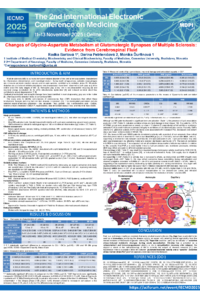
Metabolic changes and rearrangements of inhibitory/excitatory neurotransmitters identified since the early stages of multiple sclerosis (MS) [1] are associated with axonal loss and synaptic dysfunction at advanced stages [2]. The aim of this study was to identify a combination of biomarkers that would help to monitor MS progression at more advanced stages [3].
CSF levels of some neurotransmitters (glutamate-Glu, aspartate-Asp, glycine-Gly, GABA) in combination with markers of lipid peroxidation (MDA, 8-iso-PGF2α), the total antioxidant capacity (TAS), and specific neuronal damage (NSE) were determined in patients with MS (n=85; of which 76 had RR-MS, 9 had SP-MS), non-neurological controls (CG; n=26) and other neurological diagnoses (ONDs; n=31). The RP-HPLC method was used for the determination of neurotransmitters [4] and MDA [5]; F2-isoprostanes and NSE were determined by ELISA; TAS was determined colorimetrically [6].
Significantly higher concentrations of Gly (1.60 µmol/l vs 0.96 µmol/l p=0.0104) and Asp (0.16 µmol/l vs 0.026 µmol/l p=0.0333) in the whole cohort of MS and RR-MS patients compared to the CG and ONDs were found. Glu levels were higher in the total MS and RR subtype than in the CG (0.089 µmol/l vs 0.038 µmol/l p=0.0689; p=0.0616). Asp levels were significantly increased in EDSS≤3 compared to EDSS>3. Furthermore, Gly negatively correlated with NSE in MS and RR-MS, and positively correlated with TAS in CG. Glu levels positively correlated with 8-iso-PGF2α in MS and RR-MS.
Our results show that CSF levels of some of the studied neurotransmitters have the potential to be used as biomarkers monitoring the course of a specific pathological process in MS - Asp as an indicator of oxidative stress-induced metabolic changes in glutamatergic synapses of demyelinating lesions; Gly has potential as a cytoprotectant and immunosuppressant in the processes of remyelination [7,8].
Keywords
glycine
aspartate
glutamate synaptopathy
multiple sclerosis
oxidative stress
demyelinating lesion
cerebrospinal fluid
Poster
IECMD_Bartova_finalPDF.pdf
Intergenic HLA Variant rs9275596 Modulates Treatment Response in Latvian Multiple Sclerosis
Neuroprotective Effects of 6-Paradol on Okadaic Acid-Induced Cognitive Impairment in Zebrafish