Event submissions
Published
This submission belongs to the session S2. Dementia Spectrum Disorders: From Frontotemporal Degeneration to Parkinson’s and Alzheimer’s Disease of the event The 2nd International Electronic Conference on Medicine
Published date
06 Nov, 2025
Academic Editor
'%3e%3cpath%20d='M12.6657%2010.9104C12.4185%2010.325%2012.0599%209.79327%2011.6097%209.34482C11.1609%208.89508%2010.6293%208.5365%2010.0442%208.28888C10.0389%208.28626%2010.0337%208.28495%2010.0285%208.28233C10.8446%207.69279%2011.3752%206.73249%2011.3752%205.64904C11.3752%203.8542%209.92103%202.39999%208.1262%202.39999C6.33136%202.39999%204.87715%203.8542%204.87715%205.64904C4.87715%206.73249%205.40774%207.69279%206.22393%208.28364C6.21869%208.28626%206.21345%208.28757%206.20821%208.29019C5.62129%208.5378%205.09463%208.89284%204.64265%209.34613C4.1929%209.79493%203.83432%2010.3266%203.58671%2010.9117C3.34345%2011.4845%203.21226%2012.0987%203.20023%2012.7209C3.19988%2012.7349%203.20233%2012.7488%203.20744%2012.7619C3.21255%2012.7749%203.22022%2012.7867%203.22998%2012.7968C3.23975%2012.8068%203.25142%2012.8147%203.26431%2012.8202C3.2772%2012.8256%203.29105%2012.8284%203.30504%2012.8284H4.09109C4.14874%2012.8284%204.19459%2012.7825%204.1959%2012.7262C4.2221%2011.7148%204.62823%2010.7676%205.34617%2010.0497C6.08899%209.30683%207.0755%208.89808%208.1262%208.89808C9.17689%208.89808%2010.1634%209.30683%2010.9062%2010.0497C11.6242%2010.7676%2012.0303%2011.7148%2012.0565%2012.7262C12.0578%2012.7838%2012.1037%2012.8284%2012.1613%2012.8284H12.9474C12.9613%2012.8284%2012.9752%2012.8256%2012.9881%2012.8202C13.001%2012.8147%2013.0126%2012.8068%2013.0224%2012.7968C13.0322%2012.7867%2013.0398%2012.7749%2013.0449%2012.7619C13.0501%2012.7488%2013.0525%2012.7349%2013.0522%2012.7209C13.0391%2012.0947%2012.9094%2011.4855%2012.6657%2010.9104ZM8.1262%207.9024C7.52486%207.9024%206.9589%207.6679%206.53312%207.24211C6.10733%206.81633%205.87283%206.25037%205.87283%205.64904C5.87283%205.0477%206.10733%204.48174%206.53312%204.05596C6.9589%203.63018%207.52486%203.39567%208.1262%203.39567C8.72753%203.39567%209.29349%203.63018%209.71927%204.05596C10.1451%204.48174%2010.3796%205.0477%2010.3796%205.64904C10.3796%206.25037%2010.1451%206.81633%209.71927%207.24211C9.29349%207.6679%208.72753%207.9024%208.1262%207.9024Z'%20fill='%235D1EE1'/%3e%3c/g%3e%3c/svg%3e) Alberto Ouro
Alberto OuroCitation
Ana Pérez Vázquez, P. Barciela, A.O.S Jorge, M. Carpena, M.A. Prieto, Incorporation of adaptogens in functional products as a preventive strategy for neurodegenerative diseases, in Proceedings of The 2nd International Electronic Conference on Medicine, 11 November–13 November 2025, MDPI: Basel, Switzerland
Share
Email
Facebook
Twitter
LinkedIn
Incorporation of adaptogens in functional products as a preventive strategy for neurodegenerative diseases
'%3e%3cpath%20d='M12.6647%2010.9104C12.4176%2010.325%2012.0589%209.7933%2011.6088%209.34485C11.16%208.89511%2010.6283%208.53653%2010.0432%208.28891C10.038%208.28629%2010.0327%208.28498%2010.0275%208.28236C10.8437%207.69282%2011.3743%206.73252%2011.3743%205.64907C11.3743%203.85423%209.92005%202.40002%208.12522%202.40002C6.33038%202.40002%204.87618%203.85423%204.87618%205.64907C4.87618%206.73252%205.40677%207.69282%206.22296%208.28367C6.21772%208.28629%206.21248%208.2876%206.20724%208.29022C5.62031%208.53783%205.09365%208.89287%204.64167%209.34616C4.19192%209.79496%203.83334%2010.3266%203.58573%2010.9117C3.34247%2011.4846%203.21128%2012.0987%203.19925%2012.721C3.1989%2012.735%203.20135%2012.7489%203.20646%2012.7619C3.21157%2012.7749%203.21924%2012.7868%203.22901%2012.7968C3.23877%2012.8068%203.25045%2012.8148%203.26334%2012.8202C3.27623%2012.8256%203.29007%2012.8284%203.30406%2012.8284H4.09012C4.14776%2012.8284%204.19362%2012.7825%204.19493%2012.7262C4.22113%2011.7148%204.62726%2010.7676%205.34519%2010.0497C6.08802%209.30686%207.07452%208.89811%208.12522%208.89811C9.17592%208.89811%2010.1624%209.30686%2010.9052%2010.0497C11.6232%2010.7676%2012.0293%2011.7148%2012.0555%2012.7262C12.0568%2012.7839%2012.1027%2012.8284%2012.1603%2012.8284H12.9464C12.9604%2012.8284%2012.9742%2012.8256%2012.9871%2012.8202C13%2012.8148%2013.0117%2012.8068%2013.0214%2012.7968C13.0312%2012.7868%2013.0389%2012.7749%2013.044%2012.7619C13.0491%2012.7489%2013.0515%2012.735%2013.0512%2012.721C13.0381%2012.0947%2012.9084%2011.4856%2012.6647%2010.9104ZM8.12522%207.90243C7.52388%207.90243%206.95792%207.66793%206.53214%207.24215C6.10636%206.81636%205.87185%206.2504%205.87185%205.64907C5.87185%205.04773%206.10636%204.48177%206.53214%204.05599C6.95792%203.63021%207.52388%203.3957%208.12522%203.3957C8.72655%203.3957%209.29252%203.63021%209.7183%204.05599C10.1441%204.48177%2010.3786%205.04773%2010.3786%205.64907C10.3786%206.2504%2010.1441%206.81636%209.7183%207.24215C9.29252%207.66793%208.72655%207.90243%208.12522%207.90243Z'%20fill='%235D1EE1'/%3e%3c/g%3e%3c/svg%3e)
Ana Pérez Vázquez 1

P. Barciela 1
A.O.S Jorge 1,2

M. Carpena 1

M.A. Prieto 1
1. Instituto de Agroecoloxía e Alimentación IAA, Universidade de Vigo, Nutrition and Food Group NuFoG, Campus Auga, 32004 Ourense, Spain
2. REQUIMTE/LAQV, Department of Chemical Sciences, Faculty of Pharmacy, University of Porto, R. Jorge Viterbo Ferreira 228, 4050-313 Porto, Portugal
Abstract
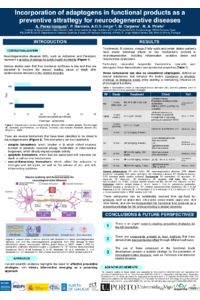
Introduction: Neurodegenerative diseases (ND), such as Alzheimer's and Parkinson's, represent a growing challenge for public health worldwide. Various studies warn that their incidence continues to rise and they are expected to become the second leading cause of death after cardiovascular diseases in the coming decades. In this context, current scientific evidence highlights the need for effective preventive strategies, with dietary intervention emerging as a promising approach.
Methodology: A systematic review was conducted analyzing evidence regarding adaptogens with potential effects preventing neurodegeneration. Studies published between 2018 and2025 were identified in PubMed, ScienceDirect, and Google Scholar. Selection was based on their relevance to the safety and efficacy as preventive compounds against neurodegeneration.
Results: Polyphenols, B vitamins, and certain dietary patterns have shown beneficial effects on key mechanisms involved in neurodegeneration, including inflammation, oxidative stress and mitochondrial dysfunction. In particular, resveratrol, hesperidin, theobromine, quercetin, and oleuropein have demonstrated neuroprotective properties. These effects are associated with mechanisms including CaMKII/CREB/BDNF activation, which is linked to cognitive and anti-inflammatory benefits, microglial inhibition via MAPK/NF‑κB/PI3K/Akt, promotion of autophagy, blood–brain barrier protection, and mitigation of oxidative stress and neuronal apoptosis. These compounds can also be considered adaptogens, defined as natural substances that enhance the body’s resistance to physical, chemical, or biological stress while exerting a normalizing influence on physiological functions. Their multifunctional properties may help regulate stress-related pathways involved in neurodegeneration. These compounds can be sustainably sourced from agri-food by-products, including grape skin, citrus peel, cocoa waste, apple peel, and olive leaves, and can be incorporated into functional food products as a preventive strategy for ND while promoting a circular economy.
Conclusions: This systematic review explores the potential of these bioactive compounds in the development of functional beverages for ND prevention, discussing their mechanisms of action, limitations, and the estimated impact of their application.
Keywords
Neurodegenerative diseases
preventive strategy
adaptogens
functional products
agri-food byproducts
circular economy.
Poster
IECMD 2025_Ana Pérez Vázquez.pdf
Neuroprotective Effects of 6-Paradol on Okadaic Acid-Induced Cognitive Impairment in Zebrafish
Trends in Mortality from Neurological Disorders in Rio Grande do Sul, Brazil (2013–2023): Alzheimer’s Disease, Multiple Sclerosis, and Parkinson’s Disease