Event submissions
Published
This submission belongs to the session S2. Dementia Spectrum Disorders: From Frontotemporal Degeneration to Parkinson’s and Alzheimer’s Disease of the event The 2nd International Electronic Conference on Medicine
Published date
06 Nov, 2025
Academic Editor
'%3e%3cpath%20d='M12.6657%2010.9104C12.4185%2010.325%2012.0599%209.79327%2011.6097%209.34482C11.1609%208.89508%2010.6293%208.5365%2010.0442%208.28888C10.0389%208.28626%2010.0337%208.28495%2010.0285%208.28233C10.8446%207.69279%2011.3752%206.73249%2011.3752%205.64904C11.3752%203.8542%209.92103%202.39999%208.1262%202.39999C6.33136%202.39999%204.87715%203.8542%204.87715%205.64904C4.87715%206.73249%205.40774%207.69279%206.22393%208.28364C6.21869%208.28626%206.21345%208.28757%206.20821%208.29019C5.62129%208.5378%205.09463%208.89284%204.64265%209.34613C4.1929%209.79493%203.83432%2010.3266%203.58671%2010.9117C3.34345%2011.4845%203.21226%2012.0987%203.20023%2012.7209C3.19988%2012.7349%203.20233%2012.7488%203.20744%2012.7619C3.21255%2012.7749%203.22022%2012.7867%203.22998%2012.7968C3.23975%2012.8068%203.25142%2012.8147%203.26431%2012.8202C3.2772%2012.8256%203.29105%2012.8284%203.30504%2012.8284H4.09109C4.14874%2012.8284%204.19459%2012.7825%204.1959%2012.7262C4.2221%2011.7148%204.62823%2010.7676%205.34617%2010.0497C6.08899%209.30683%207.0755%208.89808%208.1262%208.89808C9.17689%208.89808%2010.1634%209.30683%2010.9062%2010.0497C11.6242%2010.7676%2012.0303%2011.7148%2012.0565%2012.7262C12.0578%2012.7838%2012.1037%2012.8284%2012.1613%2012.8284H12.9474C12.9613%2012.8284%2012.9752%2012.8256%2012.9881%2012.8202C13.001%2012.8147%2013.0126%2012.8068%2013.0224%2012.7968C13.0322%2012.7867%2013.0398%2012.7749%2013.0449%2012.7619C13.0501%2012.7488%2013.0525%2012.7349%2013.0522%2012.7209C13.0391%2012.0947%2012.9094%2011.4855%2012.6657%2010.9104ZM8.1262%207.9024C7.52486%207.9024%206.9589%207.6679%206.53312%207.24211C6.10733%206.81633%205.87283%206.25037%205.87283%205.64904C5.87283%205.0477%206.10733%204.48174%206.53312%204.05596C6.9589%203.63018%207.52486%203.39567%208.1262%203.39567C8.72753%203.39567%209.29349%203.63018%209.71927%204.05596C10.1451%204.48174%2010.3796%205.0477%2010.3796%205.64904C10.3796%206.25037%2010.1451%206.81633%209.71927%207.24211C9.29349%207.6679%208.72753%207.9024%208.1262%207.9024Z'%20fill='%235D1EE1'/%3e%3c/g%3e%3c/svg%3e) Alberto Ouro
Alberto OuroCitation
Michele Antonelli, Elena Mazzoleni, Davide Donelli, The Effects of Therapeutic Cannabis and Cannabinoids in Parkinson’s Disease: An Overview of Meta-Analyses, in Proceedings of The 2nd International Electronic Conference on Medicine, 11 November–13 November 2025, MDPI: Basel, Switzerland
Share
Email
Facebook
Twitter
LinkedIn
The Effects of Therapeutic Cannabis and Cannabinoids in Parkinson’s Disease: An Overview of Meta-Analyses

Michele Antonelli 1
'%3e%3cpath%20d='M12.6647%2010.9104C12.4176%2010.325%2012.0589%209.7933%2011.6088%209.34485C11.16%208.89511%2010.6283%208.53653%2010.0432%208.28891C10.038%208.28629%2010.0327%208.28498%2010.0275%208.28236C10.8437%207.69282%2011.3743%206.73252%2011.3743%205.64907C11.3743%203.85423%209.92005%202.40002%208.12522%202.40002C6.33038%202.40002%204.87618%203.85423%204.87618%205.64907C4.87618%206.73252%205.40677%207.69282%206.22296%208.28367C6.21772%208.28629%206.21248%208.2876%206.20724%208.29022C5.62031%208.53783%205.09365%208.89287%204.64167%209.34616C4.19192%209.79496%203.83334%2010.3266%203.58573%2010.9117C3.34247%2011.4846%203.21128%2012.0987%203.19925%2012.721C3.1989%2012.735%203.20135%2012.7489%203.20646%2012.7619C3.21157%2012.7749%203.21924%2012.7868%203.22901%2012.7968C3.23877%2012.8068%203.25045%2012.8148%203.26334%2012.8202C3.27623%2012.8256%203.29007%2012.8284%203.30406%2012.8284H4.09012C4.14776%2012.8284%204.19362%2012.7825%204.19493%2012.7262C4.22113%2011.7148%204.62726%2010.7676%205.34519%2010.0497C6.08802%209.30686%207.07452%208.89811%208.12522%208.89811C9.17592%208.89811%2010.1624%209.30686%2010.9052%2010.0497C11.6232%2010.7676%2012.0293%2011.7148%2012.0555%2012.7262C12.0568%2012.7839%2012.1027%2012.8284%2012.1603%2012.8284H12.9464C12.9604%2012.8284%2012.9742%2012.8256%2012.9871%2012.8202C13%2012.8148%2013.0117%2012.8068%2013.0214%2012.7968C13.0312%2012.7868%2013.0389%2012.7749%2013.044%2012.7619C13.0491%2012.7489%2013.0515%2012.735%2013.0512%2012.721C13.0381%2012.0947%2012.9084%2011.4856%2012.6647%2010.9104ZM8.12522%207.90243C7.52388%207.90243%206.95792%207.66793%206.53214%207.24215C6.10636%206.81636%205.87185%206.2504%205.87185%205.64907C5.87185%205.04773%206.10636%204.48177%206.53214%204.05599C6.95792%203.63021%207.52388%203.3957%208.12522%203.3957C8.72655%203.3957%209.29252%203.63021%209.7183%204.05599C10.1441%204.48177%2010.3786%205.04773%2010.3786%205.64907C10.3786%206.2504%2010.1441%206.81636%209.7183%207.24215C9.29252%207.66793%208.72655%207.90243%208.12522%207.90243Z'%20fill='%235D1EE1'/%3e%3c/g%3e%3c/svg%3e)
Elena Mazzoleni 2

Davide Donelli 3
1. Private Practice for Evidence-Based Integrative and Preventive Medicine, Cavriago (RE), 42025 Italy
2. Department of Biomedical, Metabolic and Neural Sciences, University of Modena and Reggio Emilia (UNIMORE), Modena (MO), 41125 Italy
3. Cardiology Unit , University Hospital of Parma, Parma (PR), 43126 Italy
Abstract
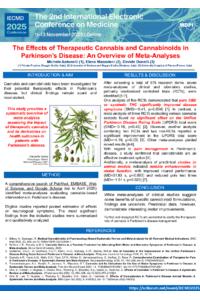
Background: Cannabis and cannabinoids have been investigated for their potential therapeutic effects in Parkinson’s disease, but clinical findings remain scant and inconsistent. This study provides a systematic overview of meta-analyses assessing their impact on health outcomes in patients with Parkinson’s disease.
Methods: A comprehensive search of PubMed, EMBASE, Web of Science, and Google Scholar (up to April 2025) identified meta-analyses evaluating cannabis-based interventions in Parkinson’s disease. Eligible studies reported pooled estimates of effects on neurological symptoms. The most significant findings from the included studies were summarized and qualitatively analyzed.
Results: After screening a total of 975 research items, seven meta-analyses of clinical and laboratory studies, primarily randomized controlled trials (RCTs), were identified. One analysis of five RCTs demonstrated that pure CBD or synthetic THC significantly improved disease symptoms (SMD=−0.41, p=0.004). In contrast, a meta-analysis of three RCTs evaluating various cannabis extracts found no significant effect on the Unified Parkinson Disease Rating Scale (UPDRS) total score (SMD=−0.18, p=0.48). However, another analysis combining two RCTs and two non-RCTs reported a significant improvement in the UPDRS total score (MD=−4.19, p=0.03). With regard to pain management in Parkinson’s disease, a study confirmed that cannabinoids are an effective treatment option. Additionally, a meta-analysis of preclinical studies in animal models indicated notable enhancements in motor function, with improved rotarod performance (MD=31.63 s, p=0.003) and reduced pole test times (MD=−1.51 s, p=0.028).
Conclusions: While meta-analyses of clinical studies suggest some benefits of specific cannabinoid formulations, findings are uncertain. Preclinical data, however, demonstrate interesting motor improvements. Further well-designed RCTs are warranted to clarify the therapeutic role of cannabis in Parkinson’s disease management.
Keywords
Parkinson’s disease
cannabinoids
cannabis
CBD
THC
quality of life
Poster
Cannabis Parkinson Poster Antonelli et al 2025.pdf
Trends in Mortality from Neurological Disorders in Rio Grande do Sul, Brazil (2013–2023): Alzheimer’s Disease, Multiple Sclerosis, and Parkinson’s Disease
Hospital Morbidity due to Parkinson's Disease in Brazilian Regions between 2020 and 2024