Event submissions
Published
This submission belongs to the session S2. Dementia Spectrum Disorders: From Frontotemporal Degeneration to Parkinson’s and Alzheimer’s Disease of the event The 2nd International Electronic Conference on Medicine
Published date
06 Nov, 2025
Academic Editor
'%3e%3cpath%20d='M12.6657%2010.9104C12.4185%2010.325%2012.0599%209.79327%2011.6097%209.34482C11.1609%208.89508%2010.6293%208.5365%2010.0442%208.28888C10.0389%208.28626%2010.0337%208.28495%2010.0285%208.28233C10.8446%207.69279%2011.3752%206.73249%2011.3752%205.64904C11.3752%203.8542%209.92103%202.39999%208.1262%202.39999C6.33136%202.39999%204.87715%203.8542%204.87715%205.64904C4.87715%206.73249%205.40774%207.69279%206.22393%208.28364C6.21869%208.28626%206.21345%208.28757%206.20821%208.29019C5.62129%208.5378%205.09463%208.89284%204.64265%209.34613C4.1929%209.79493%203.83432%2010.3266%203.58671%2010.9117C3.34345%2011.4845%203.21226%2012.0987%203.20023%2012.7209C3.19988%2012.7349%203.20233%2012.7488%203.20744%2012.7619C3.21255%2012.7749%203.22022%2012.7867%203.22998%2012.7968C3.23975%2012.8068%203.25142%2012.8147%203.26431%2012.8202C3.2772%2012.8256%203.29105%2012.8284%203.30504%2012.8284H4.09109C4.14874%2012.8284%204.19459%2012.7825%204.1959%2012.7262C4.2221%2011.7148%204.62823%2010.7676%205.34617%2010.0497C6.08899%209.30683%207.0755%208.89808%208.1262%208.89808C9.17689%208.89808%2010.1634%209.30683%2010.9062%2010.0497C11.6242%2010.7676%2012.0303%2011.7148%2012.0565%2012.7262C12.0578%2012.7838%2012.1037%2012.8284%2012.1613%2012.8284H12.9474C12.9613%2012.8284%2012.9752%2012.8256%2012.9881%2012.8202C13.001%2012.8147%2013.0126%2012.8068%2013.0224%2012.7968C13.0322%2012.7867%2013.0398%2012.7749%2013.0449%2012.7619C13.0501%2012.7488%2013.0525%2012.7349%2013.0522%2012.7209C13.0391%2012.0947%2012.9094%2011.4855%2012.6657%2010.9104ZM8.1262%207.9024C7.52486%207.9024%206.9589%207.6679%206.53312%207.24211C6.10733%206.81633%205.87283%206.25037%205.87283%205.64904C5.87283%205.0477%206.10733%204.48174%206.53312%204.05596C6.9589%203.63018%207.52486%203.39567%208.1262%203.39567C8.72753%203.39567%209.29349%203.63018%209.71927%204.05596C10.1451%204.48174%2010.3796%205.0477%2010.3796%205.64904C10.3796%206.25037%2010.1451%206.81633%209.71927%207.24211C9.29349%207.6679%208.72753%207.9024%208.1262%207.9024Z'%20fill='%235D1EE1'/%3e%3c/g%3e%3c/svg%3e) Alberto Ouro
Alberto OuroCitation
Isabela Karina Vilas Boas, Mayra Leindeker Maffini, Eduarda Paiva Borsa, Luana Ramin Alves, Pedro Henrique Paesi Dutra, Fabiano Barbosa Carvalho, Trends in hospitalizations for Alzheimer’s disease in the Brazilian unified health system, 2016–2025: age group analysis and evidence of early-onset cases, in Proceedings of The 2nd International Electronic Conference on Medicine, 11 November–13 November 2025, MDPI: Basel, Switzerland
Share
Email
Facebook
Twitter
LinkedIn
Trends in hospitalizations for Alzheimer’s disease in the Brazilian unified health system, 2016–2025: age group analysis and evidence of early-onset cases

Isabela Karina Vilas Boas 1
'%3e%3cpath%20d='M12.6647%2010.9104C12.4176%2010.325%2012.0589%209.7933%2011.6088%209.34485C11.16%208.89511%2010.6283%208.53653%2010.0432%208.28891C10.038%208.28629%2010.0327%208.28498%2010.0275%208.28236C10.8437%207.69282%2011.3743%206.73252%2011.3743%205.64907C11.3743%203.85423%209.92005%202.40002%208.12522%202.40002C6.33038%202.40002%204.87618%203.85423%204.87618%205.64907C4.87618%206.73252%205.40677%207.69282%206.22296%208.28367C6.21772%208.28629%206.21248%208.2876%206.20724%208.29022C5.62031%208.53783%205.09365%208.89287%204.64167%209.34616C4.19192%209.79496%203.83334%2010.3266%203.58573%2010.9117C3.34247%2011.4846%203.21128%2012.0987%203.19925%2012.721C3.1989%2012.735%203.20135%2012.7489%203.20646%2012.7619C3.21157%2012.7749%203.21924%2012.7868%203.22901%2012.7968C3.23877%2012.8068%203.25045%2012.8148%203.26334%2012.8202C3.27623%2012.8256%203.29007%2012.8284%203.30406%2012.8284H4.09012C4.14776%2012.8284%204.19362%2012.7825%204.19493%2012.7262C4.22113%2011.7148%204.62726%2010.7676%205.34519%2010.0497C6.08802%209.30686%207.07452%208.89811%208.12522%208.89811C9.17592%208.89811%2010.1624%209.30686%2010.9052%2010.0497C11.6232%2010.7676%2012.0293%2011.7148%2012.0555%2012.7262C12.0568%2012.7839%2012.1027%2012.8284%2012.1603%2012.8284H12.9464C12.9604%2012.8284%2012.9742%2012.8256%2012.9871%2012.8202C13%2012.8148%2013.0117%2012.8068%2013.0214%2012.7968C13.0312%2012.7868%2013.0389%2012.7749%2013.044%2012.7619C13.0491%2012.7489%2013.0515%2012.735%2013.0512%2012.721C13.0381%2012.0947%2012.9084%2011.4856%2012.6647%2010.9104ZM8.12522%207.90243C7.52388%207.90243%206.95792%207.66793%206.53214%207.24215C6.10636%206.81636%205.87185%206.2504%205.87185%205.64907C5.87185%205.04773%206.10636%204.48177%206.53214%204.05599C6.95792%203.63021%207.52388%203.3957%208.12522%203.3957C8.72655%203.3957%209.29252%203.63021%209.7183%204.05599C10.1441%204.48177%2010.3786%205.04773%2010.3786%205.64907C10.3786%206.2504%2010.1441%206.81636%209.7183%207.24215C9.29252%207.66793%208.72655%207.90243%208.12522%207.90243Z'%20fill='%235D1EE1'/%3e%3c/g%3e%3c/svg%3e)
Mayra Leindeker Maffini 1
Eduarda Paiva Borsa 1
Luana Ramin Alves 1
Pedro Henrique Paesi Dutra 1
Fabiano Barbosa Carvalho 1
1. Academic of Medicine, School of Medicine, Federal University of Health Sciences of Porto Alegre (UFCSPA), Porto Alegre, 90050-170, Brazil
Abstract
Introduction:
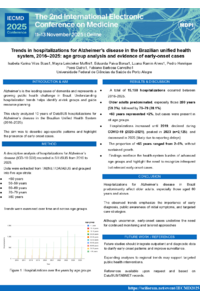
Alzheimer’s is the most common form of dementia, affecting memory, thinking, and behavior. It represents a public health challenge worldwide, and Brazil is no exception. Understanding hospitalization patterns for Alzheimer's is essential to identify at-risk populations and guide healthcare planning. This study analyzed DataSUS records, Brazil’s public health database, over the past 10 years to provide insights into the epidemiology and inform strategies for early-onset cases.
Methods:
A descriptive analysis of hospitalizations for Alzheimer’s disease (ICD-10 G30) recorded in the SIH/SUS between 2016 and 2025 was conducted. Data were obtained from TABNET/DATASUS and categorized by age groups, which were subsequently regrouped into five strata (<50, 50–59, 60–69, 70–79, and ≥80 years).
Results and discussion:
From 2016 to 2025, 15,198 hospitalizations for Alzheimer’s disease (ICD-10 G30) were recorded in SIH/SUS, mostly in individuals aged ≥80 years (59.3%), followed by those aged 70–79 (28.1%) and those aged 60–69 (9.4%). Hospitalizations in those <60 years old were rare (<2%), though they were present across all ages. Cases rose until 2019, dropped during 2020–2021 with the COVID-19 pandemic, peaked in 2023 (n=2,125), and declined in 2025, likely due to reporting delays. The proportion <65 years ranged from 2 to 6%, without a clear increase.
Findings confirm the predominance in older adults and the health system burden of advanced age groups, while the persistent, though infrequent, cases in those aged <65 highlight the need for awareness and tailored strategies for early-onset Alzheimer’s disease.
Conclusions sections:
The analysis of DataSUS records confirms the predominance of hospitalizations for Alzheimer’s among older adults, particularly those aged 80 years and above. These findings underscore the need for public awareness of early symptoms and appropriate patient care, as well as early diagnosis and targeted health strategies to address the challenges associated with the disease.
Keywords
Alzheimer’s disease
hospitalizations
Brazil
Poster
Pôster Mayra Leindeker Maffini.pdf
THE USE OF VISUAL RATING SCALES IN THE DISCRIMINATION BETWEEN ALZHEIMER’S DISEASE AND DEPRESSION
Investigation of the Effects of Mansorin on Memory Processes in a Zebrafish (Danio rerio) Animal Model