Event submissions
Published
This submission belongs to the session S3. Stroke and Brain Injury of the event The 2nd International Electronic Conference on Medicine
Published date
06 Nov, 2025
Academic Editor
'%3e%3cpath%20d='M12.6657%2010.9104C12.4185%2010.325%2012.0599%209.79327%2011.6097%209.34482C11.1609%208.89508%2010.6293%208.5365%2010.0442%208.28888C10.0389%208.28626%2010.0337%208.28495%2010.0285%208.28233C10.8446%207.69279%2011.3752%206.73249%2011.3752%205.64904C11.3752%203.8542%209.92103%202.39999%208.1262%202.39999C6.33136%202.39999%204.87715%203.8542%204.87715%205.64904C4.87715%206.73249%205.40774%207.69279%206.22393%208.28364C6.21869%208.28626%206.21345%208.28757%206.20821%208.29019C5.62129%208.5378%205.09463%208.89284%204.64265%209.34613C4.1929%209.79493%203.83432%2010.3266%203.58671%2010.9117C3.34345%2011.4845%203.21226%2012.0987%203.20023%2012.7209C3.19988%2012.7349%203.20233%2012.7488%203.20744%2012.7619C3.21255%2012.7749%203.22022%2012.7867%203.22998%2012.7968C3.23975%2012.8068%203.25142%2012.8147%203.26431%2012.8202C3.2772%2012.8256%203.29105%2012.8284%203.30504%2012.8284H4.09109C4.14874%2012.8284%204.19459%2012.7825%204.1959%2012.7262C4.2221%2011.7148%204.62823%2010.7676%205.34617%2010.0497C6.08899%209.30683%207.0755%208.89808%208.1262%208.89808C9.17689%208.89808%2010.1634%209.30683%2010.9062%2010.0497C11.6242%2010.7676%2012.0303%2011.7148%2012.0565%2012.7262C12.0578%2012.7838%2012.1037%2012.8284%2012.1613%2012.8284H12.9474C12.9613%2012.8284%2012.9752%2012.8256%2012.9881%2012.8202C13.001%2012.8147%2013.0126%2012.8068%2013.0224%2012.7968C13.0322%2012.7867%2013.0398%2012.7749%2013.0449%2012.7619C13.0501%2012.7488%2013.0525%2012.7349%2013.0522%2012.7209C13.0391%2012.0947%2012.9094%2011.4855%2012.6657%2010.9104ZM8.1262%207.9024C7.52486%207.9024%206.9589%207.6679%206.53312%207.24211C6.10733%206.81633%205.87283%206.25037%205.87283%205.64904C5.87283%205.0477%206.10733%204.48174%206.53312%204.05596C6.9589%203.63018%207.52486%203.39567%208.1262%203.39567C8.72753%203.39567%209.29349%203.63018%209.71927%204.05596C10.1451%204.48174%2010.3796%205.0477%2010.3796%205.64904C10.3796%206.25037%2010.1451%206.81633%209.71927%207.24211C9.29349%207.6679%208.72753%207.9024%208.1262%207.9024Z'%20fill='%235D1EE1'/%3e%3c/g%3e%3c/svg%3e) Alberto Ouro
Alberto OuroCitation
Andrea Gutiérrez-Suárez, Marta Perez-Rodrıguez, Integrating Sport-Based Exercise in Acquired Brain Injury Rehabilitation: A Biopsychosocial Perspective
, in Proceedings of The 2nd International Electronic Conference on Medicine, 11 November–13 November 2025, MDPI: Basel, Switzerland
Share
Email
Facebook
Twitter
LinkedIn
Integrating Sport-Based Exercise in Acquired Brain Injury Rehabilitation: A Biopsychosocial Perspective
'%3e%3cpath%20d='M12.6647%2010.9104C12.4176%2010.325%2012.0589%209.7933%2011.6088%209.34485C11.16%208.89511%2010.6283%208.53653%2010.0432%208.28891C10.038%208.28629%2010.0327%208.28498%2010.0275%208.28236C10.8437%207.69282%2011.3743%206.73252%2011.3743%205.64907C11.3743%203.85423%209.92005%202.40002%208.12522%202.40002C6.33038%202.40002%204.87618%203.85423%204.87618%205.64907C4.87618%206.73252%205.40677%207.69282%206.22296%208.28367C6.21772%208.28629%206.21248%208.2876%206.20724%208.29022C5.62031%208.53783%205.09365%208.89287%204.64167%209.34616C4.19192%209.79496%203.83334%2010.3266%203.58573%2010.9117C3.34247%2011.4846%203.21128%2012.0987%203.19925%2012.721C3.1989%2012.735%203.20135%2012.7489%203.20646%2012.7619C3.21157%2012.7749%203.21924%2012.7868%203.22901%2012.7968C3.23877%2012.8068%203.25045%2012.8148%203.26334%2012.8202C3.27623%2012.8256%203.29007%2012.8284%203.30406%2012.8284H4.09012C4.14776%2012.8284%204.19362%2012.7825%204.19493%2012.7262C4.22113%2011.7148%204.62726%2010.7676%205.34519%2010.0497C6.08802%209.30686%207.07452%208.89811%208.12522%208.89811C9.17592%208.89811%2010.1624%209.30686%2010.9052%2010.0497C11.6232%2010.7676%2012.0293%2011.7148%2012.0555%2012.7262C12.0568%2012.7839%2012.1027%2012.8284%2012.1603%2012.8284H12.9464C12.9604%2012.8284%2012.9742%2012.8256%2012.9871%2012.8202C13%2012.8148%2013.0117%2012.8068%2013.0214%2012.7968C13.0312%2012.7868%2013.0389%2012.7749%2013.044%2012.7619C13.0491%2012.7489%2013.0515%2012.735%2013.0512%2012.721C13.0381%2012.0947%2012.9084%2011.4856%2012.6647%2010.9104ZM8.12522%207.90243C7.52388%207.90243%206.95792%207.66793%206.53214%207.24215C6.10636%206.81636%205.87185%206.2504%205.87185%205.64907C5.87185%205.04773%206.10636%204.48177%206.53214%204.05599C6.95792%203.63021%207.52388%203.3957%208.12522%203.3957C8.72655%203.3957%209.29252%203.63021%209.7183%204.05599C10.1441%204.48177%2010.3786%205.04773%2010.3786%205.64907C10.3786%206.2504%2010.1441%206.81636%209.7183%207.24215C9.29252%207.66793%208.72655%207.90243%208.12522%207.90243Z'%20fill='%235D1EE1'/%3e%3c/g%3e%3c/svg%3e)
Andrea Gutiérrez-Suárez 1
Marta Perez-Rodrıguez 2
1. Department of Physiotherapy, Medicine and Biomedical Sciences, Faculty of Physiotherapy, University of A Coruna, Spain
2. I+D Area, Segunda Parte Foundation, 28029, Madrid, Spain
Abstract
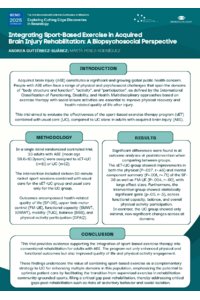
This trial aimed to evaluate the effectiveness of the sport-based exercise therapy program (sET) combined with usual care (UC) compared to UC alone in adults with an acquired brain injury (ABI). In a single-blind randomized controlled trial, 23 adults with an ABI, precisely with stroke and traumatic brain injury (mean age 59.6±10.3 years), were assigned to sET+UC (n=11) or UC (n=12). The intervention included sixteen 60-minute racket sport sessions plus UC, matched in duration and frequency with the control group. Outcomes included health-related quality of life (SF-36), upper limb motor control (FM-UE), functional capacity (6MWT, 10MWT), mobility (TUG), balance (BBS), and physical activity participation (GPAQ). Significant between-group differences were observed following the intervention. Participants in the sET+UC group demonstrated substantial improvements in both physical (p=.027, r=.46) and mental (p=.001, r=.71) components of the SF-36, and in FM-UE scores (p=.004, r=.60), all with moderate to large effect sizes. In addition, the intervention group showed statistically significant gains (p<.05, r>.5) across functional capacity, balance, and overall physical activity participation. In contrast, the UC group showed only minimal, non-significant changes across all domains. This trial provides evidence supporting the integration of sport-based exercise therapy into conventional rehabilitation for adults with ABIs. The program not only enhanced physical and functional outcomes but also improved quality of life and physical activity engagement. These findings underscore the value of combining sport-based exercise as a complementary strategy to UC for enhancing multiple domains in this population. Furthermore, these findings emphasize the potential to optimize patient care by facilitating the transition from supervised exercise in rehabilitation community-grounded sports, filling a critical gap post-rehabilitation, thereby addressing critical gaps post-rehabilitation such as risks of sedentary behavior and social isolation. Larger studies with long-term follow-up are needed to confirm the sustainability and wider applicability of this approach.
Keywords
Acquired Brain Injury
Exercise
Rehabilitation
Sports
Poster
Poster IECDM.pdf
A Hybrid Deep Ensemble Framework with CNN Transformer Feature Fusion for Stroke Detection from Neuroimaging Data
Colloid Cysts: A 15-Year Retrospective Review of Clinical Presentation and Outcomes