Event submissions
Published
This submission belongs to the session S9. Agricultural Water Systems of the event The 9th International Electronic Conference on Water Sciences
Published date
06 Nov, 2025
Academic Editor
'%3e%3cpath%20d='M12.6657%2010.9104C12.4185%2010.325%2012.0599%209.79327%2011.6097%209.34482C11.1609%208.89508%2010.6293%208.5365%2010.0442%208.28888C10.0389%208.28626%2010.0337%208.28495%2010.0285%208.28233C10.8446%207.69279%2011.3752%206.73249%2011.3752%205.64904C11.3752%203.8542%209.92103%202.39999%208.1262%202.39999C6.33136%202.39999%204.87715%203.8542%204.87715%205.64904C4.87715%206.73249%205.40774%207.69279%206.22393%208.28364C6.21869%208.28626%206.21345%208.28757%206.20821%208.29019C5.62129%208.5378%205.09463%208.89284%204.64265%209.34613C4.1929%209.79493%203.83432%2010.3266%203.58671%2010.9117C3.34345%2011.4845%203.21226%2012.0987%203.20023%2012.7209C3.19988%2012.7349%203.20233%2012.7488%203.20744%2012.7619C3.21255%2012.7749%203.22022%2012.7867%203.22998%2012.7968C3.23975%2012.8068%203.25142%2012.8147%203.26431%2012.8202C3.2772%2012.8256%203.29105%2012.8284%203.30504%2012.8284H4.09109C4.14874%2012.8284%204.19459%2012.7825%204.1959%2012.7262C4.2221%2011.7148%204.62823%2010.7676%205.34617%2010.0497C6.08899%209.30683%207.0755%208.89808%208.1262%208.89808C9.17689%208.89808%2010.1634%209.30683%2010.9062%2010.0497C11.6242%2010.7676%2012.0303%2011.7148%2012.0565%2012.7262C12.0578%2012.7838%2012.1037%2012.8284%2012.1613%2012.8284H12.9474C12.9613%2012.8284%2012.9752%2012.8256%2012.9881%2012.8202C13.001%2012.8147%2013.0126%2012.8068%2013.0224%2012.7968C13.0322%2012.7867%2013.0398%2012.7749%2013.0449%2012.7619C13.0501%2012.7488%2013.0525%2012.7349%2013.0522%2012.7209C13.0391%2012.0947%2012.9094%2011.4855%2012.6657%2010.9104ZM8.1262%207.9024C7.52486%207.9024%206.9589%207.6679%206.53312%207.24211C6.10733%206.81633%205.87283%206.25037%205.87283%205.64904C5.87283%205.0477%206.10733%204.48174%206.53312%204.05596C6.9589%203.63018%207.52486%203.39567%208.1262%203.39567C8.72753%203.39567%209.29349%203.63018%209.71927%204.05596C10.1451%204.48174%2010.3796%205.0477%2010.3796%205.64904C10.3796%206.25037%2010.1451%206.81633%209.71927%207.24211C9.29349%207.6679%208.72753%207.9024%208.1262%207.9024Z'%20fill='%235D1EE1'/%3e%3c/g%3e%3c/svg%3e) Dapeng Li
Dapeng LiCitation
Maria Sismanidi, Kyriakos D. Giannoulis, Yiannis Panagopoulos, Evaluating the environmental and economic trade-offs of introducing perennial bioenergy crops in the low-productivity land of a Greek agricultural basin, in Proceedings of The 9th International Electronic Conference on Water Sciences, 11 November–14 November 2025, MDPI: Basel, Switzerland
Share
Email
Facebook
Twitter
LinkedIn
Evaluating the environmental and economic trade-offs of introducing perennial bioenergy crops in the low-productivity land of a Greek agricultural basin
'%3e%3cpath%20d='M12.6647%2010.9104C12.4176%2010.325%2012.0589%209.7933%2011.6088%209.34485C11.16%208.89511%2010.6283%208.53653%2010.0432%208.28891C10.038%208.28629%2010.0327%208.28498%2010.0275%208.28236C10.8437%207.69282%2011.3743%206.73252%2011.3743%205.64907C11.3743%203.85423%209.92005%202.40002%208.12522%202.40002C6.33038%202.40002%204.87618%203.85423%204.87618%205.64907C4.87618%206.73252%205.40677%207.69282%206.22296%208.28367C6.21772%208.28629%206.21248%208.2876%206.20724%208.29022C5.62031%208.53783%205.09365%208.89287%204.64167%209.34616C4.19192%209.79496%203.83334%2010.3266%203.58573%2010.9117C3.34247%2011.4846%203.21128%2012.0987%203.19925%2012.721C3.1989%2012.735%203.20135%2012.7489%203.20646%2012.7619C3.21157%2012.7749%203.21924%2012.7868%203.22901%2012.7968C3.23877%2012.8068%203.25045%2012.8148%203.26334%2012.8202C3.27623%2012.8256%203.29007%2012.8284%203.30406%2012.8284H4.09012C4.14776%2012.8284%204.19362%2012.7825%204.19493%2012.7262C4.22113%2011.7148%204.62726%2010.7676%205.34519%2010.0497C6.08802%209.30686%207.07452%208.89811%208.12522%208.89811C9.17592%208.89811%2010.1624%209.30686%2010.9052%2010.0497C11.6232%2010.7676%2012.0293%2011.7148%2012.0555%2012.7262C12.0568%2012.7839%2012.1027%2012.8284%2012.1603%2012.8284H12.9464C12.9604%2012.8284%2012.9742%2012.8256%2012.9871%2012.8202C13%2012.8148%2013.0117%2012.8068%2013.0214%2012.7968C13.0312%2012.7868%2013.0389%2012.7749%2013.044%2012.7619C13.0491%2012.7489%2013.0515%2012.735%2013.0512%2012.721C13.0381%2012.0947%2012.9084%2011.4856%2012.6647%2010.9104ZM8.12522%207.90243C7.52388%207.90243%206.95792%207.66793%206.53214%207.24215C6.10636%206.81636%205.87185%206.2504%205.87185%205.64907C5.87185%205.04773%206.10636%204.48177%206.53214%204.05599C6.95792%203.63021%207.52388%203.3957%208.12522%203.3957C8.72655%203.3957%209.29252%203.63021%209.7183%204.05599C10.1441%204.48177%2010.3786%205.04773%2010.3786%205.64907C10.3786%206.2504%2010.1441%206.81636%209.7183%207.24215C9.29252%207.66793%208.72655%207.90243%208.12522%207.90243Z'%20fill='%235D1EE1'/%3e%3c/g%3e%3c/svg%3e)
Maria Sismanidi 1
Kyriakos D. Giannoulis 2

Yiannis Panagopoulos 3
1. Department of Hydraulics, Soil Science and Agricultural Engineering, School of Agriculture, Aristotle University, Thessaloniki 54124, Greece
2. Laboratory of Agronomy and Applied Crop Physiology, Department of Agriculture, Crop Production & Rural Environment, University of Thessaly, Fytokoy Str., 38446 Volos, Greece
3. Department of Hydraulics, Soil Science and Agricultural Engineering, School of Agriculture, Aristotle University of Thessaloniki, 54124 Thessaloniki, Greece
Abstract
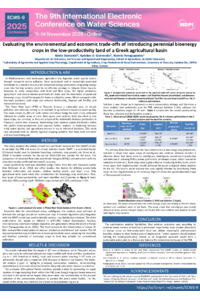
The Pinios River Basin in Thessaly, Greece, is the country’s most important agricultural producer. Still, it faces increasing environmental pressures, particularly in relation to the decline in water quality, due to intensive farming practices. Cultivating perennial bioenergy crops can be a promising strategy since it supports both environmental and renewable energy production goals. However, to avoid competition with food and fiber crops, the highly productive agricultural land should remain prioritized for them and the installation of perennial bioenergy crops, such as switchgrass, miscanthus and cardoon, should be targeted in lower-productivity areas, characterized by poor soil texture, shallow rooting depth and steeper slopes. This study utilizes the river basin Soil and Water Assessment Tool (SWAT) to develop a representative model of the Pinios River Basin and evaluate its status with respect to nitrate (N-NO3) water pollution. Based on a comprehensive representation of agricultural management, the model simulates crop growth and water N-NO3 loads arising from the cropland of the basin. A multi-objective Genetic Algorithm embedded in MATLAB is linked to SWAT and after a large number of simulations, it identifies optimum spatial allocations of the bioenergy crops in the agricultural land with respect to the farmers' net income, biomass production and surface water quality. The analysis of the resulting trade-off curves among the objectives reveals interesting spatial distributions of the crops, with selected optimal solutions indicating that each bioenergy crop responds differently to local conditions, showing higher effectiveness in certain areas of lower productivity in the basin. The results support the inclusion of perennial bioenergy crops in future sustainable cropping systems as a strategy towards the improvement in water quality and the generation of substantial biomass for renewable energy production.
Keywords
bioenergy crops
biomass production
genetic algorithm
lower productivity land
multi-objective optimization
nitrate pollution
SWAT
water quality
Poster
Poster_Sismanidi.pdf
Water treatment by adsorption using sage-based adsorbents: removal of pollutants and phytotoxicity
The effect of water quality on lettuce growth in deep-culture hydroponic systems