Event submissions
Published
This submission belongs to the session S9. Agricultural Water Systems of the event The 9th International Electronic Conference on Water Sciences
Published date
06 Nov, 2025
Academic Editor
'%3e%3cpath%20d='M12.6657%2010.9104C12.4185%2010.325%2012.0599%209.79327%2011.6097%209.34482C11.1609%208.89508%2010.6293%208.5365%2010.0442%208.28888C10.0389%208.28626%2010.0337%208.28495%2010.0285%208.28233C10.8446%207.69279%2011.3752%206.73249%2011.3752%205.64904C11.3752%203.8542%209.92103%202.39999%208.1262%202.39999C6.33136%202.39999%204.87715%203.8542%204.87715%205.64904C4.87715%206.73249%205.40774%207.69279%206.22393%208.28364C6.21869%208.28626%206.21345%208.28757%206.20821%208.29019C5.62129%208.5378%205.09463%208.89284%204.64265%209.34613C4.1929%209.79493%203.83432%2010.3266%203.58671%2010.9117C3.34345%2011.4845%203.21226%2012.0987%203.20023%2012.7209C3.19988%2012.7349%203.20233%2012.7488%203.20744%2012.7619C3.21255%2012.7749%203.22022%2012.7867%203.22998%2012.7968C3.23975%2012.8068%203.25142%2012.8147%203.26431%2012.8202C3.2772%2012.8256%203.29105%2012.8284%203.30504%2012.8284H4.09109C4.14874%2012.8284%204.19459%2012.7825%204.1959%2012.7262C4.2221%2011.7148%204.62823%2010.7676%205.34617%2010.0497C6.08899%209.30683%207.0755%208.89808%208.1262%208.89808C9.17689%208.89808%2010.1634%209.30683%2010.9062%2010.0497C11.6242%2010.7676%2012.0303%2011.7148%2012.0565%2012.7262C12.0578%2012.7838%2012.1037%2012.8284%2012.1613%2012.8284H12.9474C12.9613%2012.8284%2012.9752%2012.8256%2012.9881%2012.8202C13.001%2012.8147%2013.0126%2012.8068%2013.0224%2012.7968C13.0322%2012.7867%2013.0398%2012.7749%2013.0449%2012.7619C13.0501%2012.7488%2013.0525%2012.7349%2013.0522%2012.7209C13.0391%2012.0947%2012.9094%2011.4855%2012.6657%2010.9104ZM8.1262%207.9024C7.52486%207.9024%206.9589%207.6679%206.53312%207.24211C6.10733%206.81633%205.87283%206.25037%205.87283%205.64904C5.87283%205.0477%206.10733%204.48174%206.53312%204.05596C6.9589%203.63018%207.52486%203.39567%208.1262%203.39567C8.72753%203.39567%209.29349%203.63018%209.71927%204.05596C10.1451%204.48174%2010.3796%205.0477%2010.3796%205.64904C10.3796%206.25037%2010.1451%206.81633%209.71927%207.24211C9.29349%207.6679%208.72753%207.9024%208.1262%207.9024Z'%20fill='%235D1EE1'/%3e%3c/g%3e%3c/svg%3e) Dapeng Li
Dapeng LiCitation
Vasileios Papantzikos, An assessment of grapevine plants’ metabolic traits under rational and deficit irrigation using a Sinorhizobium meliloti-based biostimulant, in Proceedings of The 9th International Electronic Conference on Water Sciences, 11 November–14 November 2025, MDPI: Basel, Switzerland
Share
Email
Facebook
Twitter
LinkedIn
An assessment of grapevine plants’ metabolic traits under rational and deficit irrigation using a Sinorhizobium meliloti-based biostimulant

Vasileios Papantzikos 1
1. Department of Agriculture, University of Ioannina, Arta Campus, 47100, Greece
Abstract
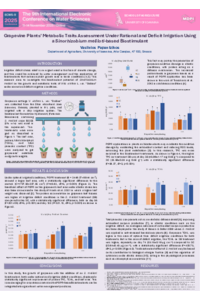
Agricultural irrigation management is considered more necessary than ever, as climate change directly threatens natural resources and the growth of economically important Mediterranean crops such as grapevines. In this work, the metabolic characteristics of grapevine plants were assessed under rational (100% of AW) and irrigation-deficit (57% of AW) conditions, with the application of a Sinorhizobium meliloti biostimulant. The study was carried out at the greenhouse of the Department of Agriculture of the University of Ioannina in 9 L pots connected with a drip irrigation system, where four treatments were established: Treatment B (100% of AW and S. meliloti application), treatment SB (57% of AW and S. meliloti application), C (100% of AW), and SC (57% of AW). During the experiment that lasted 5 months, the grapevine leaf area (cm2) was measured, and proline (µmol g−1 Fresh Leaf), total phenolic (mg GAE g−1 Dry Leaf), and chlorophyll (µg cm−2) content were assessed as indicators of abiotic stress. The data of the experiment showed that the use of S. meliloti could act as a biotic stress inhibitor due to the irrigation deficit caused in the grapevine cultivation. This case study complements the literature on the grapevine cultivation management practices in the scenario of imposing irrigation regimes due to climate change.
Keywords
irrigation deficit
grapevine
Poster
Poster ECEWS 2025.pdf
PERFORMANCE EVALUATION AND ENERGY OPTIMIZATION OF CENTRIFUGAL PUMPS FOR AGRICULTURAL WATER SYSTEMS IN PAKISTAN UNDER A CHANGING ENERGY AND WATER LANDSCAPE
Evaluating the Influence of dripline spacing on corn grain Yield in the Sandy Soil of Southeast Costal Plains