Event submissions
Published
This submission belongs to the session 2. Fermentation and sensory profiles/impact of the event The 1st International Online Conference on Fermentation
Published date
07 Nov, 2025
Academic Editor
'%3e%3cpath%20d='M12.6657%2010.9104C12.4185%2010.325%2012.0599%209.79327%2011.6097%209.34482C11.1609%208.89508%2010.6293%208.5365%2010.0442%208.28888C10.0389%208.28626%2010.0337%208.28495%2010.0285%208.28233C10.8446%207.69279%2011.3752%206.73249%2011.3752%205.64904C11.3752%203.8542%209.92103%202.39999%208.1262%202.39999C6.33136%202.39999%204.87715%203.8542%204.87715%205.64904C4.87715%206.73249%205.40774%207.69279%206.22393%208.28364C6.21869%208.28626%206.21345%208.28757%206.20821%208.29019C5.62129%208.5378%205.09463%208.89284%204.64265%209.34613C4.1929%209.79493%203.83432%2010.3266%203.58671%2010.9117C3.34345%2011.4845%203.21226%2012.0987%203.20023%2012.7209C3.19988%2012.7349%203.20233%2012.7488%203.20744%2012.7619C3.21255%2012.7749%203.22022%2012.7867%203.22998%2012.7968C3.23975%2012.8068%203.25142%2012.8147%203.26431%2012.8202C3.2772%2012.8256%203.29105%2012.8284%203.30504%2012.8284H4.09109C4.14874%2012.8284%204.19459%2012.7825%204.1959%2012.7262C4.2221%2011.7148%204.62823%2010.7676%205.34617%2010.0497C6.08899%209.30683%207.0755%208.89808%208.1262%208.89808C9.17689%208.89808%2010.1634%209.30683%2010.9062%2010.0497C11.6242%2010.7676%2012.0303%2011.7148%2012.0565%2012.7262C12.0578%2012.7838%2012.1037%2012.8284%2012.1613%2012.8284H12.9474C12.9613%2012.8284%2012.9752%2012.8256%2012.9881%2012.8202C13.001%2012.8147%2013.0126%2012.8068%2013.0224%2012.7968C13.0322%2012.7867%2013.0398%2012.7749%2013.0449%2012.7619C13.0501%2012.7488%2013.0525%2012.7349%2013.0522%2012.7209C13.0391%2012.0947%2012.9094%2011.4855%2012.6657%2010.9104ZM8.1262%207.9024C7.52486%207.9024%206.9589%207.6679%206.53312%207.24211C6.10733%206.81633%205.87283%206.25037%205.87283%205.64904C5.87283%205.0477%206.10733%204.48174%206.53312%204.05596C6.9589%203.63018%207.52486%203.39567%208.1262%203.39567C8.72753%203.39567%209.29349%203.63018%209.71927%204.05596C10.1451%204.48174%2010.3796%205.0477%2010.3796%205.64904C10.3796%206.25037%2010.1451%206.81633%209.71927%207.24211C9.29349%207.6679%208.72753%207.9024%208.1262%207.9024Z'%20fill='%235D1EE1'/%3e%3c/g%3e%3c/svg%3e) Alice Vilela
Alice VilelaCitation
CHHUN Lyhour, TAN Reasmey, Luka LY, Chanto Monychot Tepy, Comparison of Physicochemical Characteristics of Soy Sauces Made from Germinated Soybeans with Different Salt Concentrations, in Proceedings of The 1st International Online Conference on Fermentation, 12 November–13 November 2025, MDPI: Basel, Switzerland
Share
Email
Facebook
Twitter
LinkedIn
Comparison of Physicochemical Characteristics of Soy Sauces Made from Germinated Soybeans with Different Salt Concentrations
'%3e%3cpath%20d='M12.6647%2010.9104C12.4176%2010.325%2012.0589%209.7933%2011.6088%209.34485C11.16%208.89511%2010.6283%208.53653%2010.0432%208.28891C10.038%208.28629%2010.0327%208.28498%2010.0275%208.28236C10.8437%207.69282%2011.3743%206.73252%2011.3743%205.64907C11.3743%203.85423%209.92005%202.40002%208.12522%202.40002C6.33038%202.40002%204.87618%203.85423%204.87618%205.64907C4.87618%206.73252%205.40677%207.69282%206.22296%208.28367C6.21772%208.28629%206.21248%208.2876%206.20724%208.29022C5.62031%208.53783%205.09365%208.89287%204.64167%209.34616C4.19192%209.79496%203.83334%2010.3266%203.58573%2010.9117C3.34247%2011.4846%203.21128%2012.0987%203.19925%2012.721C3.1989%2012.735%203.20135%2012.7489%203.20646%2012.7619C3.21157%2012.7749%203.21924%2012.7868%203.22901%2012.7968C3.23877%2012.8068%203.25045%2012.8148%203.26334%2012.8202C3.27623%2012.8256%203.29007%2012.8284%203.30406%2012.8284H4.09012C4.14776%2012.8284%204.19362%2012.7825%204.19493%2012.7262C4.22113%2011.7148%204.62726%2010.7676%205.34519%2010.0497C6.08802%209.30686%207.07452%208.89811%208.12522%208.89811C9.17592%208.89811%2010.1624%209.30686%2010.9052%2010.0497C11.6232%2010.7676%2012.0293%2011.7148%2012.0555%2012.7262C12.0568%2012.7839%2012.1027%2012.8284%2012.1603%2012.8284H12.9464C12.9604%2012.8284%2012.9742%2012.8256%2012.9871%2012.8202C13%2012.8148%2013.0117%2012.8068%2013.0214%2012.7968C13.0312%2012.7868%2013.0389%2012.7749%2013.044%2012.7619C13.0491%2012.7489%2013.0515%2012.735%2013.0512%2012.721C13.0381%2012.0947%2012.9084%2011.4856%2012.6647%2010.9104ZM8.12522%207.90243C7.52388%207.90243%206.95792%207.66793%206.53214%207.24215C6.10636%206.81636%205.87185%206.2504%205.87185%205.64907C5.87185%205.04773%206.10636%204.48177%206.53214%204.05599C6.95792%203.63021%207.52388%203.3957%208.12522%203.3957C8.72655%203.3957%209.29252%203.63021%209.7183%204.05599C10.1441%204.48177%2010.3786%205.04773%2010.3786%205.64907C10.3786%206.2504%2010.1441%206.81636%209.7183%207.24215C9.29252%207.66793%208.72655%207.90243%208.12522%207.90243Z'%20fill='%235D1EE1'/%3e%3c/g%3e%3c/svg%3e)
CHHUN Lyhour 1
TAN Reasmey 1,2
Luka LY 3
Chanto Monychot Tepy 1,2
1. Faculty of Chemical and Food Engineering, Institute of Technology of Cambodia, Phnom Penh, P.O. Box 86, Russian Federation Boulevard, Phnom Penh, Cambodia
2. Food Technology and Nutrition Research Unit, Research and Innovation Center, Institute of Technology of Cambodia, Phnom Penh, P.O. Box 86, Russian Federation Boulevard, Phnom Penh, Cambodia
3. Research and Innovation Center, Institute of Technology of Cambodia, Phnom Penh, P.O. Box 86, Russian Federation Boulevard, Phnom Penh, Cambodia
Abstract
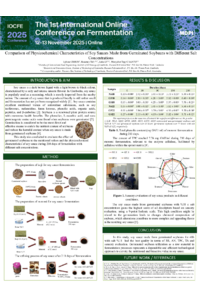
Soy sauce, a dark brown fermented liquid, is a staple condiment in Asian cuisine, including Cambodia. A good quality soy sauce is made from soybeans, which serve as the primary raw material and potentially yield health benefits when soybeans are germinated. The purpose of this study is to produce a soy sauce from germinated soybeans with different salt concentrations. Initially, soybeans were germinated for 48 and 72 hours, then homogenized with roasted wheat, and 0.1% of A. oryzae was added. The koji mash after fermentation was homogenized with salt at 18% and 22% to make moromi. In addition, the physicochemical characteristics were determined, and a sensory evaluation was conducted to assess the quality during moromi fermentation. Moreover, 5 *107 CFU/ml of Z. rouxii was used in moromi. The optimized results for enzyme activity, total phenolic content, and sensory evaluation of germinated soybean with a salt content of 18% were higher than those of non-germinated soybean, which were 118.02 U/g, 7.40 g/100 mg GAE/ml, and 7.36, respectively. The soy sauce made from germinated soybeans over 48 hours resulted in the best conditions in this study, including TA, amino acid nitrogen, RS, enzyme activity, sensory evaluation, and bioactive compounds at optimal levels.
Keywords
soy sauce
germinated soybeans
salt concentration
bioactive compound
reducing sugar
amino acid nitrogen
Poster
CHHUN Lyhour-Poster Presentation for The 1st International Online Conference on Fermentation.pdf
The effect of rehydration media, freezing temperature, and combinations of cryoprotectants on the survival rate of freeze-dried lactic acid bacteria
The Effect of Different Cryoprotectants on the Survival Rate of Freeze-dried Lactic Acid bacteria (LAB) Powder for Cucumber Fermentation